








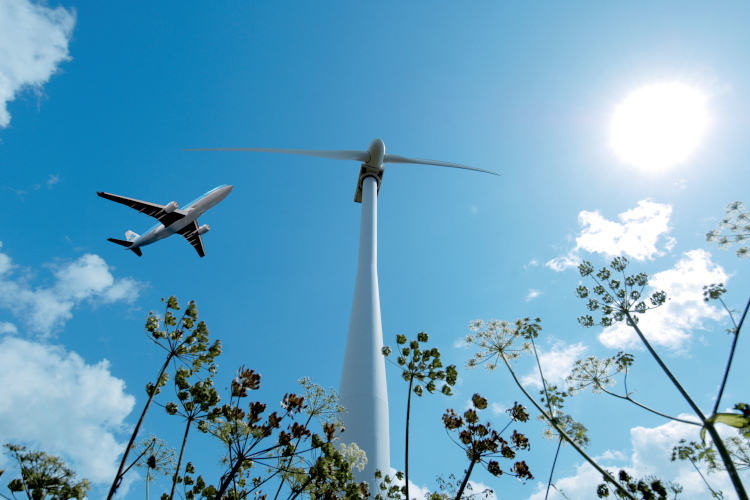
Member airlines of the SkyTeam alliance, including Air France and KLM, have joined the “SkyTeam Sustainable Flight Challenge” competition in search of effective ways to combat CO2 emissions. In recent days, Air France and KLM operated four special flights, during which all currently available measures and tools were applied to maximize CO2 reduction and minimize environmental impact. Two scheduled Air France flights – to Montreal and Lisbon – and two KLM connections – to Edmonton and Porto – took place as part of the “SkyTeam Sustainable Flight Challenge” project, in which sixteen SkyTeam alliance members are participating. In the first half of May this year, airlines affiliated with the alliance are taking on the challenge of conducting the most eco-friendly flight operations possible to stimulate innovation and collectively gather knowledge and share experiences. The project also aims to accelerate the transformation of the aviation industry to counteract the effects of the climate crisis.
By participating in the initiative, Air France and KLM intend to:
- firstly – measure the effectiveness of already available solutions, such as the use of sustainable aviation fuels,
- secondly – research new, innovative methods, such as the extensive use of artificial intelligence for flight route optimization or unmanned baggage transport at the airport,
- thirdly – engage passengers and create an aviation service that respects the environment, in line with customer expectations.
The “SkyTeam Sustainable Flight Challenge” was initiated by a group of enthusiastic KLM employees, inspired by the famous London-Melbourne air race held in 1934. Just as long-haul flights and global access to the world were the challenge back then, the main task for the entire aviation industry now is to reduce carbon emissions. At the end of June, the results of the airlines participating in this project will be evaluated by an independent committee in four categories: impact, innovation, scalability, and collaboration, and all gathered knowledge will be shared with SkyTeam partners.
As part of the “SkyTeam Sustainable Flight Challenge” project, KLM operated two flights on May 7th: flight KL0675 from Amsterdam to Edmonton (Canada) and flight KL1713 from Amsterdam to Porto (Portugal). During these flights, KLM applied the following measures and tools aimed at reducing carbon emissions and minimizing the environmental impact of flight operations:
1. Energy-efficient aircraft – the flights were operated using the most energy-efficient aircraft currently in the KLM fleet: the Boeing 787-10 (flight to Edmonton) and the Embraer 190 (flight to Porto), which, due to their design, weight, and engine parameters, allow for lower fuel consumption and thus lower CO2 emissions. Using an energy-efficient fleet is one of the two (alongside sustainable aviation fuel) most effective ways to reduce CO2 emissions;
2. Sustainable Aviation Fuel (SAF) – during the aforementioned flights, the aircraft were powered by a blend consisting of 39 percent sustainable aviation fuel (SAF);
3. Reducing total aircraft weight – KLM took a number of steps to minimize the total weight of the aircraft, including:
- Using artificial intelligence modeling, the predicted water requirements during the flight were accurately calculated, loading the exact amount;
- Before the flight, World Business Class passengers were asked to pre-select their preferred meal so that only the necessary catering was loaded on board;
4. Eco-piloting – thanks to close cooperation between pilots and air traffic controllers, the most optimal flight route was used during both flights, avoiding unnecessary “detours”.
5. Load optimization – the aircraft loading was optimized to the maximum to ensure the best center of gravity, which allowed for improved aerodynamics and generated fuel savings of 1.5 to 2 percent;
6. Cargo in the hold traveled on lighter pallets, secured with lighter nets;
7. Zero-emission ground handling – the flights were loaded using vehicles powered by electricity or biodiesel;
8. Individual CO2 compensation – passengers on both flights were informed about their participation in a special flight and how they can travel more sustainably, for example by offsetting the carbon footprint of their flight via CO2ZERO or by contributing to the purchase of additional SAF.
– Three years ago, in 2019, KLM initiated the “Fly Responsibly” campaign, inviting other airlines to cooperate and share best practices in order to jointly change our industry and conduct flight operations in a more sustainable way. Now the time has come for the next step and a more concrete challenge: Which airline can operate both long-haul and short-haul flights in the least environmentally harmful way? The “Sustainable Flight Challenge” initiative, in which we are participating, has sparked huge enthusiasm among our employees, who are presenting their ideas on how we can fly more ecologically. Another positive aspect is the fact that the alliance’s member airlines have agreed to take on the challenge and share the experiences gained. It is also impossible to ignore the commitment of our customers and industry partners, such as sustainable fuel (SAF) producers, aircraft engine manufacturers, airports, and many others. This spirit of cooperation makes the transformation of aviation towards a more sustainable future possible and feasible. – said René de Groot, KLM Chief Operating Officer
During the aforementioned special KLM flights to Canada and Portugal, a total of over 50 new and previously used methods and tools were applied to maximize CO2 reduction and minimize environmental impact. All KLM departments and numerous partners were involved in the project, including Edmonton Airport, Amsterdam Schiphol Airport, Air Traffic Control the Netherlands (LVNL), and General Electric. The measures applied, especially the new methods and tools, will be evaluated to then decide on their further implementation.
More information about the SkyTeam Sustainable Flight Challenge is available at sustainableflightchallenge.com