








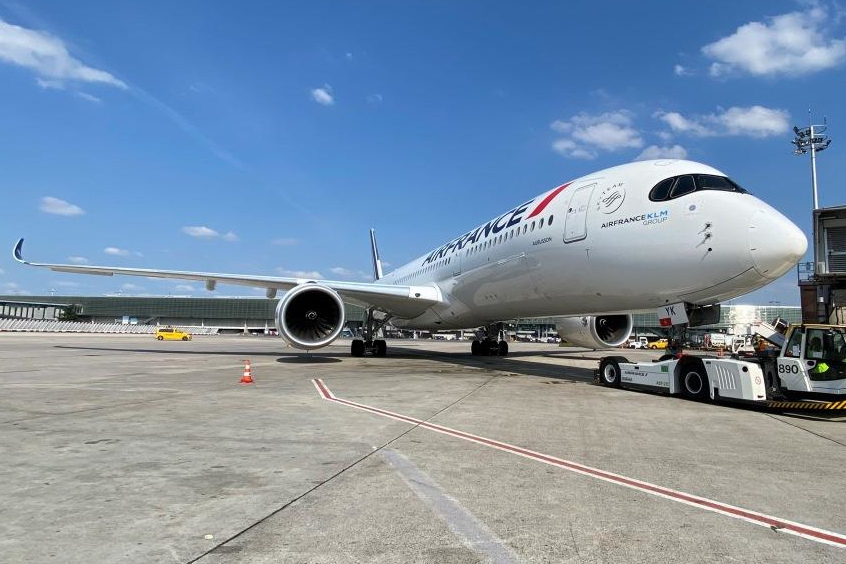
In recent days, Air France and KLM operated four special flights, during which all currently available measures and tools were applied to maximize CO2 emission reduction and minimize environmental impact. Two scheduled Air France flights – to Montreal and Lisbon – and two KLM connections – to Edmonton and Porto – took place as part of the “Skyteam Sustainable Flight Challenge,” in which sixteen members of the SkyTeam alliance are participating. In the first half of May this year, the airlines belonging to the alliance are taking on the challenge of conducting the most environmentally friendly flight operations possible to stimulate innovation and collectively gather knowledge and share experiences. The project also aims to accelerate the transformation of the aviation industry to counteract the effects of the climate crisis.
Through participation in the initiative, Air France and KLM intend to:
- firstly – measure the effectiveness of already available solutions, such as the use of sustainable aviation fuels,
- secondly – research new, innovative methods, such as the extensive use of artificial intelligence for flight route optimization or unmanned baggage transport at the airport,
- thirdly – engage passengers and create an aviation service that respects the environment, in line with customer expectations.
The “Skyteam Sustainable Flight Challenge” was initiated by a group of enthusiastic KLM employees, inspired by the famous London-Melbourne air race held in 1934. Just as long-range flights and global access to the world were the challenge back then, the main task for the entire aviation industry now is to reduce carbon dioxide emissions. At the end of June, the results of the airlines participating in this project will be evaluated by an independent committee in four categories: impact, innovation, scalability, and collaboration, and all gathered knowledge will be shared with SkyTeam partners.
As part of the “Skyteam Sustainable Flight Challenge” project, Air France operated two flights that took place on May 3 and 4 of this year: from Paris (CDG) to Lisbon (Portugal) and Montreal (Canada). During these flights, Air France applied a series of measures and tools at various stages of the journey aimed at reducing carbon dioxide emissions and decreasing the environmental impact of flight operations:
1. Energy-efficient aircraft – two commercial flights were operated using the most energy-efficient aircraft currently in the Air France fleet: the Airbus A350 (flight to Canada) and the Airbus A220 (flight to Lisbon). Both latest-generation aircraft are an important element of the carrier’s strategy regarding the environment and emission reduction, as they consume up to 25 percent less fuel than previous-generation aircraft. Additionally, they are one-third quieter. By 2030, these types of aircraft are expected to make up 70 percent of the Air France fleet, compared to 7 percent currently, thanks to an investment of one billion Euros per year planned for the 2022-2025 period.
2. Sustainable aviation fuel – during the aforementioned flights, a blend using sustainable aviation fuel (SAF) was applied at a rate of 16 percent for the flight to Montreal and 30 percent for the flight to Lisbon. (Currently, in accordance with French regulations, Air France uses a 1 percent SAF blend on all flights from France). These fuels are produced from biomass, such as used cooking oil, as part of a circular economy and do not compete with the food supply chain. Their use allows for an average reduction of CO2 emissions by 80 percent over the entire life cycle (The life cycle for fuel from vegetable oils takes into account the absorption of CO2 from the atmosphere during plant growth, the first use as cooking oil, then its recycling, and subsequent reuse as aviation fuel).
3. Eco-piloting – during takeoff and the flight itself, solutions were applied in the scope of efficient flight operations and innovative procedures to reduce fuel consumption, such as single-engine taxiing, optimization of flight paths, and climb and descent profiles. These measures allow for a reduction in fuel consumption by an average of 3-4 percent during each flight.
4. Reducing the total weight of the aircraft by:
- engaging passengers – before the flight, passengers in all cabins were asked to pre-select their hot meal, which allowed for a reduction in loading and thus the weight of the aircraft. At the same time, food waste was limited. Also, the distribution of personal travel kits for Business and Premium Economy class passengers was carried out exclusively upon request, in accordance with prior orders. (Travel kits are made from recycled materials and contain, among other things, organic cosmetics.)
- lighter catering equipment – an innovative, new type of catering trolley was used
5. Sustainable catering and plastic-free onboard service
- During both flights, Air France offered passengers meals prepared entirely in France. The flight to Lisbon included 100 percent vegetarian catering, while travelers to Montreal received a choice (based on prior pre-selection) of a meat dish sourced from France, fish from sustainable MSC-certified fisheries, or a vegetarian option.
- Special lightweight trays made of recycled plastic that can be re-processed were used, along with onboard tableware made of cellulose, wooden cutlery and stirrers, paper cups, and individual plastic bottles were withdrawn from use;
- The gastronomic offer in Air France airport lounges was composed to minimize the carbon footprint – passengers have access to local and seasonal products and reusable tableware.
- The sorting system was improved – selective waste segregation during flights took place already on board (cans, bottles, boxes).
6. Zero-emission ground handling – ground operations were carried out using exclusively electric propulsion, including electric aircraft pushback, transport of crews between the base and the aircraft parking stand by electric bus, and the use of electrically powered airport infrastructure for cargo loading.
Air France’s participation in the “Skyteam Sustainable Flight Challenge” initiative is tangible proof of the implementation of the new “Air France ACT” CO2 reduction strategy announced by the carrier a month ago. The new decarbonization strategy assumes that by 2030, Air France will reduce CO2 emissions per passenger per kilometer by 30 percent compared to 2019, which is equivalent to a 12 percent drop in total emissions. The special flights conducted confirm that with the commitment of all available measures and tools, achieving the set goal is possible.
– After we announced the new, scientifically backed goals of Air France regarding CO2 emission reduction, we wanted to illustrate in a concrete and tangible way how the aviation industry must change in the face of the climate crisis. During two of our flights – to Montreal and Lisbon, with the involvement of Air France partners and customers, we managed to prove the effectiveness of existing methods and tools, as well as apply new solutions that will allow us to further reduce CO2 emissions in the future. Although the transformation of the aviation industry regarding the environment is demanding and complex, we are determined to explore all possibilities and paths to the goal. We are happy for the opportunity to learn about and use innovations applied by other member airlines of the SkyTeam alliance, which share our common goal, which is to limit global warming, in accordance with the Paris Agreement. – said Vincent Etchebehere, Vice President of Sustainability and New Mobility at Air France.
Effects
The application of the above measures enabled a reduction of CO2 emissions during each of the two flights by nearly 45 percent. Achieving such a result and the realization of the entire project was possible thanks to the commitment of Air France teams from many departments, including pilots, cabin and ground crew, cargo staff, technical maintenance, operational support, and many others. The cooperation of numerous partners, such as Airbus, TotalEnergies, Groupe ADP, Servair, Charlatte, Navya, and the airports in Montreal and Lisbon, was also significant. The tangible effect of joint action is consistent with Air France’s belief that the decarbonization of the aviation sector is possible only as a result of close cooperation between airlines and aircraft manufacturers, airports, government authorities, and international organizations.
The effects of the campaign, including the level of CO2 emission reduction with the help of each of the activated tools, as well as feedback from passengers of both flights, will be thoroughly analyzed. On this basis, the airline will be able to select the most effective methods to apply in the future. Furthermore, insights and results will be shared with all airlines participating in the Skyteam Sustainable Flight Challenge.
More information about the Skyteam Sustainable Flight Challenge is available at sustainableflightchallenge.com
Details regarding the new Air France environmental strategy “Air France ACT” can be found at airfranceact.airfrance.com