








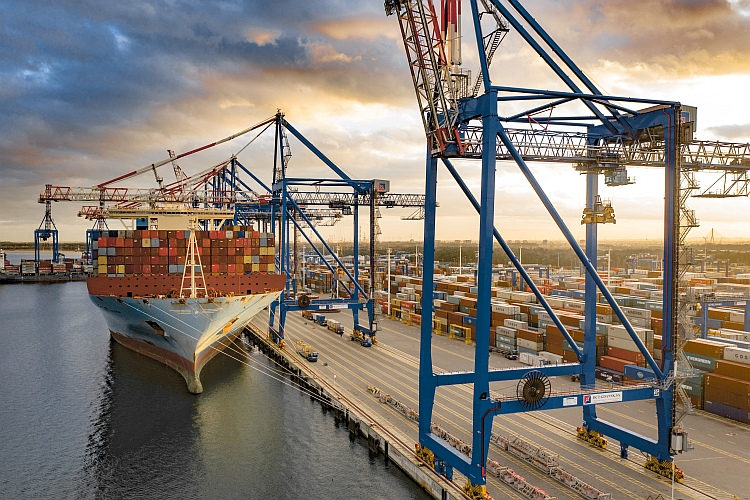
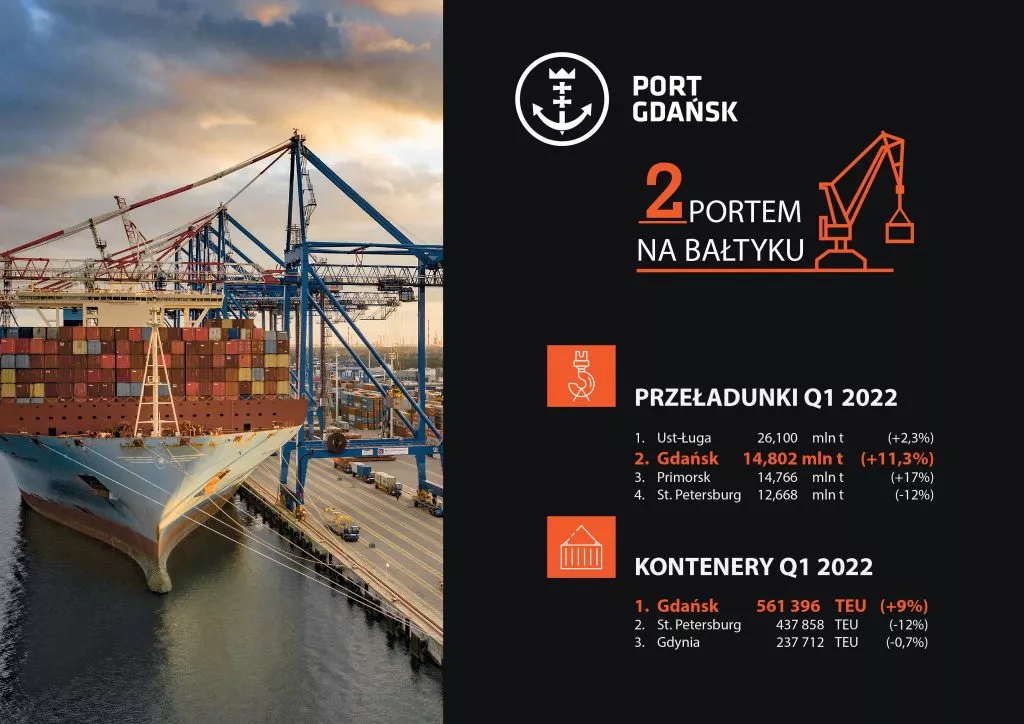
In the first quarter of 2022, the largest Polish port overtook two Russian ports (Port of Primorsk and St. Petersburg) and advanced to second place in the ranking of Baltic ports in terms of total cargo handling.
Since the beginning of 2022, the Port of Gdańsk has been recording very good results in most cargo groups, achieving a positive dynamic (quarter-on-quarter) of +11.3%. In the first quarter of this year, 14.8 million tons of goods were handled at the Port of Gdańsk – which represents an increase of 11.3 percent compared to the same period last year. General cargo remains the largest cargo group – approx. 6 million tons (an increase of 2 percent). Liquid fuels are in second place, recording an increase of 25.7 percent and reaching a result of 5.7 million tons. Coal is also in the black, with over 1.6 million tons handled. Increases were also recorded for containers (+9 percent), passengers (+12.3 percent), and Ro-Ro cargo (+19.6 percent). The record belongs to timber – 3535 percent more was handled than last year. Grain and other bulk cargo recorded declines.
– Our primary task, which we are consistently implementing, is the modernization of port infrastructure. We are finalizing key projects related to access infrastructure from both the water and land sides. We are doing this with our current and future trade partners in mind. Thanks to these actions, the Port of Gdańsk is a leader on the Baltic Sea today. We prove this with constantly growing cargo handling. This year, we estimate a result of 55 million tons. If we achieve the goals we have set for this year, we have a chance for an even higher result. However, we must remember that planning in today’s geopolitical situation is much more difficult and many scenarios must be taken into account – says Łukasz Greinke, CEO of the Port of Gdańsk.
Currently, the Port of Gdańsk handles 21 regular maritime connections. In addition to Europe, constant directions for trade turnover include the USA, Central and South America, and Asia. As part of the offered oceanic connections (alliances: 2M and Ocean Alliance), it is the only Baltic port that handles direct container connections with China. The world’s largest transoceanic vessels, requiring deep-water quays, call at the port. Due to its geographical advantages, it is already one of the key points on the world’s logistics map, one of the main links of the Trans-European Transport Corridor No. VI, which connects Scandinavian countries with countries located on the Adriatic Sea. The Port of Gdańsk is a gateway for goods imported and exported by companies in Central and Eastern Europe.
Source: Port of Gdańsk