









By mid-2022, as many as 64 Polish municipal transport companies will have electric buses in their fleets. Over the coming months, the total number of e-buses in Poland will reach nearly 850 units – almost four times more than at the end of 2019 – according to the latest edition of the periodic report by the Polish Alternative Fuels Association (PSPA) titled “Polish EV Outlook 2022”.
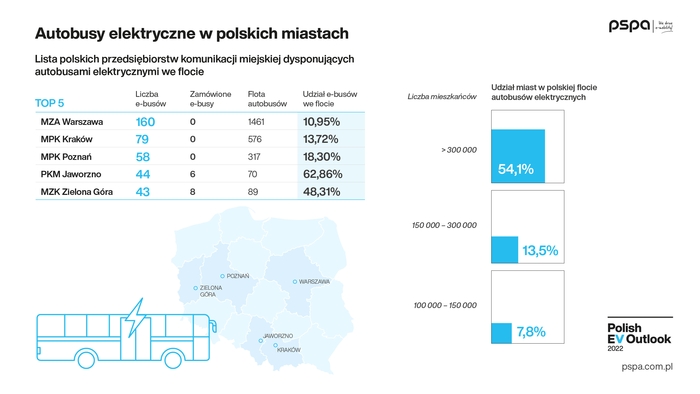
Based on data from the Chamber of Urban Transport (IGKM), as of December 31, 2021, there were 615 electric buses operating in Polish cities. This accounts for nearly 5.2% of the entire municipal bus fleet in Poland. The largest fleet, consisting of 160 e-buses, is operated by MZA Warszawa. Zero-emission vehicles make up nearly 11% of the capital’s company fleet. Subsequent places are held by entities such as MPK Kraków (79 units, 13.7% of the fleet), MPK Poznań (59 units, 18.3%), PKM Jaworzno (44 units, 62.9% – this is the highest percentage share in Poland among companies owning at least 3 e-buses), and MZK Zielona Góra (43 units, 48.3%). Zero-emission public transport – like other areas of electromobility in Poland – is concentrated primarily in the largest cities.
– More than half (54.1%) of all electric buses registered in Poland (333 units) are part of fleets operating in certain cities with over 300,000 inhabitants, namely Warsaw, Kraków, Poznań, Szczecin, Bydgoszcz, and Lublin. In selected urban centers with populations between 150,000 and 300,000 (Katowice, Częstochowa, Radom, Sosnowiec, Rzeszów, Gliwice), there are 83 such vehicles (13.5% of the fleet in Poland). Only 3 Polish municipal transport companies based in municipalities with 100,000 to 150,000 inhabitants (Zielona Góra, Włocławek, Tychy) have electric buses. Their fleets contain a total of 48 e-buses (7.8% of the fleet of such vehicles in Poland), of which 43 are in Zielona Góra. However, we are noticing a trend where zero-emission vehicles are also being ordered by smaller municipalities, which are not burdened by the obligations resulting from the Electromobility Act. This is a result of the availability of support from public funds – says Jan Wiśniewski, Director of the PSPA Research and Analysis Center.
According to the IGKM, despite the significant development of electromobility in public transport, it must not be forgotten that this is a costly process. The sharp increase in costs – including electricity – puts municipal transport operators in a very difficult economic situation, at a time when the effects of the pandemic crisis are still being felt.
– In the face of a serious public finance crisis, we are very concerned about municipal transport companies. The smaller the city, the worse the consequences of a budget deficit can be for the functioning of the public transport network. We must remember this, especially when implementing new technologies – including electric buses – says Marcin Żabicki, Development Director of the Chamber of Urban Transport.
At the end of last year, 233 electric buses were awaiting delivery to the fleets of Polish operators. They will be received by 36 companies operating in the field of collective public transport. The largest number of zero-emission buses will go to the fleets of PKA Gdynia (24 units), MZK Gliwice and MPK Łódź (17 units each), PKM Gliwice (16 units), and MPK Wrocław (11 units). As many as 22 operators awaiting e-bus deliveries did not previously have zero-emission vehicles. 42 ordered e-buses (18% of all ordered vehicles) will be delivered to companies from cities with 300,000 to 1 million inhabitants (Łódź, Lublin, Wrocław, Gdańsk, Szczecin). Fleets of entities based in municipalities with 150,000 to 300,000 inhabitants (Katowice, Częstochowa, Gdynia, Radom, Toruń, Sosnowiec, Gliwice) will receive 72 zero-emission buses (31% of all ordered vehicles). Polish municipal transport companies based in municipalities with 100,000 to 150,000 inhabitants (Zielona Góra, Opole, Gorzów Wielkopolski) have contracted or intend to contract 21 e-buses in the near future (9% of all ordered vehicles).
– Poland’s policy of supporting electromobility in the field of collective public transport is yielding tangible results, leading to synergy between e-bus suppliers who have factories in our country and create supply (represented by entities such as Solaris, Volvo, or MAN) and charging infrastructure providers, as well as local government units and financial support institutions that are recipients of these vehicles, including the National Fund for Environmental Protection and Water Management (NFOŚiGW), which launched the highly popular “Green Public Transport” program. As a result, we have become not only a European export hub for electric buses but also one of the leaders in terms of the development of electrified fleets in local governments. In 2021, in terms of the number of newly registered e-buses, we took 5th place in Europe, surpassed only by countries such as Denmark, France, the United Kingdom, and Germany. There are many indications that this year Poland will strengthen its position in this ranking – says Maciej Mazur, Managing Director of PSPA.
Alongside data on the zero-emission public transport sector, “Polish EV Outlook 2022” also contains a comprehensive analysis of the electric car market and the expansion of the charging infrastructure network in Poland, as well as development forecasts for both these areas until 2040. The report also describes in detail the legal regulations shaping the Polish electromobility market. The content of “Polish EV Outlook” also includes a forecast of the increase in energy demand related to the development of electromobility in Poland.
More about the “Polish EV Outlook 2022” report at: Polishevoutlook.pl
Source: PSPA