The use of radio frequency identification in logistics processes is not widespread, which is due to significant technical limitations. A key aspect that still needs to be solved is the issue of stable and reliable operation of RFID solutions. This is mainly in the scope of marking products in mass quantities, made of various materials, arranged in a way that does not allow for defining a uniform spatial orientation, and the implementation of the identification process in states of static and dynamic location changes.
The aim of the conducted research was, first of all, to define a set of RFID tags suitable for marking logistics units and collective packaging used in the distribution and sorting processes of Poczta Polska S.A. The tags selected for the research were chosen based on geometric parameters as well as various technical and technological solutions (different antenna designs and types of tag integrated circuits, also implementing additional functions such as Autotuning and TagFocus).
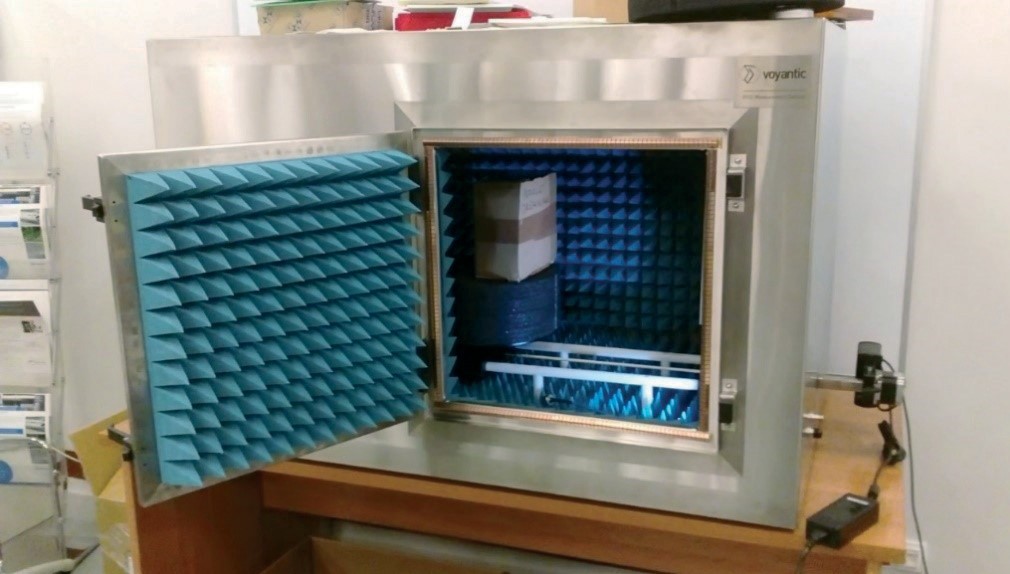 Fig. 1. Testing a tag in an anechoic chamber.jpg
Why was an anechoic chamber used for the research?
In the first phase, a pool of 27 tags was subjected to testing, for which the correct operating range, radio link budget, and threshold—i.e., the minimum transmission power required to activate the tag and receive a response—were determined under controlled laboratory conditions (anechoic chamber). As part of the tests, changes in parameters were also observed depending on the substrate material on which the tag was placed and its influence on the impedance matching of the tag circuit. All measurements were carried out for different power levels radiated by the reader and different sensitivity settings. The influence of orientation and the method of tag implementation on the range of their correct operation, as well as the effectiveness of the tag autotuning mechanism, were also verified.
As part of the research in the anechoic chamber, measurements of the correct operating ranges of selected RFID tags were made, depending on the specifics of the object on which they were placed. The possibility of performing multiple reads on non-homogeneous pallet load units, composed of previously prepared packages with diverse contents, was also verified. Based on the research results, the 3 best circuits were identified. The selected tags were then used in further research, conducted in multiple systems, in states of dynamic location change. The obtained research results were intended to allow for achieving a result in the form of a stable solution for identifying shipments throughout the entire distribution and sorting process of Poczta Polska S.A. The research on UHF RFID tag parameters consisted of placing all collected tag samples on a measuring stand and verifying the tag reading parameters in the 800MHz – 1000MHz band.
The measuring stand, consisting of an anechoic chamber and a Voyantic Tagformance Pro device (Fig. 1) along with an antenna, allows for the simulation of reading parameter settings in the full frequency range of the UHF radio band, from settings typical for mobile readers (from standard, through mid-range readers, to “state of the art” devices) to the full spectrum settings of stationary readers. Changes in simulation properties are possible in terms of the power radiated from the device and its sensitivity, as well as antenna parameters. During the research, the reading was carried out using parameters typical for a mid-range stationary UHF RFID reader. The transmission power was set in accordance with ETSI standards in the range of the maximum possible radiated power equal to 2W ERP (effective radiated power), taking into account a transceiver antenna with a gain of 6dBi. The sensitivity of the Tagformance Pro reader/programmer receiver circuit was programmed at -85dBm.
The test substrates were made of the following materials: metal, PVC, glass, rubber, PTFE, FR4, cardboard, POM, HD300, HD1000, PP, PA. Figure 2 shows a layered system consisting of two layers of bubble wrap and one layer of cardboard. The layered system was used in the test with a metal substrate, simulating transport packaging (with metal contents).
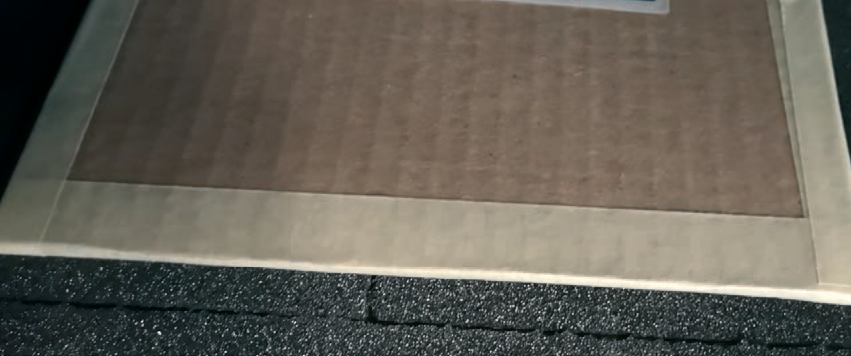 Fig. 2. Layered system spacer
Reading quality parameters and real logistics units
Tests carried out on substrates made of various materials allowed for the preliminary selection of the 5 best tags, which were used to carry out a cycle of 4 consecutive studies, conducted in a full-size anechoic chamber, the main goal of which was to determine how real logistics units, encountered in Poczta Polska processes, affect reading quality parameters. The first of the tests consisted of performing population measurements in the air. In the anechoic chamber, at a small distance, 5 tags of the same type were suspended, and population tests were carried out using a Voyantic Tagformance Pro reader. Thanks to the relatively small distances between the tags relative to the distance from the antenna, the influence of differences in the distances of individual tags from the antenna was considered negligibly small. During the test, a function of the number of read tags depending on the power radiated by the reader was obtained. Then, one tag was randomly selected from each population for further research. The selected tags were attached one by one to various packages (package models), subsequently examining the influence of their contents on the reading quality parameters. Individual logistics units were assigned to the following groups:
- package with metal elements,
- package with clothes,
- package with small electronics,
- package with wooden elements,
- package with paper articles,
- package with liquids,
- package with RTV articles,
- package with glass items,
- package with plastics,
- letter cassette.
Each package was additionally filled with bubble wrap or other materials intended to secure its contents.
The research was conducted using the Tagformance Pro device, with which it was determined from what distance it is possible to read a tag on a given package in the frequency range of 800 – 1000 MHz, using a reader with an output power of 27dBm, an antenna with a gain of 6dBi, and a reading sensitivity of -85dBm.
One of the objects on which the tags were tested was pallet load units. During the research, pallets with different spatial configurations of packages were used. The average number of packages per single pallet was 70.
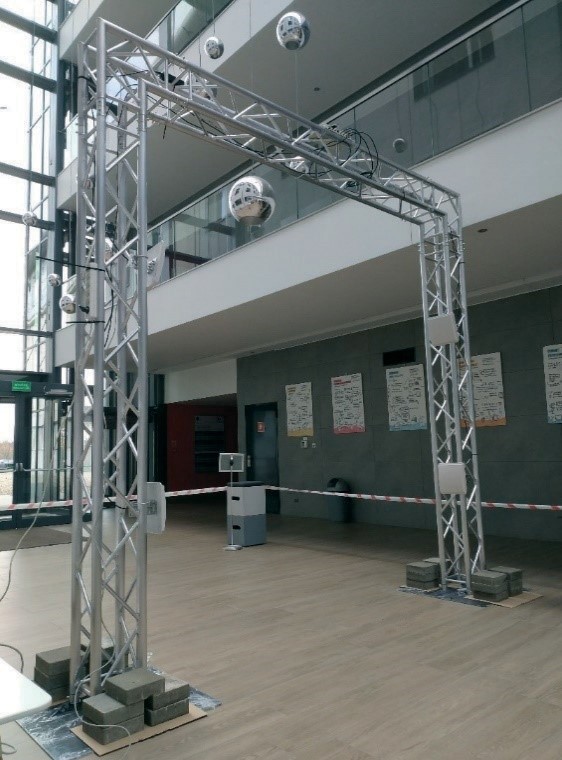 Fig. 3 Truss construction for RFID gate
Measuring stand
In the next stage of research under conditions close to reality, tests were carried out outside the anechoic chamber, using a gate made of a truss with adjustable handles for mounting antennas, which allowed for making changes to the antenna settings at the measuring stand.
Bearing in mind the collected data regarding the effectiveness of the identification process for the selected RFID tag, for the pallet load unit and the selected antenna geometry and reader/programmer configuration, a decision was made about the need to design and manufacture a dedicated RFID chamber for collective reading of postal shipments. The use of a sealed chamber made of steel plates equipped with a so-called turbo antenna, which is an antenna array composed of micro-antennas with different polarization and wave propagation angle, operating in a monostatic system, allowed for an additional increase in the effectiveness of the identification process. Especially in the process of taking inventory of many packages with different contents arranged in the form of a non-homogeneous pallet unit.
Bearing in mind the results of the research already conducted, as part of the next test, the focus was on checking how substrates closer to real conditions affect the RFID tag reading distance. Therefore, for the needs of the research, model packages containing different types of loads were developed. Then, a randomly selected tag from the previously tested population was glued one by one to individual test objects (packages). The reading distance measurement was performed as a function of the carrier frequency, with the indicated value corresponding to the distance measured for the frequency applicable in Poland, in full compliance with ETSI 302 208 and ETSI 300 220 standards.
As part of the research, a series of tests were performed, placing from 70 to 110 specially prepared and real, randomly selected Poczta Polska S.A. shipments in the chamber. In these tests, a one hundred percent reading effectiveness was obtained – regardless of the method of selection and arrangement of shipments in transport crates.
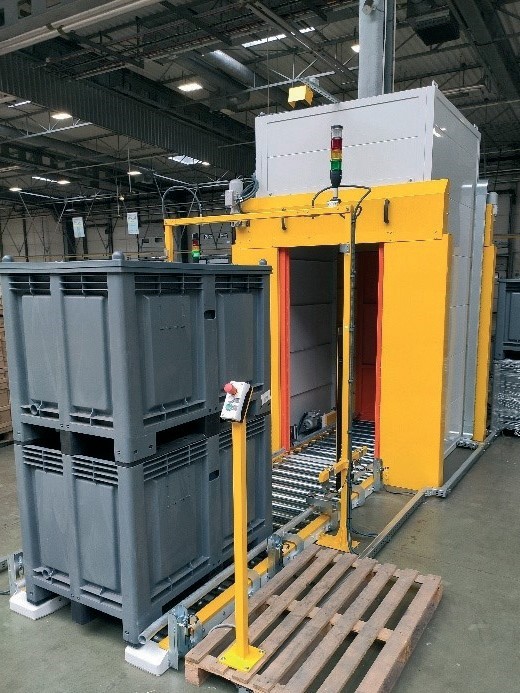 Fig. 4. Prototype of a chamber for taking inventory
The article comes from the magazine LOGISTYKA 1/2022.
The e-edition of the magazine is available in our offer!

Stay up to date, order a subscription to the LOGISTYKA magazine!