









Rail transport during the pandemic years is treated as a proven, sustainable, and competitive solution used by companies from virtually all branches of the economy – from the automotive industry to FMCG. Alice Defranoux, Head of Rail Freight Business at GEFCO, points out the most important factors that influenced this market over the past year and current trends.
What is the current situation of rail freight transport between China and Europe?
In 2021, an average of one train per hour ran between China and Europe. Intercontinental rail transport on the Silk Road accounts for 4% of the flows between these two continents. However, growth is currently slowed down due to infrastructure limitations. Therefore, new routes were necessary, such as sea and rail connections through Russian ports, to overcome these limitations. This solution proved its competitiveness during the crisis in ocean transport, and it is still impressive that trains cover over 1200 km in Russia every day. After the first wave of the pandemic, rail freight transport became attractive to many companies from virtually all sectors.
2021 was the European Year of Rail. What are the results?
The situation in Europe is quite different from that between China and Europe. The distances are obviously shorter, but each country has its own rules for managing infrastructure. These facts make European connections technically more complicated and, in reality, limit the competitiveness of rail freight transport. The European Union announced 2021 as the European Year of Rail with an ambitious plan to reach a 30% share in freight traffic by 2030. This is a challenge, as the average has remained at 18% for years.
For large flows and long distances, rail is undoubtedly a competitive and environmentally friendly solution. GEFCO handles one hundred trains per week as part of finished vehicle deliveries, but also trains with supplies for production plants. In 2021, we launched a regular connection between France and Spain for a period of 3 years. This road-rail intermodal transport allows for a reduction of annual CO2 emissions by 1,400 tons. This means a 78% reduction in carbon dioxide emissions compared to road transport. It is also a competitive solution because the transit time is 36 hours, and the connection is stable in terms of rates and transport capacity. Thanks to this, we can offer our customers a secure service in uncertain times, when fuel prices and driver shortages disrupt road freight transport in Europe.
One of the challenges of the coming months, both for us and for our customers, is shifting flows currently carried by trucks to intermodal solutions. At GEFCO, we are ready to support our customers by strengthening our engineering and operational teams to facilitate this transformation.
Why should rail freight transport be treated as a sustainable and competitive transport solution?
If you want to be competitive, you must be able to handle transport over significant distances. It is recommended to have at least 1000 km of rail line for 150 km of (road) access to the rail terminal. Of course, this remains in the realm of theory, as one must also take into account costs and transit time, flexibility, capacity, rate stability, and of course CO2 emissions. It should also be emphasized that rail freight transport offers a range of value-added solutions, such as secured transport, temperature-controlled transport, or flow tracking, the level of which today would not be possible without the development of the Internet of Things. For example, between China and Europe, as proven during crises, we managed to achieve a transit time of about 18 days and a significant reduction in CO2 emissions compared to air transport. Rail freight transport has become a real, sustainable alternative for all sectors, including the consumer goods industry.
Rail is an environmentally friendly solution in terms of reducing CO2 emissions, as well as other emissions. Which ones?
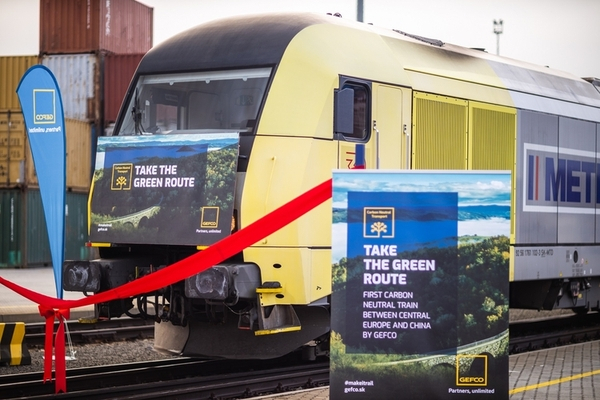
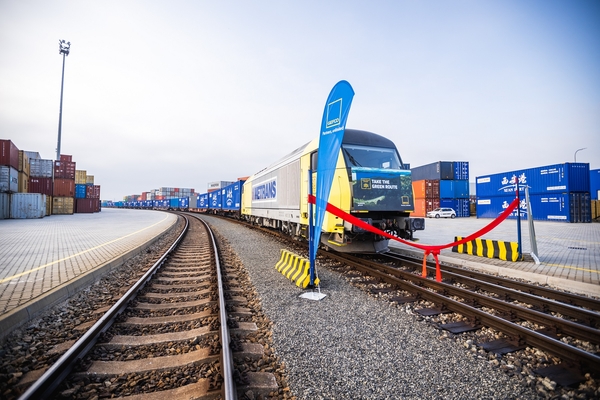
Indeed, rail freight transport contributes to the reduction of CO2 emissions and is the first step towards a sustainable supply chain. In November 2021, we presented our first carbon-neutral freight train from Slovakia to China for a client in the consumer goods industry. First, we optimized the route, and then we offset 100% of the CO2 emissions. Emissions depend on how electricity is produced in different countries, but generally speaking, rail freight transport also allows for the reduction of fine particulate matter (PM10), sulfur dioxide (SO2), nitrogen oxides (NOX), and hydrocarbons (NMHC), reducing health risks associated with air pollution.
Since the first COVID-19 crisis, and then the crisis in ocean transport, rail freight transport has become a sustainable solution for the transport plans of all industries, and from GEFCO’s perspective, we can confirm this trend. We can expect double-digit growth as we transition to a more sustainable economy.