








In 2021, cargo handling at the ten largest Baltic ports increased by 5.21% to 471.1 million tons compared to 2020. The total performance of the ports is also 1.57% higher than in the last year before the Covid-19 pandemic..
Total cargo handling at the 10 largest Baltic ports
The leading ports on the Baltic Sea are Russian ports (among the Russian ports in the top 10 are Ust-Luga, St. Petersburg, Primorsk, and Kaliningrad), whose combined cargo handling accounts for 47% of the cargo turnover of the top ten. In the largest Baltic port – the Port of Ust-Luga, general cargo handling increased by 12% y/y, in particular ferry cargo (+96.6 thousand tons, +9% y/y). Growth was also recorded in oil handling (+5% y/y) and petroleum products (+4% y/y). In the Port of St. Petersburg, general cargo handling also increased by 13% compared to 2020. Both ports recorded a recovery in coal and coke handling (each of the analyzed ports saw an 11% increase compared to 2020). According to data from the International Energy Agency (IEA), 2020 brought a 4.4% decline in global coal demand compared to 2019. In turn, daily demand values in 2021 were about 6% higher than the 2020 results.
Just behind the Russian ports of Ust-Luga and St. Petersburg was the Port of Gdańsk, which advanced to third place in 2021. The port recorded significant growth in liquid fuel handling (+37.9% y/y), grain (+7.6% y/y), and general cargo (+5.5% y/y). The other Polish ports, occupying 7th and 9th place, were also characterized by an increase in cargo handling. At the Port of Szczecin-Świnoujście, total cargo handling amounted to 33.2 million tons. Turnover decreased only in 2 cargo groups: other bulk (-5.2% y/y) and grain (-4.8% y/y). In turn, cargo handling at the Port of Gdynia in 2021 was record-breaking. The port recorded impressive growth in liquid fuel handling (+0.7 million tons, +42% y/y), which was contributed to by the expansion of the Fuel Base in Gdynia’s Dębogórze.
At the Port of Primorsk, crude oil handling increased by 9%, reaching 36.3 million tons, and petroleum product handling amounted to over 16.6 million tons (+4% compared to 2020). In 2021, cargo handling at the port did not reach pre-pandemic results. It should be borne in mind that 2019 was a record year for the Port of Primorsk due to high crude oil handling (47.5 million tons in 2019).
The increase in crude oil handling in 2021 is the result of increased demand. According to data from the International Energy Agency (IEA), in 2020, due to the limitation of business activities caused by the Covid-19 pandemic, demand for oil fell by 8.6% compared to 2019. In 2021, a recovery in this sector was visible – according to preliminary estimates, daily demand for oil increased by over 5% y/y. In 2022, growth is projected compared to pre-pandemic values.
Increases in cargo handling were also recorded at the Port of Rostock (+3.6 million tons, 14.26% y/y) and the Port of Tallinn (+1 million tons, 5% y/y). For the Port of Rostock, cargo handling in 2021 proved to be record-breaking. The largest increases were recorded in crude oil and diesel oil handling (+27% y/y), general cargo (+12% y/y), and ro-ro cargo (+18% y/y). At the Port of Tallinn, liquid bulk cargo has the largest share in handling, where there was a slight decrease (-3% y/y). A small decline in this group was compensated by increases in the ro-ro (16.6% y/y) and dry bulk (6.3% y/y) groups.
The decline at the Port of Klaipėda (-2.2 million tons, -4.54% compared to 2020) is a result of the geopolitical situation – in 2021, the Port of Klaipėda lost supplies of some Belarusian petroleum products and fertilizers.
At the Port of Gothenburg, there was a single-digit decline in cargo handling (-2.64% y/y) due to reduced turnover in the crude oil and energy products group in exports. Declines in these groups were to some extent compensated by increases in container and ro-ro cargo handling, which saw significant growth.
Table 1. Cargo handling volume in the 10 largest Baltic ports in 2019-2021 [thousand tons]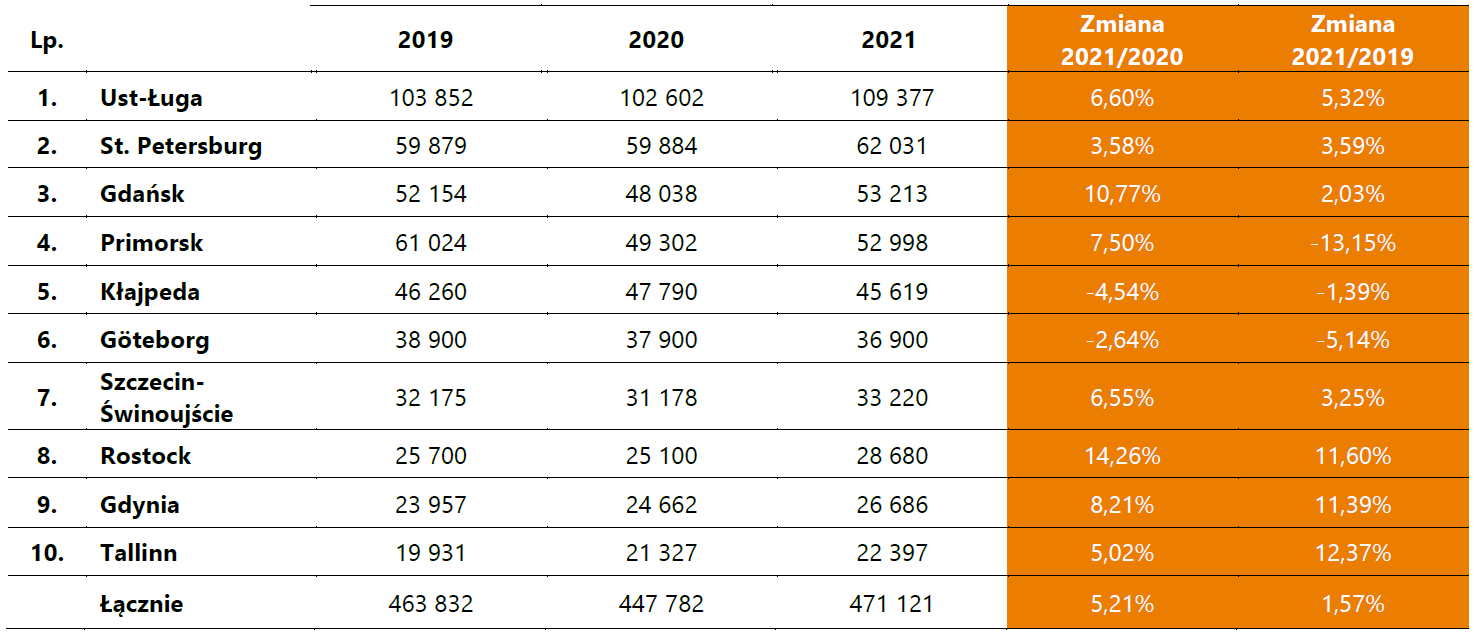
Source: Actia Forum based on data from seaports
Containers
Despite various perturbations that took place in 2021 in the global container market (blocking of the Suez Canal, shortage of containers on the global market, as well as high freight rates), the volume of cargo handling in the largest container ports on the Baltic Sea in 2021 increased by 4.56% compared to 2020 (Table 2). In total, the top 10 ports handled 9.2 million TEU, which indicates growth also in relation to the record-breaking 2019.
For the Port of Gdańsk, 2021 brought an advancement to the position of leader in container handling, with an increase of over 10% compared to 2020. In August 2021, the Gdańsk port gained a new feeder connection – ships of the operator Fields call twice a week as part of the Gdańsk – Liepāja (Latvia) connection.
The Port of St. Petersburg recorded a decline in cargo handling for the third year in a row. The result for 2021 shows a deepening of the decline to 8% compared to 2019.
The increase in container handling at the Port of Gdynia (+8.93% y/y) was influenced by the launch of new feeder and ocean connections. In 2021, the Port of Gdynia gained a connection with the port of Hamburg and Bremerhaven operated by Maersk, a weekly Gdynia – Oslo – Klaipėda connection by the operator Viasea, as well as two connections with Great Britain: by the operator Unifeeder and Containerships. Among the ocean connections calling at the Port of Gdynia was the MSC operator’s connection linking Gdynia with the Port of Rades in Tunisia as well as India and Pakistan (with a call at the BCT terminal) and the transatlantic connection of the shipowner Hapag-Lloyd from the Port of Gdynia (GCT terminal) directly to North American ports.
The Port of Gothenburg is on a growth wave. Cargo handling at the port increased both in the difficult year of 2020 and in 2021. Last year, the port achieved a result of 828 thousand TEU, which is an increase of 6.7% y/y. For the Port of Gothenburg, this is the largest increase since 2015.
The Danish Port of Aarhus recorded significant growth. Over the last five years, container handling has increased by 58%. The high growth dynamics in 2021 are due to increased refrigerated container handling (+7% y/y) and pork exports to China. Due to problems in pig production in China, large quantities of pork were exported through the Port of Aarhus to Asia.
A single-digit increase in container handling occurred at the Port of Klaipėda (+4.66% y/y), however, the port has not yet returned to pre-pandemic cargo handling volumes.
Declines in Finnish ports are the result of a global shortage of transport containers. At the Port of Helsinki, empty container handling fell by over 25% compared to 2020. Moreover, in 2021, the volume of transit to Russia fell, which affected cargo handling at the Port of HaminaKotka. Transit accounts for about 15% of the port’s container handling, and in 2021 it decreased by 13% compared to 2020.
The impressive growth in Kaliningrad is due to the development of container rail connections on the China-Europe line of a multimodal (sea-land) nature. Over the last two years, new container connections with European ports have been launched from the Port of Kaliningrad (among others, since March 2021 the port has had a connection with the Port of Immingham in Great Britain), and in October 2021, a new rail terminal with a capacity of 450,000 TEU was opened, where containers in transit traffic between Europe and Asia are handled.
At the Port of Riga, a decline in container handling occurred in both the full container segment (-8.8% y/y) and the empty container segment (-7% y/y).
Table 2. Cargo handling volume in the 10 largest Baltic container ports [TEU]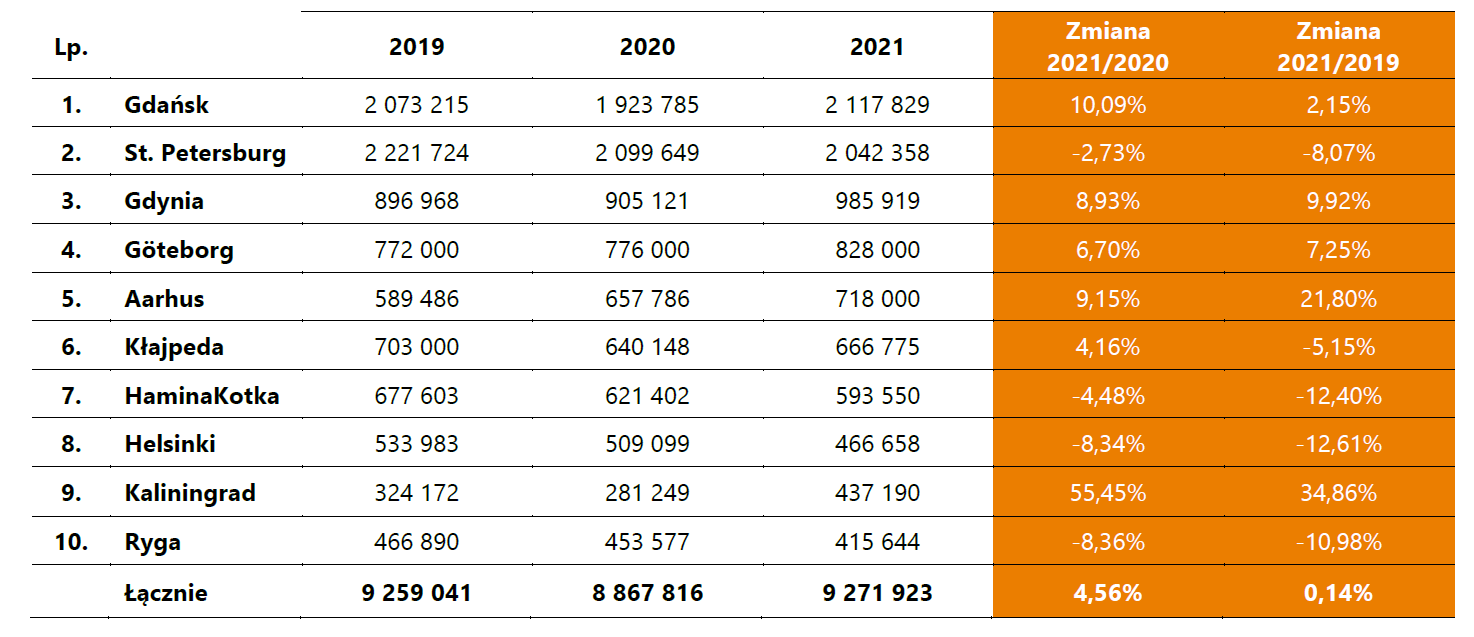
Source: Actia Forum based on data from seaports