








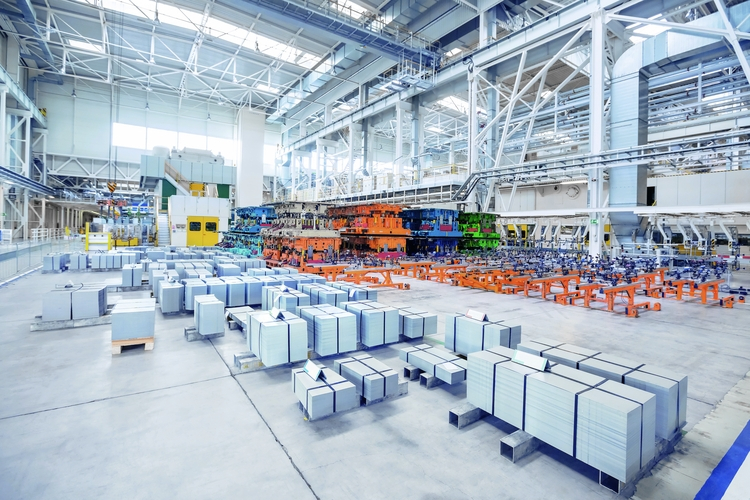
The previous year was absolutely record-breaking in terms of delivered space, with its resources exceeding the level of 24 million square meters. It is also worth mentioning that 5 million square meters were leased within the first nine months of the year, which is a result over 40% better than in the corresponding period of the previous year. Furthermore, 3.7 million square meters are still under construction, which is almost 150% more than in the same period last year. The international consulting firm Cushman&Wakefield examines the trends in the industrial sector for 2022.
At first glance, we are generally talking about modern warehouse space. To a layman, a warehouse is a large structure with ramps for trucks to pull up to, where unspecified warehouse operations are carried out inside. However, when we look at the subject of warehouses more closely, we quickly notice that a seemingly similar-looking building is characterized by heterogeneous technical specifications, equipment, and fulfills various roles in the supply chain management process. Its space may accommodate the work of a few or a dozen people, but also even several thousand warehouse employees on not much more space. It can also be a place where supply chain operations begin in a given country, or an element of its last mile, or even re-introduction into circulation.
In summary – we are increasingly talking about seemingly similar structures, but with completely diverse purposes and functions. In the landscape of Polish warehouses, we see more and more not only large distribution centers, but also urban warehouses, courier hubs, return centers, and even warehouse space in shopping malls located next to omnichannel stores, or dark stores – small warehouse spaces often occupying the place of former service premises and small local shops. The diversity of warehouse space will therefore grow along with the saturation of the Polish market, increasing customer demands, and growing competition.
– Last year, we also noticed a constantly growing emphasis on ecological solutions. This trend will be present on an even larger scale this year. According to data from the World Economic Forum, buildings account for 40% of global energy consumption and one-third of greenhouse gas emissions, and the priority for EU member states is to be the reduction of carbon dioxide emissions. The plans are ambitious, as according to the EC’s assumptions, the climate goal is to reduce emissions by at least 55% by 2030. In the following decades, greenhouse gas emissions are to gradually decrease so that the EU can achieve climate neutrality by 2050 – says Damian Kołata, Partner, Head of Industrial & Logistics Agency | Poland, Head of E-Commerce | CEE.
Until now, when thinking about ecology in warehouses, we usually discussed the topic of photovoltaic panels on the roof and the now-famous beehives on the roofs of distribution centers. For some time now, however, the green approach has been increasingly structured and is called ESG (Environmental, Social and Governance). ESG criteria, based on which ratings of business entities are created, include “E”, i.e., “environmental”, as one of the three main pillars. It is important that ecology in this sense also means huge savings. According to calculations by various developers operating on the Polish market, by using photovoltaic panels, increased wall and roof insulation, LED lighting, and an energy management system, energy consumption in a building drops by up to 50%. LED lighting consumes 90% less energy than a standard light bulb. In turn, the intelligent DALI (Digital Addressable Lighting Interface) lighting control system adjusts light intensity to changing environmental conditions. It uses motion sensors and activity patterns, ensuring optimal working conditions and effective energy management. Electric car chargers, vegetation plantings, flower meadows, or green roofs allow for a reduction in carbon dioxide emissions by about 381 tons per year for a medium-sized warehouse. From the point of view of building tenants, it also matters that green solutions affect the well-being of their employees. Greenery around the building, relaxation zones, small architecture, or bicycle infrastructure make the efficiency of people satisfied with their workplace increase.
Source: Cushman&Wakefield