








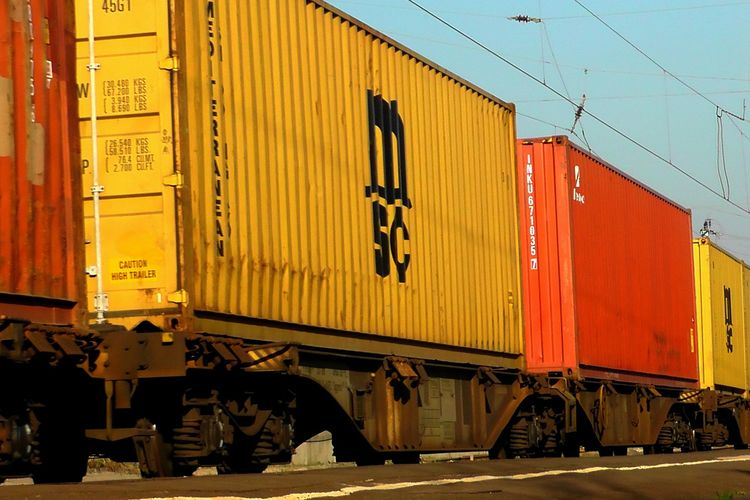
Thanks to its central location in Europe and the fact that it lies at the junction of two different railway track gauge systems, Poland is a transit country for the majority of shipments from China to the Old Continent. However, its share in transport within the New Silk Road is decreasing year by year. The blame lies with the insufficient infrastructure and operational capabilities of the transshipment point in Małaszewicze, located a dozen or so kilometers from the border with Belarus. The situation is further complicated by the tense relations with Poland’s eastern neighbor. This is why more and more goods are being transshipped and transported via other routes – from the north through Kaliningrad and from the south through Hungary.
– Today, freight traffic from Asia to Europe, partly as part of the New Silk Road initiative, is largely carried out through Małaszewicze. It is a place near the Terespol-Brest border crossing through which most of the cargo heading to Europe passes – says Bartosz Baca from the Polish Association of Logistics and Purchasing Managers. – This is for a simple reason. We are the first European Union country on the route from Asia to Europe. There is often a prevailing belief that our position in transport on the New Silk Road is secure, well-established, and cannot be threatened, but this way of thinking is a mistake.
Currently, rail freight traffic from the Far East to Europe takes place mainly through Poland. It is estimated that about 70% of transport and transshipment operations are currently carried out here. However, the problem is that the volume of transport exceeds the infrastructure and operational capabilities of Małaszewicze, which causes entrepreneurs to look for other routes. There are several such options: either the intermodal Northern Corridor, through Kaliningrad and Baltic ports, or the Southern Corridor, i.e., for example, the LHS – a broad-gauge line through Ukraine and Poland, but also variants bypassing Poland, e.g., through Hungary.
– In 2013, when the New Silk Road was initiated, 80 freight trains traveled on the route from Asia to Europe. Last year, there were almost 12.5 thousand trains, so the scale of growth is enormous, and in the first two quarters of this year, there were over 10 thousand trains – informs Bartosz Baca. – When we overlay the share of Małaszewicze, it can be seen that in 2019, 94% of the total volume traveled from Asia to Europe. In 2020, it was already 79%, and in the first two quarters of 2021 – 68%. The volume is therefore enormous and it is growing, Małaszewicze is constantly congested, but its share is falling year by year.
The transport of goods measured in TEU units, i.e., twenty-foot equivalent unit, in 2020 amounted to 1.14 million TEU, and it is estimated that in 2025 it will be 1.5 million TEU. The terminal in Małaszewicze will be expanded, but this will, firstly, take several years – until 2027, and secondly, the expansion will temporarily further limit capacity. Meanwhile, the competition is not sleeping. Intermodal transport is carried out through Kaliningrad, goods are brought by trains to Baltic ports and from there they sail to Western Europe across the Baltic Sea. The second important alternative is Hungary, which is expanding its border crossing with Ukraine. The East-West Gate project is being built there, involving the construction of a huge transshipment terminal.
– There is also the port of Piraeus, which is owned by the Chinese, the COSCO consortium. They are currently financing the construction of a railway line between Belgrade and Budapest. When we connect these dots, i.e., the development of infrastructure in Hungary, the “Chinese” port of Piraeus, and the newly built railway line between them, another alternative is in the making – emphasizes the expert from the Polish Association of Logistics and Purchasing Managers. – Let us also remember that for the Chinese, it is important that in the case of large business contracts, there is also consent, a certain “blessing” at the government level, and this is missing. On our side, there is a passive approach, business organizes this space on its own, this is the difference in approach between Poland and China.
The situation at the border with Belarus, which is an important transit country for the Chinese, may also become a hindrance. China is also a significant investor in Belarus. A flagship example is the Great Stone Industrial Park, built by the Chinese next to the Minsk airport, with an area of approx. 100 sq km (almost one-fifth of Warsaw). The China Railway Construction Corporation is involved in the expansion of the Minsk metro line, and the Chinese are also investing in Belarus in the construction of nurseries, kindergartens, and apartment buildings.
– If border crossings were to be closed, I believe that it would actually arouse the interest of the Chinese side. It seems to me that the Chinese will not leave this without a reaction, although I am not able to predict it, but it will certainly matter to them – says Bartosz Baca. – Belarus would suffer colossal damage because its image and reputation as a transit country would suffer. Today, it guarantees a relatively efficient flow of goods from Asia to Europe and suddenly this efficient flow of goods is stopped. If this were some element of pressure on Belarus, it seems to me that this is a strong argument because it would actually lose out on it. Poland would also lose out on this from a business point of view, because closing border crossings means that these goods bypass it.
Source: Newseria