









Representatives of Generation Y are entering the business world in increasing numbers. As the “B2B E-commerce – business online” report shows, young entrepreneurs and employees are stimulating a series of changes in online B2B trade. User experience related to the purchasing process is gaining importance, including tailoring to buyer preferences, also in terms of communication. As a result, the B2B e-commerce sector will increasingly resemble the B2C sector.
New generations, new expectations
Millennials make up an increasingly large group among entrepreneurs and employees. Accustomed to digital realities or even unfamiliar with the pre-internet world, they navigate the digital environment perfectly while having specific expectations of it. They gained their e-commerce experience as consumers on platforms that competed to provide the buyer with comfort and positive impressions. Millennials now expect the same standards in B2B trade.
– The most important trends – just like the characteristics of Generation Y – have a global reach. Young entrepreneurs are not used to the opaque, visually unattractive websites from the early days of the internet. They also expect complete information and value online communication. The number of such people will continue to grow, which is why B2B e-commerce must catch up in this regard to the standards known to consumers from B2C e-commerce – notes Małgorzata Nesterowicz, Director of the Services and Family Business Sector at Santander Bank Polska.
Global trends in the domestic market
It is no different in Poland. As the “B2B E-commerce – business online” report, prepared by Santander Bank Polska and the Mobile Institute, shows, the most important phenomena for Polish B2B e-commerce are the increasing influence of Generation Y, the growth in conviction towards e-commerce caused by the pandemic, and the growing emphasis on customer purchasing experience.
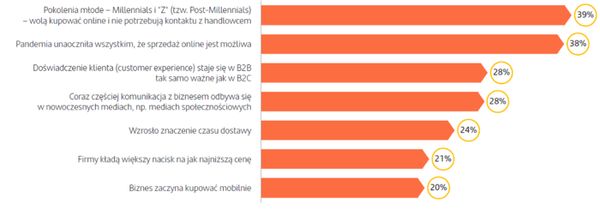
What trends do you see in the area of B2B e-commerce (company purchases online) in your industry? N=546 companies
Source: B2B E-commerce – business online report.
– The B2B market is beginning to be characterized by more and more phenomena known more from the B2C market. Transferring purchasing habits and expectations from the B2C world to processes carried out in B2B is now practically the norm, especially for the young. 39% of surveyed companies notice that millennials and Gen Z prefer to buy online. In the world of the so-called new normal, the overall experience of cooperation is becoming more important than the product itself. B2B companies should therefore implement solutions and processes that are increasingly adapted to these new needs of digital generations, which allows not only for maintaining existing business relationships but also for establishing new ones. At the same time, it is worth taking advantage of the opportunity that B2B e-commerce provides and reaching for new sales markets and optimizing existing operations, after all, the Internet has no borders – explains Justyna Skorupska, Head of the B2B E-commerce Content Group at the Chamber of Electronic Economy.
Among the surveyed companies, as many as 39% noticed that business clients from generations Y and Z do not need contact with a salesperson at all. 38% believe that the pandemic has finally proven the universal usefulness of the e-commerce channel in the B2B sector; in the subgroup of companies conducting online sales for business, this percentage reached 52%. In turn, 28% of all entrepreneurs believe that customer experience is already just as important in B2B e-commerce as it is in B2C. The same number express the conviction that the importance of modern, more direct communication, including on social media, is growing in the B2B channel.
Online presence alone is not enough
Experts involved in the creation of the “B2B E-commerce – business online” report point out that online sales for business have their period of most dynamic growth still ahead of them. However, competition between sellers will also increase, and simply launching online sales will not guarantee success in digital.
Already, company representatives notice that business is starting to buy mobile (20%), manufacturers are trying to reach the end customer directly (19%), and the omnichannel approach is gaining more and more importance (16%). This is accompanied by pressure to shorten delivery times (noted by 24% of companies) and the lowest possible prices (21%). Therefore, transferring a paper catalog to an online store is not enough. Modern multi-channel platforms will be needed, allowing customers to buy in a way that is convenient for them, suggesting relevant recommendations, and providing support at every stage of the transaction, as well as after its completion, if necessary.
– At the purchasing stage, “self-service” will become increasingly popular, not contact with a salesperson, but a clear presentation of products, an intuitive purchasing process, and accurate suggestions. All this can be provided by modern e-commerce tools. Human work should instead be directed towards consulting and support for customers and towards additional elements, such as useful content on the website. Business clients are just as willing as private ones to show loyalty, but you have to earn it. B2C e-commerce can provide patterns – summarizes Małgorzata Nesterowicz, Director of the Services and Family Business Sector at Santander Bank Polska.
The full report is available below in PDF format.
The “B2B E-commerce – business online” report prepared for Santander Bank Polska by the Mobile Institute under the patronage of the Chamber of Electronic Economy, Łukasiewicz – Institute of Logistics and Warehousing, the Polish Packaging Chamber, and TLP – Transport and Logistics Poland, comes from the website: www.santander.pl/raportecommerceb2b