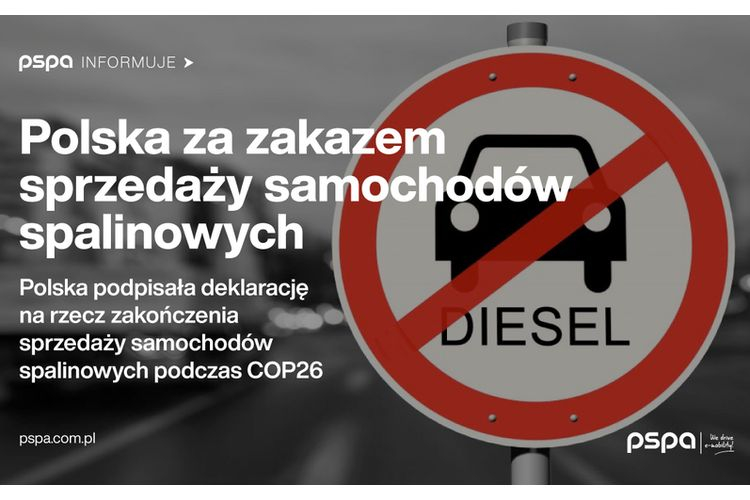
The declaration signed by Poland at COP26 to end the sale of internal combustion engine vehicles no later than 2035 in leading markets and by 2040 globally should initiate a substantive dialogue and public discussion on this topic in Poland, assesses the Polish Alternative Fuels Association (PSPA). The declaration should be followed by an update of national strategic goals in this area, and subsequently, the introduction of appropriate regulations.
During the 26th UN Climate Change Conference in Glasgow (COP26), 33 countries, 39 cities and regions from around the world, as well as dozens of automotive companies, major fleet operators, financial institutions, and other entities signed a declaration to end the sale of internal combustion engine vehicles. Poland was among the signatories of the agreement. The primary goal of the document is to accelerate the popularization of zero-emission vehicles to implement the Paris Agreement. The signatories committed to working together towards registering only zero-emission passenger cars and vans in the new vehicle market. This goal is to be achieved no later than 2035 in leading markets and by 2040 in other countries. According to the assumptions, zero-emission vehicles are to become widely available and affordable in all regions of the world by 2030.
– The declaration signed at COP26 is the first such position of the Polish government regarding the end of sales of internal combustion engine vehicles. We treat this declaration as an important step towards accelerating the decarbonization of the transport sector in Poland. There has been a lack of dialogue and public discussion on this topic in our country. However, the declarations should be followed by the implementation of concrete instruments – first of all, in the form of updating national strategic goals in this area, and then – in the longer term – the introduction of appropriate, binding legal regulations – says Maciej Mazur, Managing Director of the Polish Alternative Fuels Association (PSPA).
The declaration at COP26 was signed by the governments of Austria, Azerbaijan, Chile, Croatia, Cyprus, Denmark, the Dominican Republic, Finland, Ghana, India, Ireland, Iceland, Israel, Cambodia, Canada, Kenya, Lithuania, Luxembourg, Morocco, Mexico, the Netherlands, Norway, New Zealand, Paraguay, Poland, Rwanda, El Salvador, Slovenia, Sweden, Turkey, Uruguay, the United Kingdom, and Cape Verde. The signatories also included governments of cities and regions (e.g., Atlanta, Barcelona, Buenos Aires, California, New York, Quebec, Rome, and Sao Paulo), automotive concerns (e.g., BYD, Ford, General Motors, Jaguar Land Rover, Mercedes-Benz, and Volvo), major fleet operators (e.g., ABB, E.ON, Iberdrola, IKEA, Siemens, SK Innovation, Tesco, Uber Technologies, Unilever, or Vattenfall), financial institutions, and a number of other entities.
– Importantly, a number of countries, including the signatories of the declaration, have already set earlier deadlines for the end of sales of new internal combustion engine vehicles. Norway plans to introduce similar restrictions as early as 2025; Austria, Denmark, Ireland, Iceland, Israel, the Netherlands, Singapore, Slovenia, Sweden, and the United Kingdom by 2030; China, Japan, and Cape Verde by 2035; and France, Spain, Canada, Portugal, and Sri Lanka by 2040 – lists Jan Wiśniewski, Director of the PSPA Research and Analysis Center.
Furthermore, on July 14, 2021, the European Commission announced a package of legislative proposals called “Fit for 55”. Its main assumption is to reduce net CO2 emissions by at least 55% by 2030. This is ultimately intended to lead to achieving climate neutrality in accordance with the provisions of the “European Green Deal”. The EC proposals include, among other things, the introduction of a number of instruments conducive to the decarbonization of the transport sector.
– A breakthrough proposal is the commitment of automotive concerns to reduce (relative to 2021) the emissions of new cars by 55% (passenger) and 50% (vans) from 2030. All newly registered passenger cars and vans in the European Union would have to be zero-emission from 2035. Consequently, this would mean the introduction of a ban on the registration of new cars equipped with internal combustion engines across the entire Community – summarizes Maciej Mazur, Managing Director of PSPA.
Source: PSPA
Read also about other activities for ecology:
– We ask experts: can e-commerce be more ecological?
– Donate used electrical and electronic equipment via Paczkomat® InPost
– Raben Group switches to green energy
– CHEP, Unilever, and Biedronka demonstrate the practical dimension of sustainable development
– PortBin will protect the Baltic Sea from tons of waste
– A pioneering project for recycling flexible packaging is launching
– Brambles achieves sustainable development goals
– Polish industry will benefit from the development of offshore wind farms
More articles on ecological solutions can be found in the magazine LOGISTYKA 4/2021.
The e-edition of the magazine is available in our offer!
Stay up to date, subscribe to the LOGISTYKA magazine!