








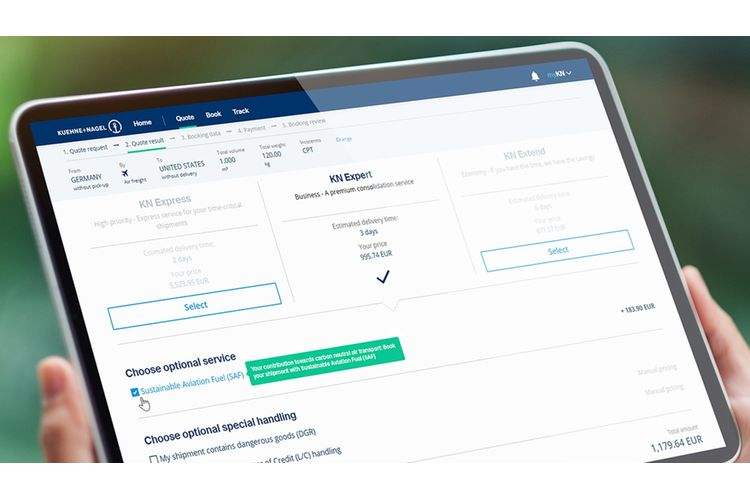
Kuehne+Nagel has become the first air logistics provider to offer customers the option to purchase sustainable aviation fuel (SAF) for every shipment, thereby immediately avoiding carbon dioxide emissions. The new add-on is available on all Kuehne+Nagel air freight quoting platforms and channels, allowing customers to choose carbon-neutral transport via their preferred online or offline quote.
With the newly introduced offer, all Kuehne+Nagel customers can easily opt to use SAF instead of fossil fuels in air transport and benefit from zero-carbon logistics services – regardless of the airline, origin, or destination. Since SAF still generates CO2 emissions, carbon neutrality is achieved by replacing every liter of kerosene in jet fuel with 1.33 liters of SAF.
When a customer requests a quote, the price add-on is immediately calculated along with all other transport charges and presented as an option to select. The novelty of the offer also lies in a more intuitive SAF pricing structure. Until now, prices for SAF usage were quoted per liter or per ton of CO2 avoided, whereas it is now linked to the actual weight of the shipment. With this new SAF option, Kuehne+Nagel calculates SAF usage and presents a quote per kilogram of shipment. Once the booking is confirmed, an equivalent amount of sustainable aviation fuel is allocated from the 12.8 million liters of SAF available to Kuehne+Nagel, and the customer receives an authorized certificate confirming the carbon emission reduction.
– As part of our Net Zero Carbon program and the migration to a low-emission business model, we are constantly developing easy and transparent sustainable shipping options so that our customers always have a choice regarding minimizing the environmental impact of their transports. Thanks to the new SAF add-on, now available in all quotes, our customers can easily take climate action – commented Yngve Ruud, member of the Kuehne+Nagel Management Board, responsible for air logistics.
SAF is currently the most effective way to significantly reduce the environmental footprint in air transport. While the carbon life cycle of fossil fuels is linear and results in the release of additional CO2 emissions, the carbon life cycle of SAF is circular and enables the reuse of waste or biomass and emissions. SAF significantly reduces the amount of additional carbon introduced into the global carbon cycle by at least 75%.
Source: Kuehne+Nagel