Electromobility and micromobility are trends that are increasingly prominent in today’s discussions about the future of transport development. Not just transport itself (understood as ideas or strategies of cities and countries), but how we will move around in the near future. Whether for holidays (an electric plane?), to the Polish seaside, but above all – to work, for shopping, or for an evening out.
Discussions about mobility usually revolve around several areas:
– urban congestion (traffic),
– lack of space (parking),
– air pollution,
– weather conditions,
– financial conditions.
Technological revolutions usually have the characteristic that few people are able to predict them in advance. There were many prophets of the “year of mobility” and earlier of “Web 2.0”, yet no one predicted the iPhone or thousands of electric scooters on the streets of cities around the world in just a few months. We usually look at the world through the prism of our current experiences and habits – if it’s a car, it’s a gas station; if it’s a short trip, it’s a bicycle; if it’s a series, it’s on TV. Kodak did not go bankrupt because it did not foresee (or believe in the development of) digital cameras. In fact, the first digital camera was created in its laboratories. Kodak did not foresee that people would want to share photos, that photographs would become “part of phones”.
Henry Ford, the American industrialist and founder of the Ford Motor Company, said: “If we ask people what they need, they will answer that they need faster horses“. This means that we should perceive innovation not as a continuation, but rather as a break, a negation of the existing order of things. Will it be the same with the way we move around our cities and villages? A year ago, there was not a single shared electric scooter in Poland. Today, there are nearly 10,000, and the number of active users reaches nearly 200,000. Private electric scooters? There are already over 120,000 of them in Poland. Let’s look at bicycles – the dominant player in the urban bicycle market is NextBike. After nearly 10 years, it has nearly 12,000 bicycles, most of them fully “analog”. But changes have come here too – the first 4,500 bicycles (all in one year) as part of the Mevo system in the Tricity are fully electric. Finally, cars – electric, autonomous, and shared. It is estimated that one shared car replaces 25-40 individual vehicles. We usually use a car for only 10% of the day, while paying for insurance, repairs, parking space, winter tires, and – above all – depreciation. Safety – why is autonomy so important and so difficult? A human is responsible for most accidents or collisions. Eliminating them from the role of the driver should therefore make everyone happy. And that is precisely why creating an autonomous vehicle is so difficult. The problem is not recognizing signs, staying in designated lanes, or reacting to traffic lights. The problem is that one-thousandth of cases where the behavior of another human/driver is unpredictable and non-schematic.
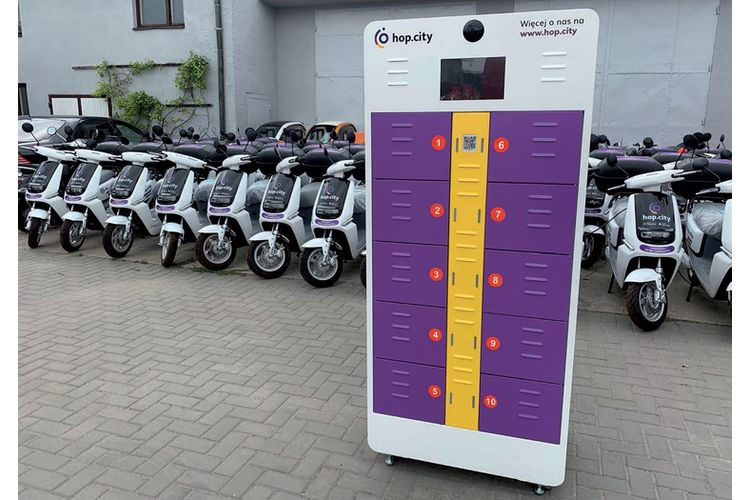
What about infrastructure? It seems that the common denominator for the efficient development of electromobile and micromobile vehicles is infrastructure. This should be divided into infrastructure for cars and infrastructure for light electric vehicles. In the case of cars, we are talking basically only about fast or ultra-fast chargers. There were some experiments in the field of battery pack swapping in cars, but due to the dimensions of such batteries, their costs, and potential damage, none of the major manufacturers is currently developing this concept.
In the case of electric cars, one must also keep in mind the connection capacities that we are able to provide. Some energy market experts claim that, for example, in Warsaw, 40,000 electric cars would cause a permanent blackout, and 40,000 electric cars would account for only 3% of all passenger cars currently registered in the capital. It also seems that by 2023 or 2025, it is not possible to significantly increase (based on power plants and large transmission lines) the next energy ring for Warsaw.
The full article is available below in PDF format.
The article comes from the magazine LOGISTYKA 5/2019.
The e-edition of the magazine is available in our offer!