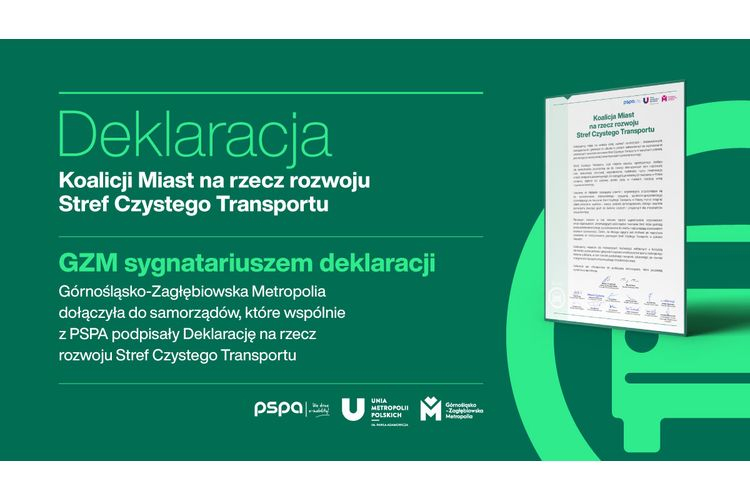
The Upper Silesian and Zagłębie Metropolis has joined the local governments that, together with the Polish Alternative Fuels Association (PSPA), have signed the Declaration for the development of Clean Transport Zones. City mayors are demanding changes to regulations that are intended to facilitate the creation of such zones in Polish cities.
Clean Transport Zones are areas in cities with over 100,000 inhabitants that can be designated by local governments. Electric, hydrogen-powered, and natural gas-powered vehicles can move through them. Vehicles with petrol and diesel engines that meet high EURO emission standards are also permitted. According to the regulations, a local government creating a zone can introduce a list of exemptions and allow the movement of other vehicles, but only for a period of up to three years from the adoption of the resolution and on the condition of paying a fee. That is as far as the legal regulations go. In reality, such zones do not function in the country.
Local governments have an idea for the Zones
In order to facilitate the creation of low-emission areas in cities, it was necessary to introduce appropriate legislative changes. The Union of Polish Metropolises, the Polish Alternative Fuels Association (PSPA), and local governments, and now also the Upper Silesian and Zagłębie Metropolis, have signed up to an initiative that creates the groundwork for building clean and resident-friendly city areas.
– The accession of the Upper Silesian and Zagłębie Metropolis is a confirmation that the initiative related to the Declaration for the development of Clean Transport Zones (SCT) is correct. This is a very strong reinforcement of this undertaking. Showing that the project itself, related to these 9 clearly defined points that indicate in which direction SCTs should go, and above all national regulations in this regard, is a confirmation of the validity of the entire concept. We hope that more local governments will join our Declaration. At the same time, we hope that it will gain strength and that national authorities will include our proposals in the changes to the Electromobility Act – says Adam Wieczorek, Deputy Mayor of the City of Łódź, representing the Union of Polish Metropolises in work on the declaration and postulates.
– As part of our coalition, PSPA and local governments are joining forces to reduce pollution and noise in Polish cities. Zones are an effective tool leading to this goal, as proven by numerous foreign examples – adds Maciej Mazur, Managing Director of PSPA, adding that there are already over 250 such areas operating in Europe.
Poland remains a blank spot on the map of the Old Continent in this regard. The creation of the Coalition is an important moment and a symbolic transition from words to deeds. Including the postulates developed within the Coalition will significantly accelerate the implementation of clean zones in cities. In the declaration issued together with the Polish Alternative Fuels Association, city mayors postulate such a change to the current regulations that they allow for flexible adaptation of the rules applicable in the zone to the needs of the local government.
“The first step in this direction will be to develop appropriate legislative changes, enabling local governments to create Zones that fulfill their basic functions, are adapted to realities, and meet the expectations of local communities. The goal we are striving for is to bring the first Clean Transport Zones into operation in Polish cities as soon as possible” – we read in the declaration.
– The Metropolis needs Clean Transport Zones. For residents, they will mean a reduction in air pollution. They will contribute to reducing the number of vehicles on the street and reducing noise – explains Kazimierz Karolczak, Chairman of the Upper Silesian and Zagłębie Metropolis. – The creation of zones is an action aimed at supporting the development of sustainable urban mobility. This is meeting the trends in transport development. The future will belong to low-emission road transport. We must already meet this trend – adds Kazimierz Karolczak.
How should the zones function?
In practice, local governments want to expand the regulations so that zones can also be created in smaller municipalities, with fewer than 100,000 inhabitants. They postulate allowing the entry of vehicles that meet a Euro emission standard defined by the local government. Cities should also have the possibility of creating several zones with different criteria taking into account local conditions. “Zones within zones” could also be created, in which stricter requirements would apply. While the setting of maximum rates for entry into the zone for a vehicle that does not meet the requirements should be left to the legislator, the entire set of rules for admitting such vehicles to the zone should be determined by the local government. Statutory regulation should also be supplemented with provisions guaranteeing that the creation of an SCT will be based on public consultations.
Source: PSPA
Read also about other ecological activities:
– Raben Logistics: closed-loop in the entire life cycle
– PortBin will protect the Baltic Sea from tons of waste
– A pioneering project for recycling flexible packaging is starting
– Brambles achieves sustainable development goals
– Polish industry will benefit from the development of offshore wind farms
– 4,000 photovoltaic panels on the roof of the LPP Distribution Center
– GLS focuses on renewable energy sources
More articles on ecological solutions can be found in the magazine LOGISTYKA 4/2021.
The e-edition of the magazine is available in our offer!
Stay up to date, subscribe to the LOGISTYKA magazine!