









The number of jobs in Poland could increase by 6,000 in connection with the transformation of the automotive industry by 2030, according to a report by the Boston Consulting Group (BCG), prepared in cooperation with the Polish Alternative Fuels Association (PSPA). However, it is necessary to implement appropriate measures to stimulate the development of the electromobility market. Otherwise, the transport sector will face layoffs.
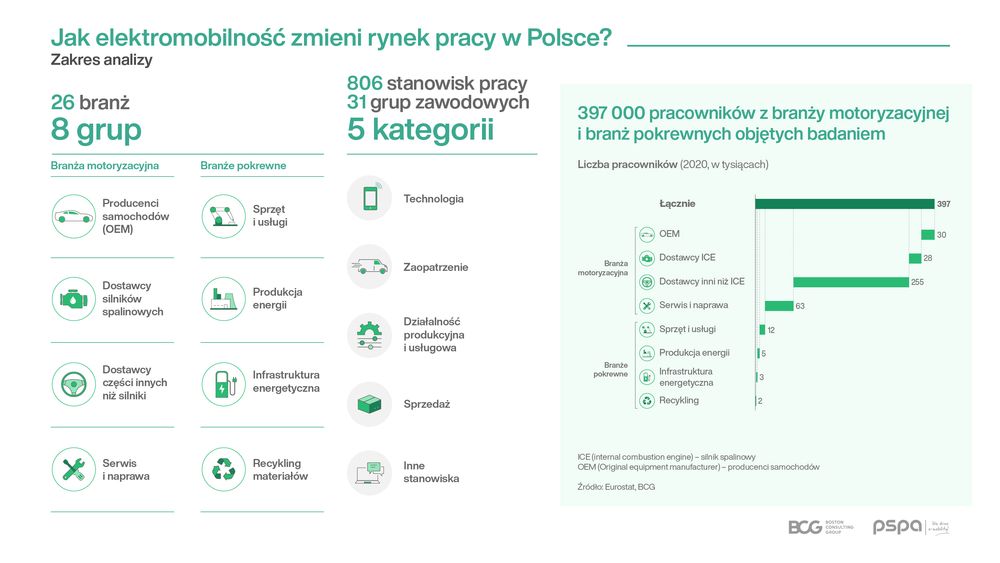
The report “How electromobility will change the labor market in Poland. Green sectors of the future” contains scenarios for the effects of the transport sector transformation in Poland on the labor market by 2030. The analysis covered a broad group of 26 industries divided into 8 main areas and 31 professional groups divided into 5 categories: technology, procurement, production and service activities, sales, and other jobs. The study took into account as many as 806 different positions.
– The uniqueness of the analysis lies in the fact that it took into account not only key industries in the automotive area (vehicle manufacturers, suppliers of components related to internal combustion engines, suppliers of components independent of the power source, vehicle service companies), but also related industries (equipment suppliers and service providers, fuel and electricity producers, and suppliers of fuel and charging infrastructure, recycling companies). As a result, the report illustrates the consequences of changes in the transport area for a total of 397,000 jobs in Poland – says Dr. Kristian Kuhlmann, Partner at Boston Consulting Group (BCG).
Transformation of the automotive sector
The authors of the report analyzed 6 main trends affecting employment in the Polish automotive industry and related sectors: a decrease in vehicle production volume, technological development, changes in the market share of individual car segments, an increase in production efficiency, and the migration of jobs.
– We assume, among other things, that the scale of production in the automotive market will not return to pre-COVID-19 pandemic levels until at least 2030. In the coming years, we should also expect an increase in the value of software installed in vehicles – by approx. 11% annually. This will increase the industry’s demand for programmers. As a result of the growing demand for premium models, the growth will also include the amount of materials used for car production. A key factor will be the increasing customer interest in electric vehicles. Their market share will grow to approx. 20% over the next decade – says Maciej Mazur, Managing Director of the Polish Alternative Fuels Association (PSPA).
Effects on the labor market
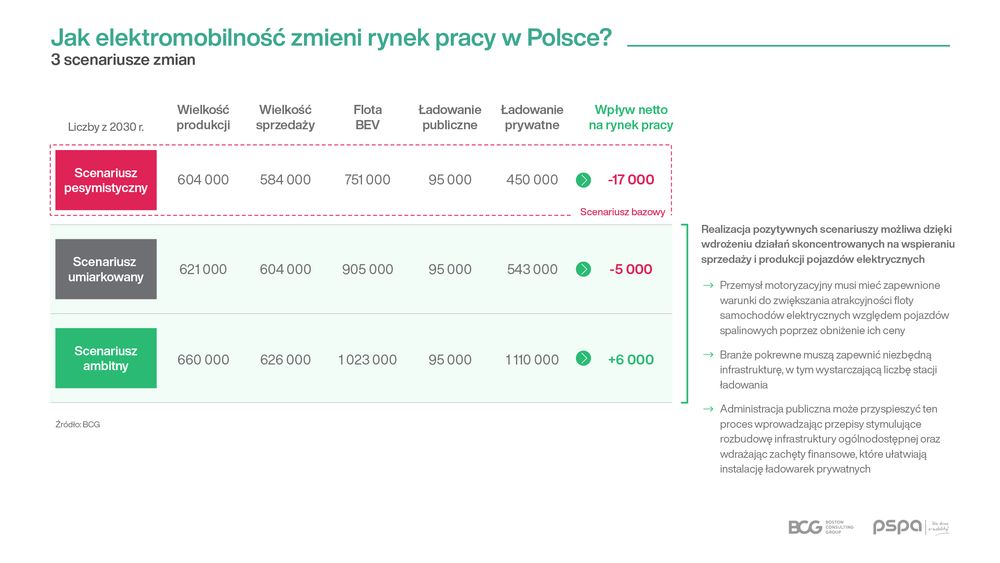
The report presents 3 scenarios for the transformation of the transport sector and its impact on the labor market in Poland. In the pessimistic variant, which does not assume additional measures to develop the electromobility sector by public administration, the authors of the study expect that by 2030, 380,000 jobs will remain in the industries covered by the study – this is a decrease of 17,000 positions compared to 2020, or more than 4%. The reduction in employment will be contributed to by a decrease in production in the automotive industry (by 1,000 jobs), offshoring (by 25,000 jobs), and an increase in production efficiency related to digitalization and automation (by 28,000 jobs). Increased use of materials in vehicle production will result in the creation of 36,000 new vacancies, and technological development – 3,000.
– The development of electromobility will contribute to a reduction in employment of only 2,000 positions. However, this relatively low number is associated with huge changes in the structure of the labor market. Car manufacturers and suppliers related to internal combustion engine-based automotive can expect a reduction in employment of 23,000 people. At the same time, the demand for products and services related to the e-mobility sector, including lithium-ion batteries and charging infrastructure, will favor the creation of 21,000 new jobs – says Dr. Kristian Kuhlmann, Partner at Boston Consulting Group (BCG).
The report assesses the changes caused by the transformation of the transport sector from three perspectives: time, individual industries and professional groups, and regions. The authors of the study point out that as a result of the changes taking place, the requirement for training or retraining will cover about 170,000 employees.
We can prepare for changes
The BCG and PSPA report shows that it is already possible to implement changes that will contribute not only to limiting the undesirable effects of the transformation on the labor market but will even lead to an increase in employment. Actions in this regard should be taken by the government, companies, and employees themselves.
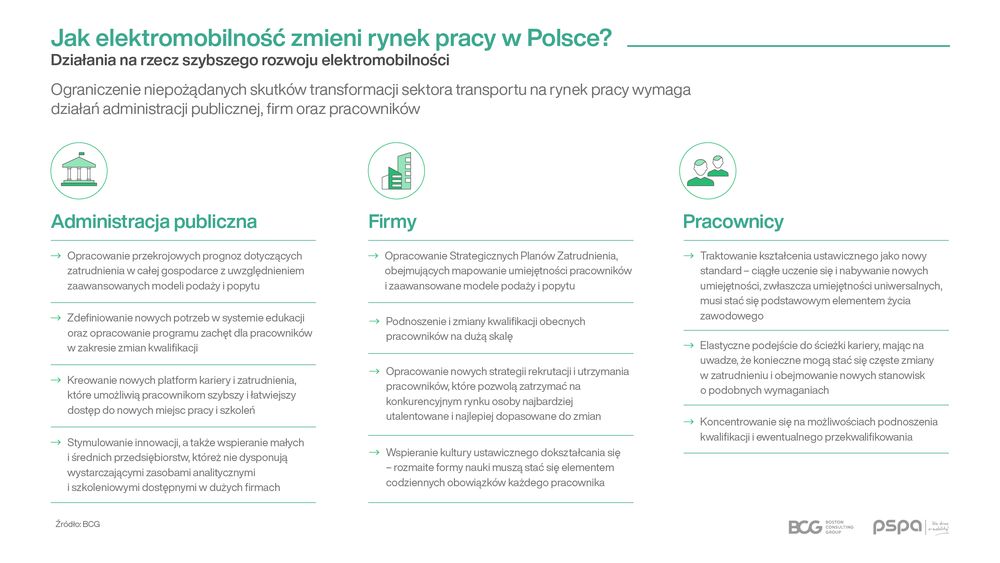
– Public administration bodies must, among other things, develop cross-sectional forecasts regarding employment in the entire economy, taking into account advanced supply and demand models. Additionally, defining new needs in the education system and qualification changes, as well as developing an incentive program, can help employees in the transformation process. The public sector should also create new career and employment platforms that will enable employees to have faster and easier access to new jobs and training – says Dr. Kristian Kuhlmann, Partner at Boston Consulting Group (BCG).
To meet the inevitable changes, companies operating in the automotive industry and related sectors can develop strategic employment plans, including skills mapping and advanced supply and demand models. The conclusions from these studies will facilitate actions in the field of upskilling and reskilling current employees on a large scale. Additionally, companies should develop new recruitment and retention strategies that will allow them to retain the most talented and best-suited people for the changes in a competitive market. It is also necessary to implement instruments that encourage employees to further their education. Continuous upskilling on one’s own initiative should also become a standard among those employed in the automotive industry. The authors of the report emphasize that intensifying efforts for the faster development of electromobility can not only mitigate the undesirable effects of the transformation but also bring positive results for the labor market in Poland.
– The key to realizing positive variants is the implementation by public administration and the industry of such instruments that will focus on supporting the sale and production of electric vehicles and the expansion of charging infrastructure. In the baseline scenario, the transformation of the automotive sector will limit the reduction of jobs by 5,000, while in the optimistic scenario, it will be possible to increase employment by as many as 6,000 new positions – concludes Maciej Mazur, Managing Director of PSPA.
The full report is available below in PDF format.
The report comes from the website: www.pspa.com.pl
PSPA_Jak_elektromobilnosc_zmieni_rynek_pracy_w_Polsce_Raport_PL.pdf