








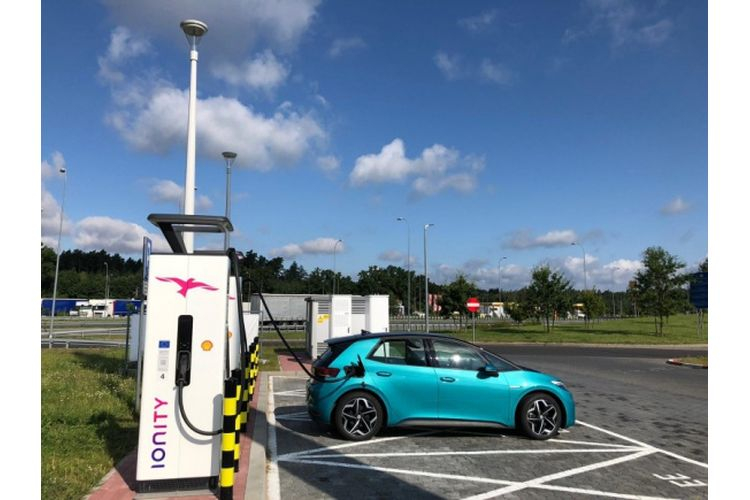
Shell and IONITY are opening a new era of electromobility in Poland. From Friday, October 15, electric vehicle drivers can use fast chargers providing power of up to 350 kW at the Olsze Wschód and Olsze Zachód service areas along the A1 motorway. This is seven times more than the power offered by existing motorway chargers (50 kW). High charging power will significantly reduce the charging time for electric vehicles.
The opening of more such stations is planned over the next few weeks. Each of them will offer at least 2 charging points and will be expandable with additional ones. IONITY stations in Poland are fully powered by green energy. The green transition is one of the most important goals set by societies, governments, and companies around the world for the coming years. An example of action in this area is the development of electromobility. This process is progressing more and more efficiently in Poland, as shown by data from the Polish Alternative Fuels Association. In 2020, despite the pandemic, 9,879 electric vehicles were registered in Poland. Year-on-year, this represents a 140% increase. This shows that the development of a charging network for popular electric cars is essential.
Partnership for electromobility
Shell, in cooperation with IONITY, Europe’s largest high-power charging network open to all vehicle brands, wants to popularize electromobility in Poland and Europe. One of the ways to achieve this goal is to increase the number of charging points on the map of the entire continent. The international partnership between Shell and IONITY covers many European countries – the goal for Poland is to create a network that will make it easier for consumers to travel across the country in electric vehicles.
– Thanks to the cooperation with IONITY, our technology partner, the General Directorate for National Roads and Motorways (GDDKiA), Gdańsk Transport Company, and the Office of Technical Inspection (UDT), Shell is introducing a pioneering solution to our market, offering drivers 350 kW chargers. They will be compatible with both existing and future electric vehicles equipped with the European CCS charging standard, charging a given vehicle at the maximum power available to it. Currently, 50 kW chargers operate along motorways. IONITY chargers increase this power sevenfold, which significantly reduces charging time and the number of stops required on the route. Most EVs moving on Polish roads can be charged at a maximum power of 150 kW. This means that 10 minutes of charging with a fast charger is enough to cover another 100 kilometers. This is great news for the growing group of electric car users – says Monika Kielak-Łokietek, Head of Shell Mobility Sales & Network, Shell Polska.
– The goal of IONITY is to enable travel by electric vehicles across Europe. Today we are one step closer to achieving this goal. The opening of our first high-power charging station in Poland is an important milestone for electromobility in Eastern Europe, and our partnership with Shell is crucial in this context – says Dr. Marcus Groll, COO of IONITY.
Poland enters the map of fast charging in Europe
In Eastern Europe, Shell’s expansion in electromobility began in 2020 in Hungary. It was there, next to the M7 motorway near Lake Balaton, that high-power IONITY chargers were installed. At that time, Hungary was the largest market for electric vehicles in Central and Eastern Europe. Subsequent launches were planned in the Czech Republic, Slovenia, Slovakia, and Poland.
Half a million Shell EV chargers by 2025
Shell is also planning investments in standard-power charging points. Currently, there are 60,000 of them worldwide. The company’s goal is to have 500,000 by 2025. A few months ago, Shell exceeded the threshold of 100,000 transactions in the field of electromobility, which confirms the great potential of this solution. Activities related to electromobility are part of Shell’s low-emission strategy. As part of it, by 2050, it is planned to reduce the net carbon footprint of Shell’s energy products by 65%, thus contributing to improving air quality in cities. At the same time, the company’s goal is to run a net-zero emission energy business by 2050.
Source: Newseria