








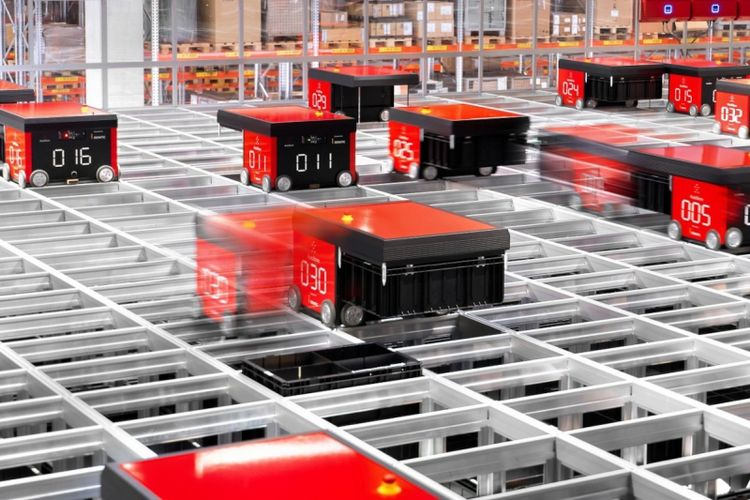
In response to the need to increase the number of stored components and improve picking efficiency, Siemens has implemented a solution combining an automated small parts warehouse, conveyors, lifts, and high-bay racking served by reach trucks.
Facility characteristics
The Siemens combined engineering plant in Chemnitz has a long tradition of designing and manufacturing machines and components for a wide variety of applications. The scope of operations covers a broad spectrum – from application engineering, through material logistics and electrical equipment assembly, to inspection and pre-commissioning. Both switchgear for machine tools and elements needed in general and mechanical engineering are produced here. On an annual basis, the plant carries out projects that require the use of nearly 1.3 million material items. As a result, a total of 46,000 switchgears, special sub-assemblies, and electronic components are produced in Chemnitz over 12 months, which are then delivered to customers worldwide. Due to the growing demand for the company’s services and products, the existing small parts warehouse proved insufficient to meet the increasing needs.
– We decided to implement this project with STILL and Dematic due to the pressure that increased demand was placing on our processes – says Carsten Sambo, Head of Inbound Logistics at Siemens AG in Chemnitz. – We had to handle a larger volume of loads and materials than ever before. Although we expanded the pallet warehouse and the external warehouse, our storage space for small components was filled to the brim. The goal of the project was to improve the efficiency of handling KLT containers, optimize the use of pallet spaces, and increase the productivity of the entire process – reports Sambo.
Applied solution
The first step in creating a solution that meets Siemens’ needs was to collect detailed data on the warehouse’s operation. This information became the basis for the supplier to create multiple project variants, from which the one that best met the customer’s requirements was selected.
– Based on information about the assortment structure, the warehouse, and orders, we defined the boundary conditions for the target system together with STILL intralogistics consultants. These became the starting point for creating many 2D and 3D warehouse layout proposals – says Sambo.
In the first phase, STILL evaluated and compared various systems using key performance indicators (KPIs) in terms of required throughput and available storage space. During discussions with the customer, the most promising designs were selected, so that one could finally be chosen, refined, and implemented. The choice fell on a solution in which the following operate simultaneously: automation of the small parts warehouse based on Dematic’s AutoStore® technology, as well as conveyors with a total area of 2,100 sq m and a pallet racking system for 12,000 spaces provided by STILL. In the modernized warehouse, the flow of goods begins with receiving loads in one of two ways. Palletized goods are transported to the racks by a manually operated STILL FM-X reach truck. Cartons with small components, on the other hand, go to conveyors and lifts and – through them – to employees responsible for unpacking packages, checking their contents, and placing components in BIN containers compatible with the AutoStore® system. Thanks to the conveyors, the containers then reach the automated warehouse – ready to be sent as soon as production reports the appropriate demand.
Implementation effect
The AutoStore® system implemented at Siemens is capable of holding up to 45,000 SLC bins with over 24,000 types of materials. Compared to the manual system used previously, up to four times more goods can be stored in the same area. Picking efficiency has also increased from 30 to 75 items per hour.
– Wanting to increase the availability of components, we programmed a demand forecasting function for the next day. Items that will be needed are retrieved and moved by robots during the night shift from the lowest levels of the AutoStore® system to the upper area of its self-supporting grid – reports Carsten Sambo. – Thanks to the new warehouse, the concept of which we developed together with STILL and Dematic consultants, we are well prepared for the future. Already at the planning stage, we took into account the need for picking scalability. The solution also meets our requirements regarding increasing storage density, improving picking efficiency, and generally streamlining handling operations and the functioning of the entire warehouse – concludes the Head of Inbound Logistics at Siemens AG in Chemnitz.
Source: Newseria