








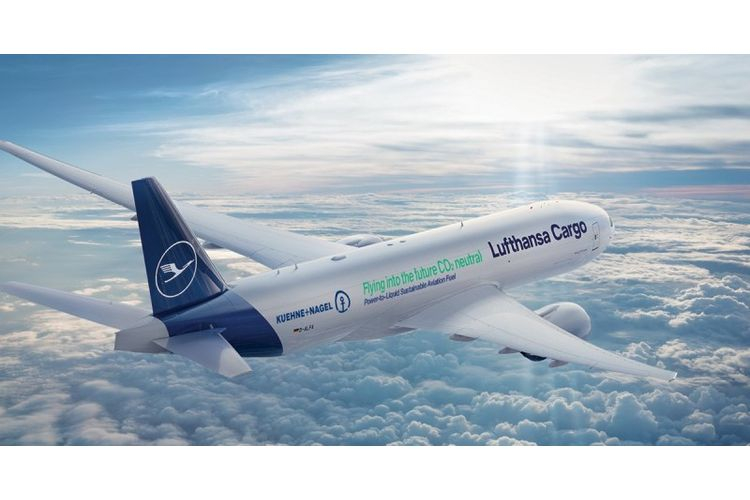
The atmosfair organization is opening the world’s first production plant for synthetic SAF (Sustainable Aviation Fuel) in Emsland, Germany. Kuehne+Nagel and Lufthansa Cargo are among the first customers. Power-to-Liquid is considered the technology of the future for CO2-neutral aviation fuel.
Kuehne+Nagel and Lufthansa Cargo have reached an agreement to promote and use synthetic fuel from the Berlin-based non-governmental organization atmosfair. The logistics service providers have jointly committed to supporting the world’s first production facility for synthetic SAF in Werlte, Emsland (Germany), by purchasing 25,000 liters of fuel annually for the next five years. Synthetic fuels are not yet produced on an industrial scale and are only available in laboratory quantities. This fuel is considered the fuel of the future, capable of reducing CO2 emissions from aircraft engines to zero.
– Already today, thanks to SAF, our customers can avoid carbon emissions from their shipments. By supporting the first power-to-liquid fuel production together with Lufthansa Cargo, we are sending a strong message about our commitment, while inviting our industry colleagues and customers to join us in creating a low-emission economy of the future today – commented Yngve Ruud, member of the Kuehne+Nagel Management Board, responsible for Air Logistics.
– We clearly see a solution to reduce emissions from flight operations through the use of synthetic, sustainable aviation fuels. This commitment once again shows that we are actively facing the challenges of climate protection – added Dorothea von Boxberg, CEO of Lufthansa Cargo.
With properties almost identical to conventional jet fuel, sustainable aviation fuels are a pillar on the path to CO2-neutral transport. There are two main types of sustainable aviation fuel – bio-SAF and synthetic SAF.
Until now, Kuehne+Nagel and Lufthansa Cargo have used bio-SAF to reduce the carbon footprint in air transport. While bio-SAF is produced from biomass (waste products and low-carbon raw materials), the primary energy source and raw materials for the production of synthetic SAF are: renewable electricity, water, and carbon dioxide (CO2). Synthetic SAF is considered a long-term solution for the industry because it can be produced without the limitations associated with biomass supplies and can reduce emissions by up to 100%.
Source: Kuehne+Nagel
Read more about air transport:
– FedEx Express launches new connection between Europe and Japan
– Dachser increases safety levels in air transport
– PANSA implements an innovative safety system in Polish airspace
– In air mobility, we are still lagging behind Western Europe
– Polish airports in a difficult situation