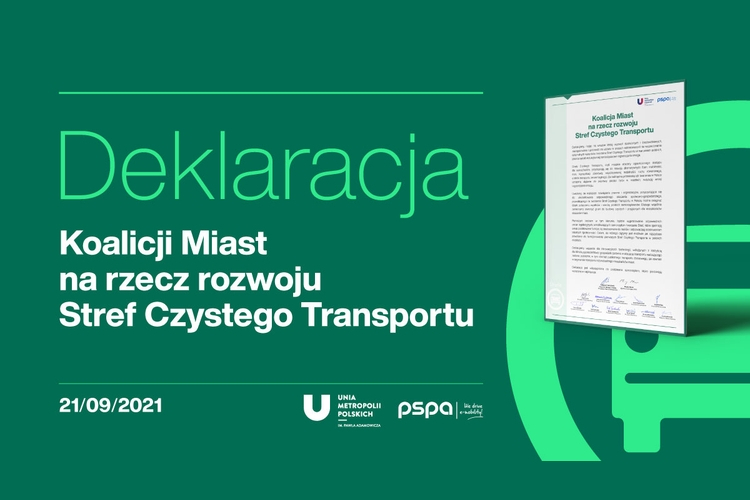
The Union of Polish Metropolises, together with the Polish Alternative Fuels Association and local governments, has signed a declaration for the development of Clean Transport Zones. Key demands defining the directions for legislative changes were also indicated, which will enable the socially acceptable and effective creation of Zones in Polish cities. The number of vehicles in Poland has increased by nearly 40 percent over the last decade.
– The quality of life for city residents depends on our actions, and today it is crucial to reduce pollutant emissions and noise. The simplest way to achieve this goal is through clean transport zones. For local governments to create them effectively, statutory regulations must be changed. When designating CTZs, local governments must adapt them to local economic and social conditions – says Adam Wieczorek, Deputy Mayor of Łódź. – From the point of view of local government units and residents, the most important thing is a gradual, time-spread introduction of further restrictions. So that, among other things, residents are given time to adapt to these requirements.
In order to facilitate the creation of low-emission areas through the introduction of appropriate legislative changes, the Union of Polish Metropolises, the Polish Alternative Fuels Association (PSPA), and local governments have signed the Declaration of Cities for the Development of Clean Transport Zones. The new initiative will create the groundwork for building clean and resident-friendly urban areas. In a consultation format, the UMP, PSPA, and local government representatives have developed proposals for key changes to the Act on Electromobility and Alternative Fuels so that it is possible to create Zones that are both effective and socially acceptable.
– As part of the Coalition, PSPA and local governments are joining forces to reduce pollution and noise in Polish cities. Zones are an effective tool leading to this goal, as proven by numerous foreign examples. There are already over 250 such areas operating in Europe. Poland remains a blank spot on the map of the Old Continent in this regard. The creation of the Coalition is an important moment and a symbolic transition from words to deeds. Taking into account the demands developed within the Coalition will significantly accelerate the implementation of clean zones in cities – says Maciej Mazur, Managing Director of the Polish Alternative Fuels Association (PSPA).
To maximize the positive ecological effects of Clean Transport Zones, it is primarily necessary to enable their creation in smaller municipalities as well. To this end, among other things, the provision in the Electromobility Act stating that CTZs can only be created in cities with 100,000 inhabitants should be deleted. Taking into account social and economic conditions, the legislator should also allow conventional vehicles that meet appropriate emission standards according to Euro classification to move within the zone area, assuming the progressiveness of the zones and their gradual closure to combustion vehicles.
Cities should also have the possibility of creating several zones with different criteria taking into account local conditions, as well as the possibility of creating “zones within a zone,” i.e., places where stricter requirements would apply. While setting maximum fee rates for entering a zone with a vehicle that does not meet the requirements should be left to the legislator, the entire set of rules for allowing such vehicles into the zone should be determined by the local government. Statutory regulation should also be supplemented with provisions guaranteeing that the creation of a CTZ will take place in a manner ensuring the participation of residents of the area where the zone is to be designated.
According to Statistics Poland (GUS) data, 9 million vehicles have been added in Poland over the last decade: in 2010 there were 23 million, and in 2019 already 31.989 million. The increase compared to 2010 is nearly 40 percent.
Legal aspects of CTZs
Let us recall that on August 22, 2018, more than three years ago, the provisions of the Act on Electromobility and Alternative Fuels entered into force, and with them the possibility of designating clean transport zones (CTZ) in cities with over 100,000 inhabitants. To this day, not a single such zone is operating in Poland. Mainly because the current legal regulations in this area do not allow for their effective designation. On one hand, they are too strict, because they allow only zero-emission cars to move around the zone (without any restrictions). On the other hand, they exclude vehicles of zone residents from the application of CTZ regulations.
In February 2021, the European Commission called on Poland to meet the requirements contained in the Directive on ambient air quality and cleaner air for Europe. It indicated, among other things, that in the Upper Silesian, Krakow, Warsaw, and Wroclaw agglomerations, the level of nitrogen dioxide from road transport has been exceeded many times. At the same time, in July of this year, the Ministry of Climate announced that after a year of work, it is withdrawing from the planned amendment to the Electromobility Act and CTZ regulations.
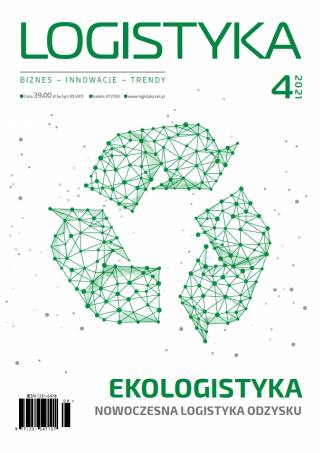
More articles on ecological solutions, not only at GLS, can be found in the magazine LOGISTYKA 4/2021.
The e-edition of the magazine is available in our offer!
Stay up to date, order a subscription to LOGISTYKA magazine!