








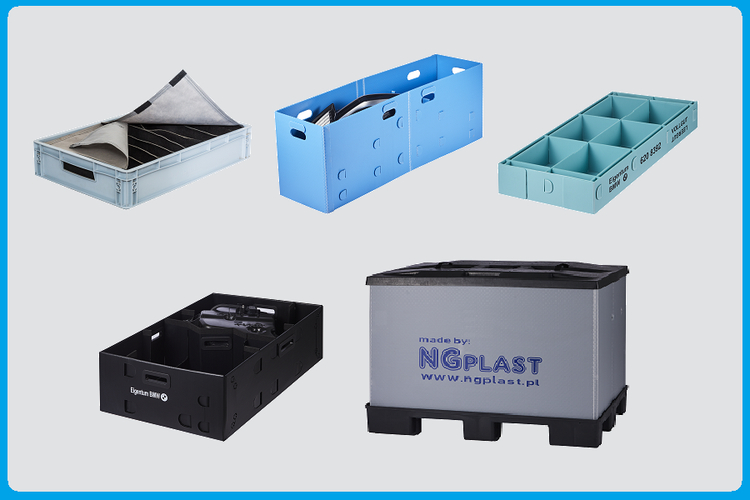
Packaging used in the automotive industry is subject to a number of requirements. Discover the five most important features of packaging for the automotive sector.
1. Durability
Containers and packaging used by the automotive industry must demonstrate high durability and utility across many process cycles. Most commonly, reusable packaging made of plastics is used for this purpose. Polypropylene sheets are a frequently used material that ensures proper robustness while remaining cost-effective. Specially designed and manufactured packaging made from PP sheets is also combined with other materials or additionally reinforced. Thanks to custom design and production tailored to specific requirements, plastic packaging guarantees proper durability and serves through many cycles.
2. High level of protection
No one doubts that expensive parts and components are used in car production. Most elements are delivered to the main assembly plant from subcontractors and other factories. All these elements require proper protection and security against damage during transport. Accountants, who often, to our dissatisfaction, cut costs in newly emerging car models, would not be pleased if additional expenses arose regarding defective components caused by insufficient protection during transport. Transport packaging for automotive parts and components is subject to strict restrictions. Properly constructed packaging made of durable materials, featuring appropriate security measures and accessories, e.g., with additional padding, soft dividers, etc., guarantees the highest protection.
3. Fit
Automotive parts, components used for production, and entire sub-assemblies, due to their physical structure, require appropriately fitted packaging. Corporations strive as much as possible for unification, using the same sub-assemblies in many models. Nevertheless, for obvious reasons, every brand and every model differs, just as subsequent generations of the same models do. For the automotive industry, the ability to produce dedicated packaging effectively and cheaply is crucial. Modern plastic packaging factories are able to meet such tasks by using appropriate materials, their processing, innovative technologies, and machinery.
4. Ecology
The world has realized the gravity of the situation and the impact of global economies on the planet. Every manufacturing activity has an impact on the environment, both in the production process and as a result of the materials and items produced. An undeniably positive action is the pursuit of the lowest possible environmental burden. This is required by economic consensus, public opinion, and regulations. The automotive industry is increasingly using organic, biodegradable, recycled, and ecologically recyclable materials in production. The ecological aspect is also important in the packaging and logistics industry. Today’s transport packaging and containers for automotive are made of fully recyclable plastics. Manufacturers are also constantly developing innovative materials and ecological solutions that are just as good and durable, while being as environmentally friendly as possible.
5. Economy
Let no one be misled by the last position of this aspect. We are not ranking the importance of the features mentioned here. The cost-effectiveness of packaging is very important, often dominant in the overall picture. Generally, it is about achieving the best possible compromise between the four features above and the question of how much it costs.
Wherever possible, reusable packaging is used. Even though it is more expensive per unit than single-use packaging, in the overall picture and assuming long-term operation, such solutions are simply cheaper. Additionally, they allow for the best compromise between durability, protection, fit, and ecology. The issue of reusable transport containers in the automotive industry is well-proven. Considering the number of usage cycles, using a new cardboard box each time, even with approximate strength values, plus its disposal, calculates worse than the repeated use of a dedicated plastic container.