








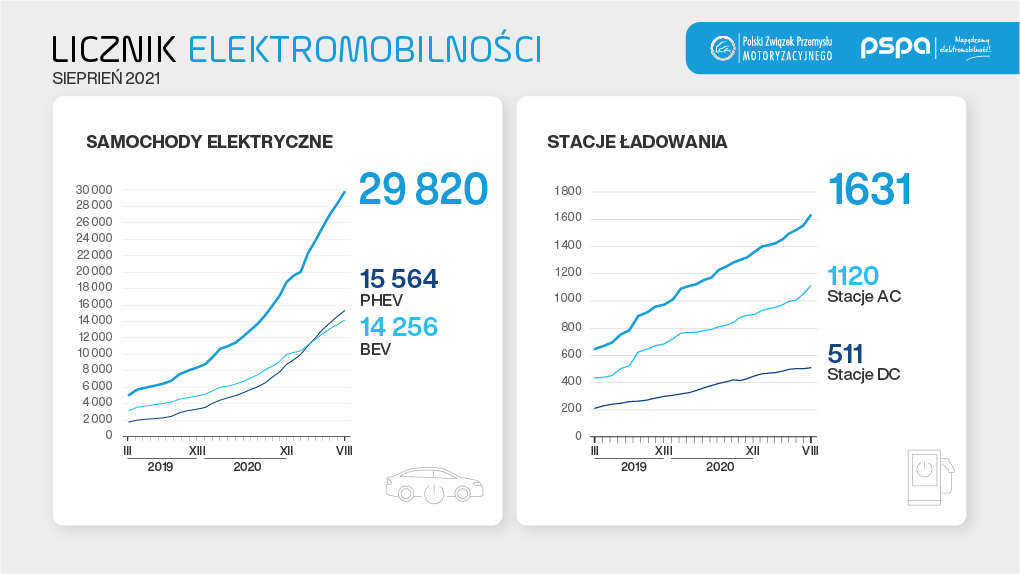
According to data from the end of August 2021, a total of 29,820 electric passenger cars were registered in Poland. During the first eight months of this year, their number increased by 11,084 units, i.e., 130% more than in the same period of 2020, according to the Electromobility Meter launched by PZPM and PSPA.
At the end of August 2021, there were 29,820 electric passenger cars on Polish roads. Fully electric vehicles (BEVs) accounted for 48% (14,256 units) of this part of the vehicle fleet, and the remainder (52%) consisted of plug-in hybrids (PHEVs) – 15,564 units. The fleet of electric delivery and heavy-duty vehicles numbered 1,125 units. The fleet of electric mopeds and motorcycles also continues to grow, consisting of 11,425 units at the end of August, as well as the number of hybrid passenger and delivery cars, which increased to 283,863 units. At the end of last month, the fleet of electric buses in Poland grew to 578 units. From January to August 2021, the electric bus fleet grew by 146 zero-emission vehicles. Compared to the same period in 2020, when 114 such buses were registered, this represents a 28% year-on-year increase.
Along with the increase in the number of electric vehicles, charging infrastructure is also developing. At the end of August, there were 1,631 publicly accessible electric vehicle charging stations (3,178 points) in Poland. 31% of them were fast DC charging stations, and 69% were slow AC chargers with a power of less than or equal to 22 kW. In August, 74 new publicly accessible charging stations (141 points) were launched.
– Considering electric drives, the results after the first eight months of this year show a clear increase in plug-in hybrid sales. While a year ago battery-powered cars were selling significantly better, for several months now it is plug-in hybrids that have been attracting customers’ attention. This is due to the fact that these cars combine the advantages of an electric drive, which works perfectly for city driving (provided the car is charged regularly), and an internal combustion engine for longer routes. Poland is no exception here, as we are observing a similar trend across Europe. It is very pleasing that after a periodic decline in electric bus registrations, there has been an upward trend of 28% compared to 2020. This means that the impact of the pandemic on city budgets and decisions regarding the purchase of bus fleets did not turn out to be as radical as we feared – says Jakub Faryś, President of PZPM.
– While 61 publicly accessible charging stations were launched in Poland in the first quarter and 93 in the second quarter, the number of newly installed chargers in the following two months reached 110 units, including as many as 74 in August. In total, in 2021, electric car drivers in Poland gained access to 264 new stations, which is 60 more than in the same period last year. It is worth emphasizing that the development of infrastructure is taking place not only in terms of quantity but also quality. There are already about 100 DC chargers with a power of over 50 kW operating in Poland, and according to the declarations of leading operators, a number of further DC charging stations are planned to be commissioned, including ultra-fast points – says Maciej Mazur, Managing Director of PSPA.
Source: PSPA