








What is export, types of export under VAT law, tax preferences in export, chain transactions.
The concept of export is defined under tax law (VAT and excise tax). In the case of accompanying customs formalities, one speaks only of customs procedures:
– export (applies to goods with Union status), or
– re-export (applies to non-Union goods, i.e., imported from outside the EU and not cleared for customs – e.g., those under the customs warehousing procedure).
Why, however, in the case of export, does the risk and economic significance of this venture concern mainly tax, and not customs duty?
 Roman Andrzejewski, expert at the Łukasiewicz – Institute of Logistics and Warehousing:
VAT on the export direction is covered by preferences identified with a zero tax rate. Such a rate level reduces the tax liability to zero. It is similar in the case of customs duty – it also does not occur in export (resulting from the lack of customs rates on goods exported from the EU), which seemingly balances both solutions in terms of financial burdens. However, the zero VAT rate is conditional, and in the event of a breach of the rules for its application, it leads to the assessment of VAT at the standard rate for a given good, along with interest. Such a risk does not exist in customs duty. Here, the canons of customs policy apply, according to which no customs duties are established on exports. This results both from the rules of international trade and the desire to seek new sales markets. Potential customs duties could thwart this.
What else distinguishes customs duty from taxes in export? These are the sources of establishing both levies. The customs policy responsible for customs duty is of a pan-Union nature (it is created by the European Commission), whereas the sphere of taxes is national in nature, and even when created within the framework of EU directives (requiring only the implementation of general principles), it shows greater susceptibility to the economic conditions of a specific country, pathologies occurring there, and takes into account the behavior and creativity of taxpayers.
At the same time, it should be emphasized that the definition and effects of export also depend on the nature of a given tax. In the case of VAT, export means the supply of goods dispatched or transported from the territory of the country outside the territory of the European Union. Such a supply entitles one to apply reliefs in the form of the already mentioned zero tax rate. In turn, under excise duty, export is the act of exporting excise goods or passenger cars, which turns into the right to a refund of excise duty if it was previously paid within the country.
Furthermore, export under VAT mainly covers goods sold (this results from the concept used in the definition – supply), whereas in the case of excise duty, it concerns not only a specific product (excise product or passenger car) but covers all operations related to the removal of goods. Therefore, the nature of the actions behind this (sale, entrustment, lending, etc.) is irrelevant.
The above premises mean that in the further part of the article, we will focus on taxes in export as those that play a significant role and usually indicate the success of the transactions associated with them.
Types of export under VAT law
As follows from the definition of export, it can be carried out by:
– the supplier or on their behalf (in literature, it is also called direct export), or
– the purchaser having a registered office outside the territory of the country or on their behalf (in literature, it often takes the name of indirect export).
It follows from the above that the exporter can be the seller themselves, the manufacturer, or an intermediary in the case of a chain transaction.
The exporter, regardless of the type of transaction in which they participate (single transaction, multilateral or chain transaction), is responsible for the transport sphere of the shipped goods. In the past, it was identified with INCOTERMS delivery conditions, and today it is examined in the context of individual activities consisting of the shipment or transport of exported goods. According to the new definition of an exporter and tax interpretation no. 0112-KDIL1-3.4012.357.2019.2.PR, activities such as the following can be considered transport:
– coordination of the flow of information regarding the status of the shipment (readiness for shipment) within the organizational structure (informing, e.g., the customer service department),
– preparation of documentation regarding the transaction being carried out, both accounting – VAT invoices, and logistics/warehouse – packing list,
– organizing the technical aspects of the transport of goods, including in particular:
– setting the date and time of collection of goods from the company’s warehouse,
– contact with the carrier and/or the purchaser on an ongoing basis, in case of problematic issues arising, e.g., related to production delays,
– determining the appropriate type of means of transport (size, type of vehicle),
– determining the appropriate customs office,
– assigning an arrival number for loading,
– preparing/issuing own CMR documents,
– collecting transport documents: AWB and BL, obtaining the IE-599 message,
– managing the process of preparing goods for shipment, including in particular:
– packing the goods in a way that limits the probability of damage,
– loading the goods onto the means of transport provided by the carrier (all activities related to loading the goods),
– appropriate marking of the transported goods,
– warehousing of goods until they are collected by the carrier,
– performing customs clearance (within the implemented delivery model, the company acts as an exporter and also appears as the exporting entity in the content of received customs documents (IE-599 message).
Tax preferences in export
All activities having the characteristics of indirect or direct export are covered by preferences in the form of a zero VAT rate. The condition for applying this rate is obtaining in due time (by the time of filing the tax return for a given settlement period) evidence confirming the export of goods outside the EU. Currently, this can be:
– the IE-599 message obtained from the electronic customs declaration system, or
– alternative evidence mentioned in Art. 335 of Regulation No. 2446/2015.
In the case of indirect export, it is also necessary to link the transactions behind it with the export clearance document. This is done by indicating in the customs declaration both the sales invoice for export outside the EU and the transaction preceding it. In the case of the latter, it must be disclosed in the customs declaration under code 4PL06, providing the seller’s NIP number (indirect exporter) and their invoice number.
Export and its taxation in chain transactions
Export accompanies all chain and multilateral supplies, the finale of which is the removal of goods outside the EU. It also often involves a very complex supply scenario, with the transport of goods usually taking place between the first and last entity in the supply chain. Therefore, if, for example, four participants take part in a transaction and only one transport route is defined, even with transshipment at a border port, the scheme of such a venture looks as follows:
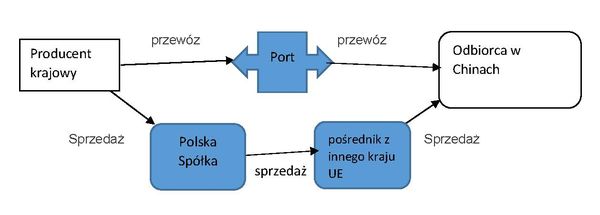 Source: own study.
In the state of affairs outlined above, bearing in mind the tax-customs aspect, it is necessary to determine which of the three transactions (Manufacturer -> Polish Company, Polish Company -> EU Intermediary, EU Intermediary -> China) can be assigned the effect of export outside the EU, i.e., to determine which of them is a moving transaction. Only to such a transaction, and thus also to its participant, will it be possible to assign the value related to the obligation to perform customs clearance and to recognize this transaction under tax law as an export. Consequently, only to this transaction and the transaction immediately preceding it will it be possible to assign the right to apply the tax preference in the form of taxing the transaction with zero VAT.
Note! The subject preference will not be able to occur when the intermediary has a registered office in Poland or is registered here for VAT purposes and indicates this number for the purposes of the transaction.
The circle of potential entities interested in obtaining the right to the described relief can be narrowed down to the Polish Company and its EU partner (intermediary). Each of them is interested in exporting goods to China on the above-mentioned terms. The EU intermediary because they must fulfill a commercial contract for sale to China at a set price (net price without Polish VAT), and the Polish Company because they want to tax the transaction at a zero VAT rate (otherwise they will lose the chance for cooperation with the EU intermediary, and thus for any sale). Certainly, the domestic manufacturer should be excluded from this function, even if they deliver their goods to the border port. This manufacturer, and specifically their contract with the Polish Company, will concern only domestic supplies neutralized tax-wise by deducting the output tax in the VAT return. As for which of the previously mentioned entities (Polish Company, EU intermediary) will be recognized as the exporter and who will bear the obligation to perform customs clearance, this will be decided by the responsibility for the transport sphere leading to the export of goods from the EU (transport from the port to China).
As shown earlier, their transaction (direct export), as well as the preceding transaction (indirect export), can count on tax preferences, although the fulfillment of the conditions entitling to these preferences will belong only to the duties of the person performing the customs clearance (vide point 3). That is why it is so important to correctly establish the above-mentioned roles, especially since in the case of an EU intermediary, they may not know Polish customs systems, local jurisdiction, or legal conditions. Without their efficiency and effectiveness in acting as an exporter, the chance for taxing foreign supplies with the application of tax relief may fail.
Summary
Customs clearance should be performed for the entity whose sale leads to the removal of goods (EU intermediary) or another entity that, due to the delivery terms, is the organizer of transport in this regard (this may be a Polish company if it coordinates all transport, transshipment, and loading processes related to the export).
In a situation where the EU intermediary is recognized as the exporter (the Polish Company is not interested in the function of transport manager), it will become a necessity on the part of the indirect exporter (Polish Company) to secure the fulfillment of conditions entitling to tax their transaction at a zero VAT rate. This can be done by:
– assuming the role of a customs representative – of the EU intermediary with the possibility of further assignment of authorization to a customs agency,
– including appropriate protective clauses in the commercial contract with the aforementioned intermediary, guaranteeing the correct fulfillment of all customs formalities and the provision of appropriate proof of export.
The above solutions will allow for the removal of the previously described shortcomings related to ensuring the appropriate content of the customs declaration or the correctness of the circulation of customs documents needed to settle VAT in export with the application of the described reliefs.
Read also about issues related to customs procedures:
– Origin of goods, customs preference and rules of origin
– Material services outside the territory of the European Union
– Effects of Brexit for entrepreneurs and carriers
– Foreign trade – its character, nature and types