








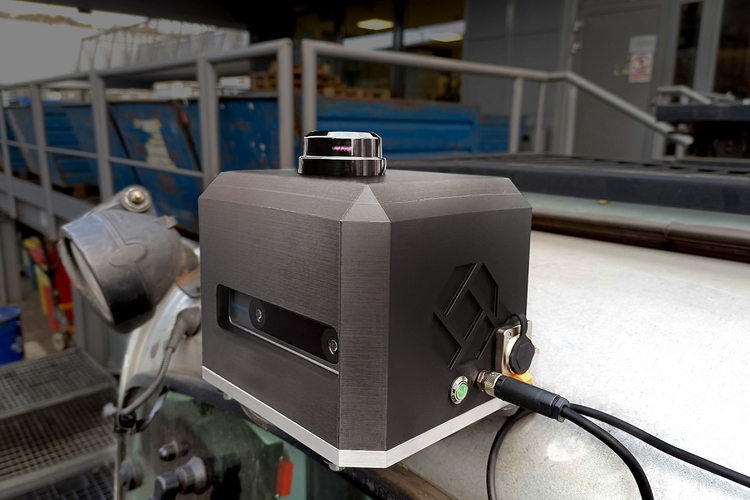
Digitalization of processes covers an increasing number of tasks that, in the manufacturing sector, have until now been in human hands. These two worlds, humans and machines, are being bridged by the startup Optimatik, which, as part of the S5 – 5G Technology Accelerator at the Łódź Special Economic Zone and with the support of Ericsson specialists, is developing a proprietary 5G platform for optimizing fleets of autonomous vehicles and traditional forklifts, revolutionizing internal logistics in industrial plants and logistics centers.
– Currently, all AGV (autonomous intralogistics vehicle) suppliers offer dedicated systems for monitoring and diagnosing their vehicles. However, the data available in these platforms is limited only to AGV vehicles. They do not measure the movement of vehicles operated by employees, which still account for over 98% of intralogistics machines, which greatly limits the functionality of such platforms. Additionally, each such system only allows for monitoring vehicles from a single AGV manufacturer. Meanwhile, the market standard in large manufacturing plants is to use vehicles from various suppliers. The Optimatik 5G Intralogistics Platform we are developing is unique on an international scale and is used for the simultaneous monitoring of traditional vehicles and AGVs from various manufacturers in a single application. This is the first step toward efficient digitalization of intralogistics processes – explains Radek Miszczak, CEO and co-founder of Optimatik.
The analog forklift becomes “smart”
On one hand, Optimatik is creating a platform for integrating internal logistics, and on the other, it is turning analog forklifts into intelligent machines. Thanks to cooperation with the Austrian technology startup SLOC, which installs IoT peripherals on forklifts, the Optimatik 5G Intralogistics system can collect diagnostic data from them, see if the forks are raised or loaded, whether the vehicle is in motion, and track other machine operations. All this data was previously unavailable to internal logistics specialists, yet it is a source of critical insights for them. In turn, the Austrian startup Insider Navigation provided the solution with a positioning algorithm that does not require the installation of any active devices in the factory, such as antennas, gateways, or beacons.
The system also analyzes data from traditional forklifts and AGV vehicles for potential problems. In every factory where traditional vehicles and robots work simultaneously, many situations that reduce the efficiency of the intralogistics process occur frequently. These include collisions between traditional forklifts and AGVs or emergency stops of AGVs causing bottlenecks. Data regarding these types of incidents allow for the improvement of the division of labor and transport orders in order to eliminate problems.
5G takes intralogistics to the next level
As part of the ŁSSE S5 acceleration program, the startup Optimatik is currently working on real-time alerting. Such a solution will enable a forklift operator to react immediately to an event.
– Due to the volume and weight of the transmitted data, 5G connectivity is essential for this. Supporting the needs of Industry 4.0 was at the heart of 5G design. Requirements regarding network throughput, a large number of simultaneously connected devices in a relatively small area, mobility, and guaranteed low latency are extremely difficult, and often even impossible to meet even by industrial WiFi networks. That is why more and more companies will opt for private 5G networks. Research suggests that internal logistics and the use of autonomous vehicles for this purpose will be the first field of 5G application in industry. This area alone can allow for achieving a return on investment in an internal 5G network – explains Tomasz Kobza, an expert at Ericsson, who serves as a mentor in the S5 – 5G Technology Accelerator program.
– Thanks to the 5G network, we will be able to implement the most competitive solution on the market that is optimal from the customer’s perspective, based on edge computing. Our sensors will be able to send collected data in the 5G band directly to a local computing system. Thanks to this, we will not have to mount local computing units on forklifts, which reduces their production cost by about 17%. Gaining access to wider 5G network bandwidth will significantly increase the attractiveness of our solution in the eyes of customers. We will be able to attach additional information sources to our onboard computer and send more data in real time. Additionally, 5G connectivity, thanks to low data transmission latency, allows us to communicate bidirectionally with devices. This includes downloading data for analysis and simultaneously sending commands to the device, e.g., reduce speed, stop, start charging. 5G infrastructure is an essential part of the digital transformation of every plant. Only such a wide network allows for transmitting data from several hundred measured vehicles simultaneously in real time – explains Jerzy Lipiński, Product Owner and co-founder of Optimatik.
A demonstration version of the Optimatik 5G Intralogistics Platform, integrating the work of forklifts and AGVs from Mobile Industrial Robots, distributed by ASTOR, can be seen in Poland’s largest Industry 4.0 showroom: hub4industry at ul. Feliksa Wrobela 3 in Krakow.
Startups accelerate 5G in Poland
The S5 Accelerator in the Łódź Special Economic Zone acts as a real industrial ecosystem, in which 40 startups and five industrial partners participate – Polkomtel, Miele, PGE, Indigo, and Wielton.
– The S5 pilot is a natural continuation of the many years of ŁSSE’s efforts to bring Polish industry to a new level. We listen carefully to our investors and look for areas to improve their production or logistics operations, which results in projects like Optimatik. 5G will revolutionize industry, and we want to be a leader in implementing innovations based on this technology – says Agnieszka Sygitowicz, Vice President of ŁSSE SA.
– The ŁSSE 5G Lab, which was established on our premises, is tangible proof that we take innovation and the idea of implementing Industry 4.0 very seriously – emphasizes Marek Michalik, President of the Management Board of ŁSSE SA.
Ericsson designed and provided the equipment needed to launch an internal 5G network on the campus of the Łódź Special Economic Zone. The company’s experts also provide individual knowledge transfer, not only to Łódź Zone specialists but also to business partners and, above all, to startups cooperating with ŁSSE. Ericsson in Poland, together with the Łódź Special Economic Zone and the Lodz University of Technology, cooperates with the academic community, startups, enterprises, and telecommunications operators to enable the first industries in Poland to implement new products and services based on 5G technology.
Source: Ericsson