








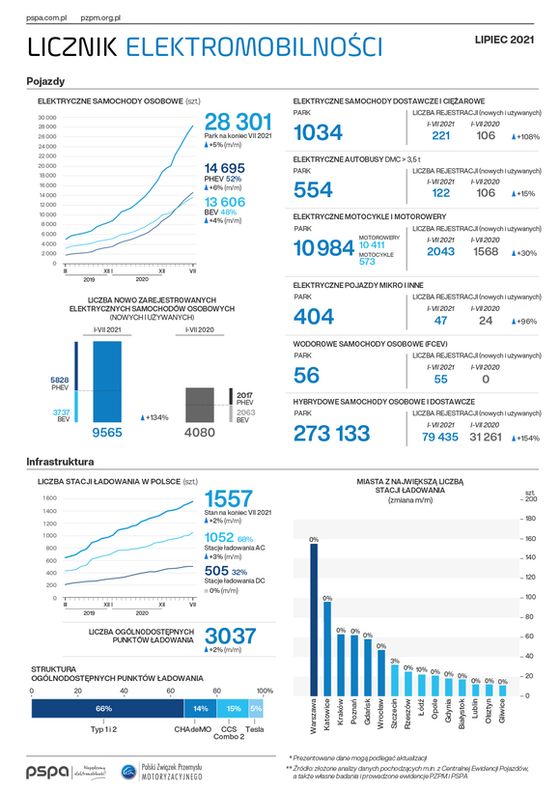
According to data from the end of July 2021, a total of 28,301 electric passenger cars were registered in Poland. In the first seven months of this year, their number increased by 9,565 units, i.e., 134% more than in the same period of 2020, according to the Electromobility Meter launched by PZPM and PSPA.
At the end of July 2021, there were 28,301 electric passenger cars on Polish roads. Fully electric vehicles (BEVs) accounted for 48% (13,606 units) of this part of the vehicle fleet, and the remainder (52%) consisted of plug-in hybrids (PHEVs) – 14,695 units. The fleet of electric delivery and heavy-duty vehicles also continued to grow, numbering 1,034 units. The fleet of electric mopeds and motorcycles also continued to grow, consisting of 10,984 units at the end of July, as did the number of hybrid passenger and delivery vehicles, which increased to 273,133 units. At the end of last month, the fleet of electric buses in Poland grew to 554 units. From January to July 2021, the electric bus fleet increased by 122 zero-emission vehicles. Compared to the same period in 2020, when 106 such buses were registered, this represents a 15% year-on-year increase.
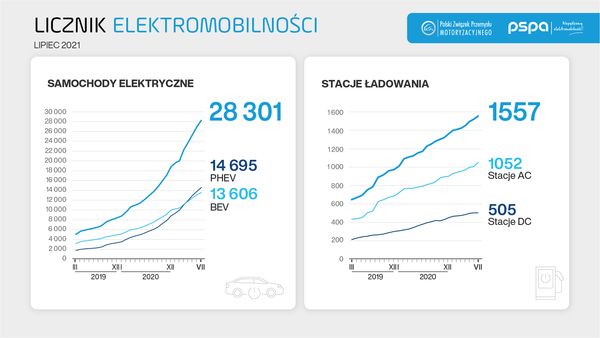
Along with the increase in the number of electric vehicles, charging infrastructure is also developing. At the end of July, there were 1,557 publicly accessible electric vehicle charging stations (3,037 points) in Poland. 32% of them were fast DC charging stations, and 68% were slow AC chargers with a power of 22 kW or less. In July, 36 new publicly accessible charging stations (73 points) were launched.
– In recent months, a higher number of plug-in hybrids than fully electric cars have been registered on the Polish market. This is a trend that was also observed in the first half of 2021 in countries such as Germany, Spain, and Italy. BEVs, on the other hand, hold an advantage in the Netherlands, France, and the UK. In Poland, the higher share of plug-in hybrids is primarily a result of a richer model offering (82 PHEVs to 68 BEVs), the insufficient level of development of publicly accessible charging infrastructure, and the fact that many companies have put their fleet replacement plans on hold while waiting for the launch of subsidies from the “My Electrician” program. All these factors are temporary, but ensuring access to chargers for people who do not have the ability to charge an electric car from a private energy source remains a particularly significant challenge – says Maciej Mazur, Managing Director of PSPA.
– Given the availability and growing range of electric car and plug-in hybrid models, such a dynamic increase in their registrations is not surprising, but the increase – by nearly one and a half times – in hybrid car registrations is just as significant. Equally good news is the increase in registrations of electric city buses. This means that despite the pandemic and still limited use of public transport, local governments, when deciding to replace their fleets, are increasingly choosing to buy electric buses. Even more noteworthy are the nearly two-fold increases in registrations of electric delivery and heavy-duty vehicles. This shows how much courier and transport companies care about ensuring that vehicles providing services mainly in cities are environmentally friendly. Observing how dynamically the number of electric car and plug-in hybrid models among delivery vehicles is growing, one can hope that this trend will strengthen – says Jakub Faryś, President of PZPM.
Source: Polish Alternative Fuels Association