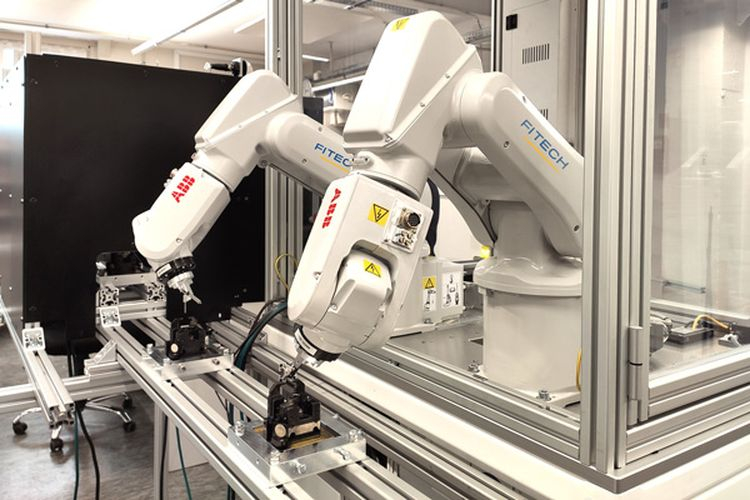
Advanced robotics combined with automation technologies and educational modules enable tasks to be performed with greater precision than ever before and increase productivity in the industry. Although many robotics technologies, such as artificial intelligence or IoT, are still in their infancy, it is still a colossal leap compared to what the industry had at its disposal back in the late 1980s. What does production process automation look like in the automotive industry today? What challenges does it have to face?
Collaborative robots, robotic arms, and the Internet of Things combined with artificial intelligence are already producing a large portion of car chassis, powertrains, and other components in many companies, with the exception of a few simpler parts that can be made by humans. Production process automation is happening before our eyes. The robots that have mastered the automotive industry today handle even the most complex production tasks and perform them several times faster than humans. This is especially true as it is becoming increasingly difficult to find qualified production operators. This is one of the reasons why more and more processes in factories are being automated. The lack of labor is becoming increasingly acute. And when demand exceeds supply, production process automation becomes a real remedy for these problems.
Production process automation for the sake of people
The automotive sector provides direct and indirect jobs for 13.8 million Europeans, which accounts for 6.1% of total employment in the EU. Interestingly, only 2.6 million people are directly employed in the production of motor vehicles. This means that the automotive industry not only directly employs a large number of production workers but also creates additional jobs in other sectors of the supply chain.
– The birth rate curve shows how the labor market will shape up in the future. It is clearly visible that the number of births is falling year by year, not only in Western Europe but also in Poland. There is, therefore, no other way than production process automation. The faster and better we prepare for these challenges today, the more efficiently companies will operate in the future – notes Artur Burian, a manager at Fitech.
Quality counts
The first production line was launched over 100 years ago. Since then, the number of cars on the roads has increased dramatically. Production process automation in the automotive industry today is not just a response to the scale and capacity of the market. Efficiency and high quality are essential. Sensitive systems, manufactured in factories and then installed in cars, directly affect human safety. Companies are well aware of this. As research results show, more than 90% of companies in this industry are automating. The automotive industry is also one of the fastest-growing in terms of robot usage. What other technologies are important here?
– Testing stations are becoming an increasingly important element. They verify not only whether the product is well-assembled but also whether it works correctly. Knowledge on this subject allows avoiding, for example, costly servicing. Equally important are traceability systems, i.e., the process of tracking and identifying a product, which, combined with database systems, allows for archiving all production parameters of the components being built – explains Artur Burian from Fitech.
A pioneering industry in the field of production process automation
Automotive was one of the first industries to use vision systems on the production line. Those currently in use perform many functions, are developing very rapidly, and have increasingly greater capabilities. One of them is checking whether the product has been assembled completely and correctly. What is important for car manufacturers and their components? The most important thing is production stability. The product life cycle is short today, and high dynamics force flexibility on the production line, which must be ready for further modifications. The ability to adapt to changes is important, so a dynamic reaction from the supplier is key here. Production process automation definitely facilitates this.
Source: Fitech
Read more about automation:
– GEFCO tests ProovStation automated vehicle inspection system
– Warehouse safety in the foreground
– FM Logistic invests in autonomous robots in warehouses
– Mobile Industrial Robots has published the results of research on intralogistics automation
– Automation strategy
– Blaklader hires robots
We wrote more about automation in Logistyka magazine no. 1/2020.
The e-edition of the magazine is available in our offer!