








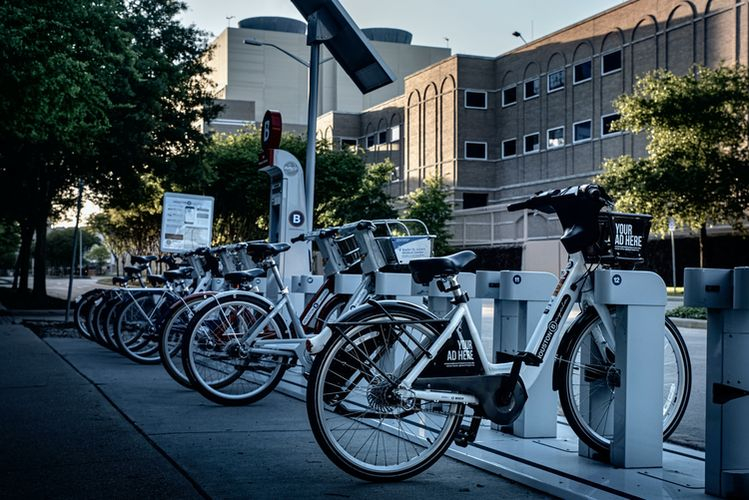
By 2050, 70% of the world’s population will live in cities1. As this number grows, along with awareness of the threat posed by climate change, there is an increasing demand for mobility solutions that have a lower environmental impact. A 2019 McKinsey study predicts that with urbanization, the value of the micromobility industry, which offers communication and transport services over short distances, will reach $300-500 billion by 20302. What impact will this have on the market for bicycles, e-bikes, and e-scooters? Was COVID-19 a growth accelerator, and what challenges accompany supply chain management for this market?
Fluctuations in the shared mobility market
The demand for shared means of transport, such as electric bicycles, scooters, and mopeds, has increased significantly over the last few years. As many as 46% of residents in the Paris Region admitted that in 2019 they reduced the number of taxi rides in favor of renting scooters3. However, the COVID-19 pandemic reversed this trend and caused public reluctance to use shared means of transport for fear of infection. In 2020, the EU recorded a decline in such services of 21-59% for bicycles and over 60% for electric scooters4. Preferences regarding the choice of a shared mobility system are distributed as follows: 51% of people choose a bicycle, 37% an electric bicycle, and 12% an electric scooter5.
Production
The production of electric bicycles, electric scooters, and their components has traditionally taken place in China. However, anti-dumping duties and local demand have recently led to a diversification of production locations. As emphasized by specialists at GEFCO, a global expert in integrated logistics and a European leader in logistics for the automotive industry, the micromobility industry’s dependence on China for components has made this market very vulnerable in light of the coronavirus pandemic.
As a result of the imposition of anti-dumping duties on exported products in the second quarter of 2020, China recorded a drop in electric bicycle sales from 660,000 to just 107,0006. Since then, countries such as Taiwan and Vietnam have become leading exporters of these types of vehicles to the EU7.
In 2019, EU countries exported 138,000 electric bicycles, which is an increase of almost 16% and further proof of the diversification of production locations. In the case of regular bicycles, EU member states (excluding the UK) produced 11.4 million vehicles in 2019, an increase of 5% compared to 2018. This is the result of locating assembly and production in this area, as well as anti-dumping duties imposed on e-bikes shipped from China8.
Vehicle sales
Demand for bicycles, electric bicycles, and scooters increased during the coronavirus pandemic as people avoided public transport and shared means of transport for fear of infection. The more frequent choice of these vehicles also stems from an increased interest in sustainable mobility among city dwellers and greater awareness of issues related to physical activity. For example, in the Netherlands, which is perhaps the most famous bicycle-friendly country, e-bike sales increased by 50% from March to June 20209. Bicycle sales increased by 25%.
The European Cyclists’ Federation estimates that by 2030, the number of electric bicycles in use will grow to 62 million compared to 6.5 million in 201510. Additionally, the market for these vehicles is expected to generate approximately $20 billion in revenue by 202311.
The electric scooter market is developing just as dynamically. In France alone, during Black Friday in 2020, about 260,000 people typed the word “scooter” into a search engine12. Bird, a company offering such vehicles as part of shared transport, launched the Bird Air electric scooter model for sale in September 2020, which suggests increased demand for such a product used mainly in a sharing system. Another confirmation of this popularity is the sales results of Razor electric scooters, which grew by 81% year-on-year.
Bicycle boom related to the coronavirus pandemic
It was not only the UK that experienced a sales increase during the pandemic. In Denmark, the retail sales index for bicycles and mopeds was almost 110 in October 2020, an increase of more than 30 points compared to the previous year13.
It seems that the pandemic also influenced where people buy bicycles. 24% of bicycles sold in Spain came from specialized stores, while other sports retail chains can boast a result of 17%14. In Poland, during the pandemic in 2020, bicycle sales results broken down by type were as follows: 39,991 units sold were city bikes, 37,575 units were children’s and youth bikes, and 27,174 units were mountain bikes. Electric bikes took fifth place with 2,400 units sold15.
Supply chain challenges
According to GEFCO specialists, the six main logistics challenges in the bicycle and two-wheeled electric vehicle market are global sourcing and distribution, supply chain management to respond to increased seasonal demand, new distribution channels related to the development of e-commerce and urban mobility, battery supply management for electric bicycles and scooters, product differentiation in terms of size and weight, and cost-efficiency and CSR issues.
Understanding how electric bicycle and electric two-wheeler manufacturers operate and their specific requirements is the basis for meeting the most important logistics challenges of this market. In addition to full 24/7 flow visibility, a logistics operator must efficiently manage the supply chain during seasonal demand spikes. That is why companies like GEFCO must often create bespoke flow architectures, taking into account the choice of transport modes or international trade regulations, which allows for minimizing transit time. Equally important is flexible warehouse space management and good organization of last-mile transport, i.e., from the warehouse to retail points in the sales network.
The future looks bright
Favorable regulatory changes and a shift in consumer awareness will likely lead to a steady increase in demand for sustainable mobility systems. Even in the current situation, as shared transport returns to normal after the pandemic, retail sales of bicycles, e-bikes, and e-scooters will continue to grow, as local suppliers are becoming strong competitors due to the diversification of production locations. EU investments in projects related to the development of cycling will increase to $3 billion in 2027 and up to $6 billion by 203416.
Changes are also visible in consumer attitudes. In a Berg Insight Survey, 30% of respondents stated that they want to continue using a bicycle and walking more after the pandemic17. In turn, as many as 70% of respondents to another study would consider purchasing a private e-scooter for commuting purposes18. Along with changing awareness, cities’ approaches to cyclists are also changing19: In Milan, 35 km of streets were converted into pedestrian zones and cycle paths, 40 km of new cycle lanes were built in Brussels, and as many as 50 km of car roads were converted into cycle paths in Paris.
1 Population Reference Bureau, https://www.statista.com/statistics/270860/urbanizationby-continent/
2 McKinsey, https://www.mckinsey.com/industries/automotive-and-assembly/ourinsights/the-future-of-micromobility-ridershipand-revenue-after-a-crisis
3 Odoxa, https://www.statista.com/statistics/1154421/taxi-minicabs-replace-byscooter-electric-lime-francilians/
4 BCG analysis, https://www.bcg.com/publications/2020/how-covid-19-will-shapeurban-mobility
5 Statista, https://www.statista.com/study/49240/emobility/
6 Cycling Industry News, https://cyclingindustry.news/taiwan-picks-up-slack-as-chinas-e-bikeexports-to-eu-slump/
7 Eurostat, Bike Europe, https://www.statista.com/statistics/1054836/e-bike-imports-bycountry-eu-28/
8 Eurostat, https://cyclingindustry.news/eubicycle-production-grows-5-as-portugalassumes-top-spot/
9 Deloitte, https://www.statista.com/statistics/1177912/netherlands-effectscoronavirus-on-bike-sales/
10 European Cyclists’ Federation (ECF), https://ecf.com/sites/ecf.com/files/EUCS_Summary_small_file.pdf
11 Mordor Intelligence; Deloitte, https://www.statista.com/statistics/674381/size-globalmarket-electric-bicycles/
12 Smartkeyword, https://smartkeyword.io/blackfriday-seo/
13 Statistics Denmark, https://www.statista.com/statistics/605262/retail-trade-index-ofbicycles-and-mopeds-in-denmark/
14 El Observatorio Cetelem, https://www.statista.com/statistics/765112/share-of-bicycle-salesin-spain-by-distribution-channel/
15 Gazeta Wyborcza; TradeWatch, https://www.statista.com/statistics/1148804/poland-mostpopular-bicycles-bought-during-covid-19-bytype/
16 European Cyclists’ Federation (ECF), https://ecf.com/sites/ecf.com/files/EUCS_Summary_small_file.pdf
17 Bike Europe, https://www.bike-eu.com/market/nieuws/2021/01/sharing-is-the-newowning-also-for-e-bikes-and-bicycles
18 McKinsey, https://www.mckinsey.com/industries/automotive-and-assembly/ourinsights/the-future-of-micromobility-ridershipand-revenue-after-a-crisis
19 McKinsey, https://www.mckinsey.com/industries/automotive-and-assembly/ourinsights/the-future-of-micromobility-ridershipand-revenue-after-a-crisis
Source: GEFCO