








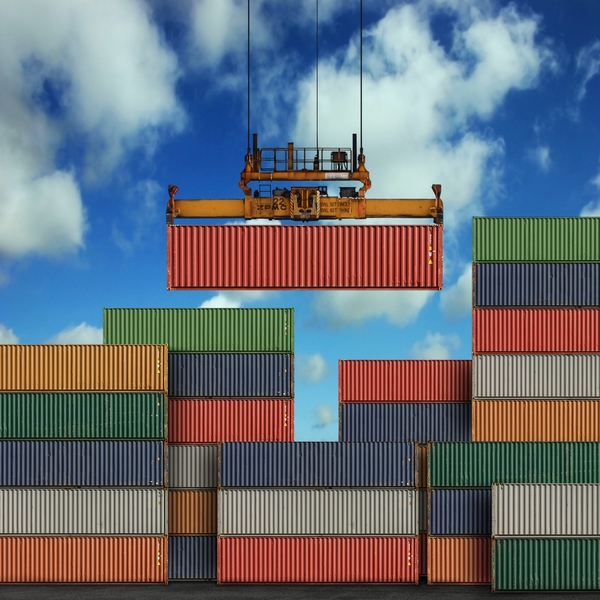
The development of intermodal connections along the New Silk Road and the Baltic-Adriatic corridor is creating many new opportunities for warehouse developers. Intensive modernization work on railway lines is underway in Małaszewicze, Bydgoszcz, and the Pomerania region, among others.
– In the coming years, intermodal connections will become the priority method for transporting goods in Poland. This is related, among other things, to the increase in maritime transshipments and the expansion of port infrastructure. Over the last 10 years, their number across the country has grown by as much as 70%, which resulted in 38 active intermodal terminals, both maritime and land-based, at the beginning of 2020. Terminals are being built not only by state-owned companies but also, albeit on a much smaller scale, by private entrepreneurs – explains Michał Rafałowicz, Head of the Pomeranian Region at Cresa Poland.
Intermodal transport involves using two or more modes of transport, but only one loading unit – a container or swap body – throughout the entire route. The entire process also takes place under a single contract with the carrier.
Małaszewicze – train speed is key
Among the largest dry transshipment ports in Poland, i.e., places deep inland that serve as an extension of a seaport for the transshipment and distribution of goods, is the terminal in Małaszewicze (Terespol municipality), through which one of the shortest railway routes connecting Western Europe with Asia runs. The expansion of this internationally significant transshipment terminal began last summer and is scheduled to be completed in 2021. The work includes extending tracks and the transshipment strip, which will make it possible to unload an entire train without the need for shunting. Małaszewicze is set to become a key point on the New Silk Road route. Already today, about 90% of all goods imported by rail from China are transshipped here.
– One of the biggest challenges will be creating infrastructure that allows freight trains to reach speeds achieved by the TEN-T rail network in the European Union – it has been assumed that this is approx. 40 km/h. Despite investments in railways in recent years, the average speed of intermodal transport in Poland is approx. 32 km/h and is quite low compared to other EU countries (partly due to capacity problems on short sections, especially at border crossings). For example, in the Netherlands, it is 64 km/h, and in Spain – 53 km/h. Nevertheless, if the continuity of funding and renovations in Poland is maintained, by 2023 the railway infrastructure should allow for an average speed of 45 km/h, which will meet the standards of the Trans-European Transport Network (TEN-T). Poland must spend significant amounts on railway investments so that these speeds can equalize. We know that railway infrastructure in Poland already allows for reaching speeds on some sections comparable to the maximum speed of heavy goods vehicles, and even exceeding it – explains Jakub Dudkiewicz, Senior Advisor in the Industrial and Warehouse Department at Cresa Poland.
All tracks lead to the Tri-City
One of the goals of expanding intermodal connections and port investments is also to increase interest in Poland among logistics companies from Southern Europe and to expand the Baltic-Adriatic corridor.
– Thanks to the ongoing investments and dry ports, the Tri-City has a chance to compete with ports in Germany or the Netherlands in the future. Our ports are characterized by high accessibility and significantly lower handling prices than in the West. Therefore, every year more companies decide to pursue their logistics goals in Pomerania – says Michał Rafałowicz.
One of the most important investments in the region is the modernization of the TEN-T core network railway lines leading to the ports in Gdańsk and Gdynia, in the Baltic-Adriatic corridor. The investment will cost approx. PLN 2.5 billion and will be nearly 40% financed by the EU’s “Connecting Europe” program, with work scheduled for completion this year.
Port investments and increasingly better intermodal connections with Pomerania are not without significance for the modern logistics and warehouse space market in the region. For a long time, Cresa analysts have been observing increased interest here – from both tenants and warehouse developers. The total supply of modern warehouse space in the Tri-City is 952,600 sqm, and another 166,700 sqm is under construction, which means that the Tri-City warehouse market will soon exceed its first million.
The most active developers in the vicinity of the Gdańsk port are: GLP, Panattoni, and 7R, and one of the largest investments is the Pomeranian Logistics Centre (GLP), located in the immediate vicinity of the Deepwater Container Terminal. The park will ultimately offer tenants 505,000 sqm. The Gdańsk Port Park, built by 7R, will also be located near the port, with construction planned to be completed in the second quarter of 2022. A total of approx. 119,000 sqm of space will be created there in two buildings. Another investment worth noting is the Panattoni industrial parks on Elbląska Street, near the Lotos refinery. Thanks to the southern bypass, they are a good alternative for companies that use the port but do not need to have a warehouse right next to the terminal.
Bydgoszcz as a hinterland for Pomerania
An important land hinterland for seaports in the near future is to be the terminal in Bydgoszcz Emilianowo. This is one of the most important investments in the country, on the route of a new logistics chain connecting the Baltic Sea with the Adriatic.
– The first step towards implementing this project was the creation of a special-purpose vehicle in July last year. The Bydgoszcz Emilianowo Intermodal Terminal will act as a dry port and will become a rail-road logistics hub and a hinterland for grain ports in Pomerania – explains Jakub Dudkiewicz.
It will be based on a rail-road platform near the junction of railway line 201, the S10 expressway, Bydgoszcz Airport, and the river port on the Vistula. The Bydgoszcz City Council has applied to the European Commission to recognize the city as a road-rail core node of the TEN-T network. The councilors motivated their request by the fact that Bydgoszcz, as one of the large cities in Poland, is located on the route of railway line 131, which forms the TEN-T core network. It is also significant that line 131 connects to line 201, which is dedicated to freight transport and is being modernized and prepared for freight train speeds exceeding 100 km/h.
Bydgoszcz on the warehouse market
The terminal in Emilianowo could also serve as a logistics center, which may be indicated by the fact that the largest warehouse developers in the country have been interested in this location for a long time. According to data from the consulting firm Cresa Poland, at the end of the first quarter of 2021, the total supply of modern warehouse space in the Bydgoszcz and Toruń region was over 413,000 sqm, while 11,800 sqm was under construction.
– The most active developer in the region is Panattoni, which has been successfully operating in the Bydgoszcz area for several years and has delivered over 180,000 sqm of modern warehouse space here in both multi-tenant and BTS projects. Currently, this developer is building another 95,000 sqm, which puts it in the position of a leader both in terms of delivered space and space under construction. Hillwood, one of the leading developers in Poland, has secured land for the construction of over 100,000 sqm of modern warehouse space in the vicinity of the planned intermodal terminal – says Jakub Dudkiewicz. – The owner of a large park in Bydgoszcz, with the possibility of expansion, is also Fortress REIT (formerly Waimea Logistic Park Bydgoszcz) – a new player on the commercial real estate market in Poland. Investment land in the city is also owned by companies: 7R, which is starting the construction of its first logistics center, and P3 – lists Jakub Dudkiewicz.
Tracks are more eco-friendly than wheels
Modernizing railway lines is not just about speed and competition in the European market. Rail transport is also considered the most environmentally friendly. Meanwhile, it is estimated that the share of transport in total global greenhouse gas emissions is about 25%. At the same time, it is known that trains emit on average three times less pollution than road transport and eight times less than air transport.
– That is why the European Union, by focusing on environmentally friendly investments, has decided to support railway projects. Investments in their construction and modernization will be financed from various European sources, not just the main EU budget. Railways could become one of the biggest beneficiaries of the European Green Deal program – concludes Michał Rafałowicz.
Source: Cresa Poland