








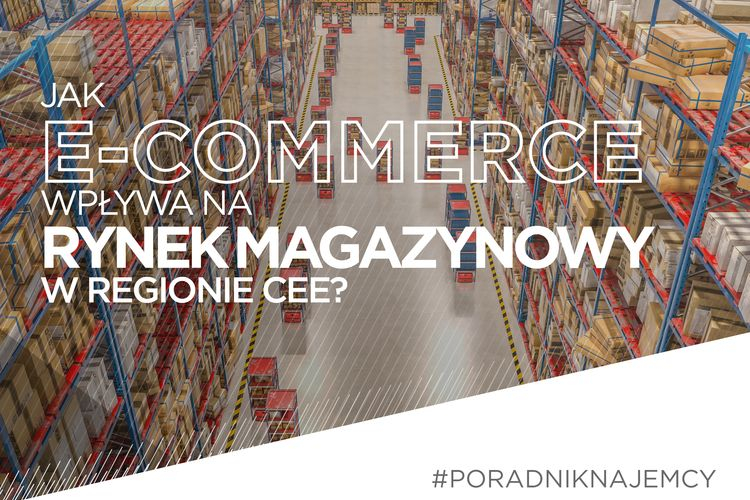
E-commerce is flourishing. In the coming years, we will remember 2020 as a breakthrough year, as the last few months have undoubtedly been difficult for both the global and European economies. The e-commerce and warehouse space sectors are booming, recording a dynamic acceleration in growth, mainly due to the crisis caused by the Covid-19 pandemic.
E-commerce is the main trend in retail. Large sales increases in the online channel are observed for most products in all regions of Europe. Significant changes have taken place in the retail sector with lasting consequences for online sales. Selling online is no longer just an option, but a necessity for market players who want to stay in the game and keep up with the changing market.
The e-commerce market in Europe was developing at an impressive pace even before the pandemic broke out. However, the largest growth to date was recorded in 2020 – data shows that the industry’s revenue in Europe increased by approximately 11% year-on-year to €326 billion last year. According to forecasts, this strong upward trend will continue in 2021, with growth potentially exceeding 10% compared to the previous year. It is estimated that by 2024, the value of the European e-commerce market will grow to nearly €423 billion, and the share of online retail in total retail sales could reach almost 30%.
Despite the challenges for the retail sector related to Covid-19, the share of e-commerce is growing much faster than before the pandemic. The observed boom in the e-commerce and 3PL logistics sector, including fulfillment centers, courier companies, and those handling “last mile” deliveries, as well as companies conducting cross-border and logistics operations, indicates a significant increase in the popularity of online shopping and a gradual shift of consumers towards buying most products online.
Retail chains that conduct both online and omnichannel sales and have extensive e-commerce platforms are benefiting from the accelerated growth. This makes companies interested in increasing their occupied space and looking for more technologically advanced facilities that will ensure greater operational efficiency, enabling them to keep up with consumer demand in the Central and Eastern Europe region.
Supply chain revolution driven by omnichannel
A new trend in the retail sector is the omnichannel supply chain, which involves coordinating a number of processes within supply channels and warehouse management. Since the popularization of the omnichannel strategy, online order fulfillment centers have become much more technologically advanced in response to changing market conditions and the need to streamline order fulfillment and shorten delivery times. The challenge is to simultaneously manage several sales channels, which include various solutions for last-mile delivery, such as PUDO (pick up, drop off) points, click & collect, or parcel locker networks. Dedicated warehouses and storage facilities should be adapted to the increased demand for sorting and storage services. No less important are reverse logistics and returns management processes, for which additional or even dedicated warehouse facilities are quite often needed. Analyses show that 52% of online stores are growing, compared to only 39% of stores that operate exclusively in brick-and-mortar locations.
Growing interest in e-grocery
The long-predicted boom in online grocery sales happened suddenly in 2020. The e-grocery market could grow to approximately 22% by 2024, up from about 4% in 2019. The pandemic, which forced new trends among consumers mainly in large cities, obviously has a direct impact on the development of the warehouse facility sector. Grocery chains realize that they must either build new fulfillment centers or move existing centers to dedicated facilities if the retail space they occupy is inefficient in relation to increased demand and requirements for process optimization and ensuring a satisfying shopping experience.
Development of warehouse facilities for urban logistics
Traditional locations of logistics centers near highways and in the suburbs no longer meet the requirements of the e-commerce industry in terms of last-mile delivery, reverse logistics, and local order fulfillment hubs. Smaller warehouse facilities located closer to city centers are needed. Previously, online customers received shipments on average within two or three days of placing an order. This trend is evolving towards same-day delivery, for which having a hub in an urban location is necessary and justified for operational reasons.
Impact of the EU e-commerce VAT package and Brexit on the warehouse market
In addition to the pandemic, several other factors are contributing to the development of the warehouse market in Central and Eastern Europe, including the EU e-commerce VAT package and Brexit. Due to new VAT regulations, the effects of the changes in legislation may be felt by all entities that carry out or facilitate online sales or deliveries of goods to consumers (in B2C relations), such as online stores, marketplaces, and postal operators or shipping companies operating in the EU. For this reason, the largest e-commerce platform operators and non-EU marketplaces are looking for new warehouse locations where they could open their warehouses and fulfillment centers in Europe.
Due to Brexit-related supply restrictions and customs risks, a number of companies have decided to relocate from the UK to continental Europe – mainly to the Central and Eastern Europe region, whose strengths are: a strategic location in the center of the continent, transport infrastructure upgrades and new investments in this area, and a competitive labor market. Recent analyses show that thanks to the development of e-commerce, more new jobs are being created in the logistics sector than in retail, which further emphasizes the importance of human resources in Central and Eastern Europe.
Growing importance of the warehouse and logistics space sector in Central and Eastern Europe
One of the biggest challenges for the development of warehouse locations is the problems related to the availability of employees in Western and Central and Eastern Europe. Smaller regional markets are gaining importance and will strengthen their position in the long term. This is favored by the development of local markets, further investments in transport infrastructure, and the need to diversify locations in national logistics chains of the e-commerce sector. New warehouse locations are being built continuously throughout the Central and Eastern Europe region.
The Central and Eastern Europe market is developing dynamically, as evidenced by record tenant activity in 2020 and the continuation of this trend in 2021. This region recorded the largest increase in demand for logistics space in Europe, which is driven primarily by logistics and e-commerce. We are observing great interest in high-class logistics facilities among operators in the e-commerce industry (in B2C/B2B relations) and other thriving companies, which also influences the acceleration of warehouse investment development in the Central and Eastern Europe region.
High dynamics of warehouse space market development in Poland
At the end of 2020, the total stock of modern industrial and warehouse space in Central and Eastern Europe amounted to over 39 million sq m, of which more than half (51%) was located in Poland. The warehouse market in this region is developing at a fast pace – in the last three years, approximately 11.5 million sq m of new space has been commissioned. The markets in Poland, the Czech Republic, and Romania are growing the fastest. Over 3 million sq m of new space is currently under construction, and about one-third of this volume is being built on a speculative basis. This testifies to the good condition of these markets, which investors perceive as less risky than in the previous decade.
In 2021, the situation in the Central and Eastern Europe market remains stable – rents for the best warehouse space range from €3.80-4.90/sq m, and the average vacancy rate is approximately 6%. Companies from various industries (especially retail chains) are intensively developing omnichannel sales strategies. They are also responsible for the increase in demand for logistics services and various types of warehouse space: logistics centers used for domestic and international distribution and facilities dedicated to last-mile logistics.
While many industries are struggling with the pandemic, the warehouse space market is thriving. It owes this mainly to long-term development, driven to a huge extent by the high dynamics of investments in the e-commerce sector, the importance of which is growing even more in the face of lockdowns and subsequent trade restrictions. The strategic location of Central and Eastern Europe at the intersection of major trade routes and further investments in transport infrastructure, combined with the development of urban and cross-border logistics, allow for optimism about the future of this market in 2021. At the same time, the warehouse and logistics space market in Central and Eastern Europe still has significant potential for stable development.
Source: Cushman & Wakefield