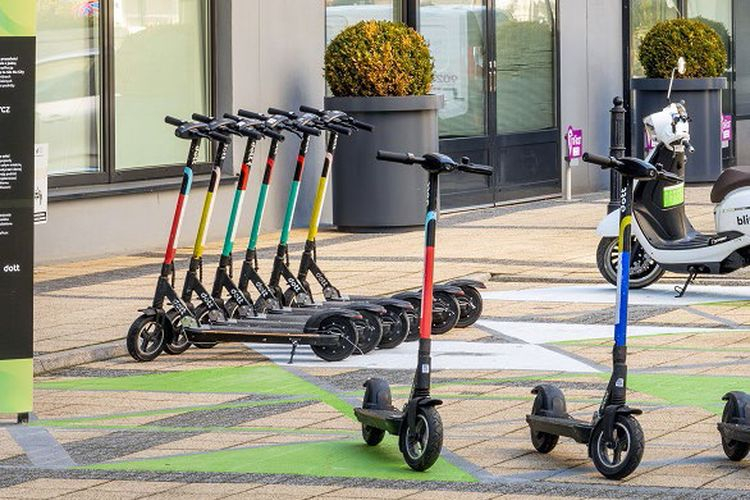
Mobility Hubs are specially organized parking areas for shared vehicles. They gather bicycles, electric single-track vehicles (especially e-scooters and mopeds), and cars from carsharing systems, all rentable via an app, at selected real estate or city locations. Additionally, Mobility Hubs offer charging stations for various electric vehicles.
The first Mobility Hub was launched in May of this year in Warsaw – at the Adgar Plaza office complex on Postępu Street 15 – offering, in an open-access and 24/7 format, Dott electric scooters, blinkee.city electric mopeds, and shared cars from Traficar (including electric and delivery vehicles). The strength of Mobility Hubs lies in the fact that they can offer any set of shared mobility services available on the local market, provided that the providers decide to make their vehicles available at a given location.
Beyond the physical presence of vehicles at the hubs, users also have at their disposal the multimodal travel planner Vooom – in the form of a free app that will plan a trip from A to B using various forms of transport: walking, various shared vehicles, and public transport (based on the current timetable). The multimodal planner takes into account not only the current availability of vehicles and the forecast of vehicle availability in the future, but also their range (e.g., the charge level of a scooter), the possibility of returning them at the destination, or the roads on which a given vehicle can travel (e.g., electric cars in bus lanes).
Why Mobility Hubs?
The mission of Mobility Hubs is to provide the local community and cities with a real alternative to traveling by private cars, which are the least efficient form of moving around cities. A car for individual use (private or company) remains parked for 95% of the time and serves only 1-2 people, while occupying over a dozen square meters of valuable space. In contrast, there are on average as many as 90 registered users per shared vehicle, and it is in constant motion, satisfying the mobility needs of many people at the same time (1 shared car can replace up to 7-11 private cars)1.
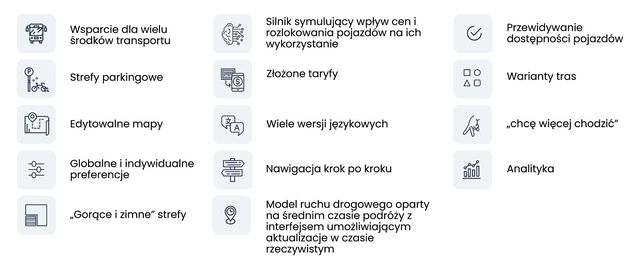
Key features of the Vooom travel planner.
Mobility Hubs also offer a choice of different types of vehicles (and thus different forms of travel): from bicycles, through electric single-track vehicles (single-person scooters and two-person mopeds) to “cars by the minute” in various classes and segments (e.g., city, SUV, delivery). This means that in a Mobility Hub, we will find vehicles suitable for different mobility needs (e.g., for shorter or longer distances), and even for different weather conditions.
Advantages
The primary advantage of the hubs is the predictable availability of various vehicles in one place – directly at the office, at the store, or in a residential area, as well as in selected key public places (e.g., at train stations or public transport stops). This allows for reliable planning of both private and business trips, and thus becoming independent of traveling by private car. Furthermore, charging services for various electric vehicles are available at Mobility Hubs, so that, for example, owners of private electric single-track vehicles can use them. Moreover, the arrangement of a hub is both simple and beneficial for the property. One contract is enough, based on which the company organizes a Mobility Hub from A to Z within a few months – starting from designing and executing a dedicated parking space, through concluding contracts with individual mobility service providers and/or electric vehicle charging infrastructure, to daily management of vehicle availability during the contract period. This is an offer for most types of properties, as well as for local governments that want to promote sustainable mobility among their residents. In line with future trends, Mobility Hubs fit into the trend of balancing urban mobility, i.e., making it more efficient, ecological, and less burdensome for the city and its residents. More than 90% of vehicles available in sharing services in Poland are zero-emission vehicles (powered by muscle power or an electric motor), and the multimodal travel planner Vooom will also show the way using public transport. Over time, the accessibility of many urban areas for individual motorized traffic (especially cars) will be fundamentally limited. At that point, the shared vehicles available at Mobility Hubs will be even more of a “must-have” for both properties and entire urban areas.
Furthermore, Mobility Hubs fit into the paradigm of “Mobility-as-a-Service” (MaaS), i.e., digital access to all forms of mobility available from the level of a single solution (e.g., a mobile app that will plan a trip and allow the use of all types of vehicles, while being a ticket/access to each of the offered forms of travel, and also enabling convenient payment for the entire trip, whether in the form of a one-off payment or a subscription). MaaS platforms are already one of the most important directions in the development of automotive and mobility, which have found their place, among others, among solutions intended for support under the European Green Deal.
MaaS technology and multimodal transport will have a breakthrough significance in the near future for the way people move in crowded cities. There will be no more room for cars in the centers of Polish cities. To improve the quality of life for residents and reduce exhaust emissions, we must reach for new solutions and technologies that support ecological movement and transport. While EU plans assuming broad support for the use of MaaS platforms and travel planners are spread over several years, in Poland we can already boast of the breakthrough cooperation of Vooom with the city of Gdynia and the Upper Silesian-Zagłębie Metropolis (GZM).
1 The cited data comes from the market report “On the threshold of a breakthrough. Shared mobility in Poland” by the Mobilne Miasto Association and the SmartRide.pl portal (as of mid-2019).
The article comes from the magazine LOGISTYKA 3/2021.
The e-edition of the magazine is available in our offer!

Stay up to date, subscribe to the LOGISTYKA magazine!