









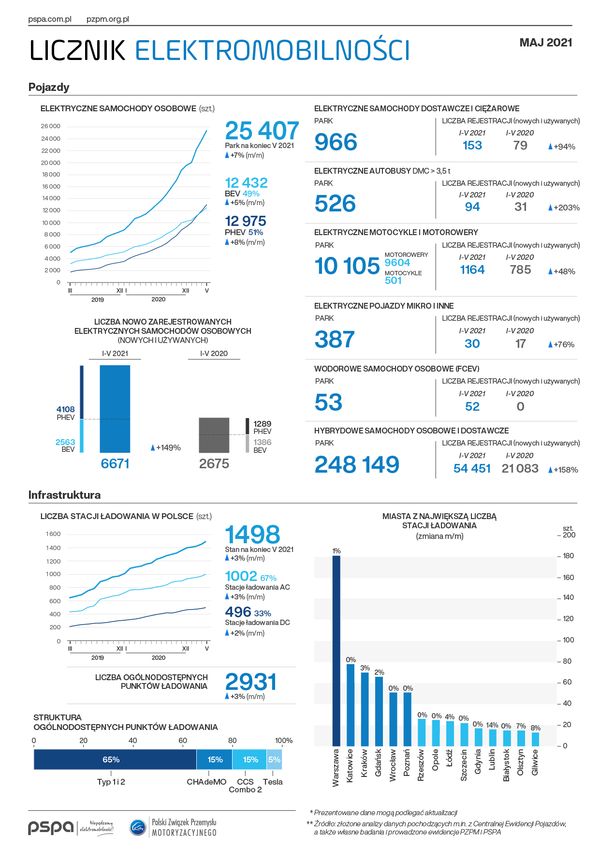
According to data from the end of May 2021, a total of 25,407 electric passenger cars were registered in Poland. During the first five months of this year, their number increased by 6,671 units, i.e., 149% more than in the same period of 2020, according to the Electromobility Meter launched by PZPM and PSPA.
At the end of May 2021, there were 25,407 electric passenger cars on Polish roads. Fully electric vehicles (BEVs) accounted for 49% (12,432 units) of this part of the vehicle fleet, and the remainder (51%) consisted of plug-in hybrids (PHEVs) – 12,975 units. The fleet of electric delivery and heavy-duty vehicles numbered 966 units. The fleet of electric mopeds and motorcycles also continues to grow, consisting of 10,105 units at the end of May.
At the end of last month, the electric bus fleet in Poland grew to 526 units. From January to May 2021, the e-bus fleet increased by 94 zero-emission vehicles. Compared to the same period in 2020, when 31 such buses were registered, this represents a 203% year-on-year increase.
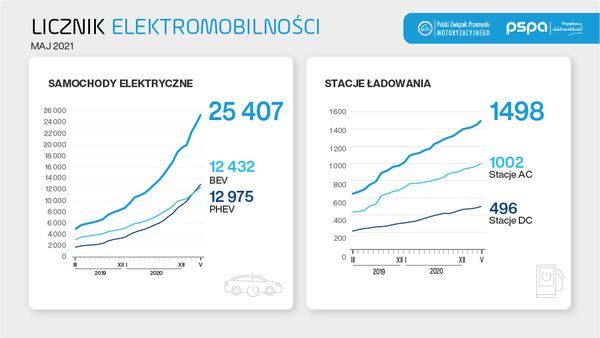
Along with the increase in the number of electric vehicles, charging infrastructure is also developing. At the end of May, there were 1,495 publicly accessible electric vehicle charging stations (2,897 points) in Poland. 33% of them were fast DC charging stations, and 67% were slow AC chargers with a power of 22 kW or less. In May, 39 new public charging stations (59 points) were launched.
– Between June 2019 and May 2020, 479 public electric vehicle charging stations were installed in Poland; in the following 12 months, only 322. The pace of charger network expansion has clearly slowed down. At the same time, the number of electric passenger cars per one public charging point is increasing. In May 2019, this ratio was 4.4, a year later 5.3, and currently, it is already 8.8. In the first quarter of 2021, the number of public points in Poland increased by only 5% compared to the end of 2020, while in Germany it grew by as much as 10%. This is a gap, especially considering that the network of charging points across our western border is incomparably more developed – it has exceeded 40,000 points – says Maciej Mazur, Managing Director of PSPA.
– I am pleased to point out that starting from this edition, the Electromobility Meter will also report hydrogen vehicle registrations. The reason is the visible increase in their registrations – 46 units were registered in May this year, and currently, the fleet in Poland consists of 53 units. We still hope that the number of electric vehicles will continue to grow, but it must be emphasized that the demand for these vehicles depends on two factors – including them in a subsidy system and providing charging infrastructure. The industry is eagerly awaiting the next subsidy program for the purchase of low-emission vehicles, as well as subsidies for the support system for building charging and refueling infrastructure – from the government program as well as from funds from the National Recovery Plan. The lack of declarations regarding support plans dampens purchasing sentiment, both for individual and corporate customers, which is why announcing the details of both programs as soon as possible is so important – says Jakub Faryś, President of PZPM.
Source: PSPA