









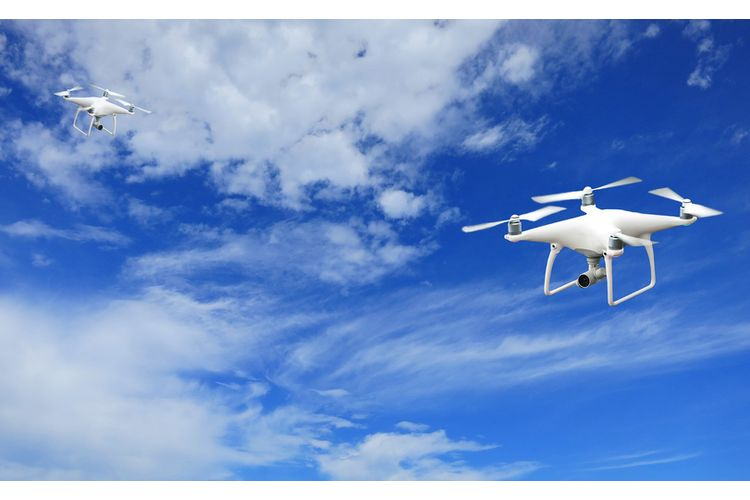
The United Arab Emirates recently announced that they will use drones to induce rain. The unmanned aerial vehicles are intended to fly into clouds and trigger electrical discharges that will lead to precipitation. Weather modification programs have also been conducted by the USA, Russia, and Australia. China has gone even further, implementing a weather-on-demand program – by 2025, they want to increase the total area of their test weather modification zone to 5.5 million square miles.
– Drones are a good method for inducing rain on demand, but weather control is only possible to a limited extent – comments Prof. Cezary Galiński, PhD, Eng., Head of the Department of Aircraft and Helicopters at the Faculty of Power and Aeronautical Engineering of the Warsaw University of Technology. – The idea of weather control is quite old; the first concepts in this area appeared at the turn of the 1950s and 60s. And one of the possible technologies that they tried to invent back then was precisely inducing rain. Since then, attempts to implement such projects have been ongoing, most often carried out either by spraying silver iodide inside clouds where appropriate conditions prevail, or using frozen carbon dioxide, or electrical discharges induced artificially by means of a flying object – adds Prof. Galiński.
The United Arab Emirates intends to test a high-tech way of inducing more precipitation. Drones are to fly into clouds and trigger electrical discharges to lead to rainfall. As scientists from the University of Reading explain, the project aims to change the balance of the electrical charge in cloud water droplets. The drones will “provoke” them to clump into larger particles and merge into bigger drops, which will then fall to the ground. It is already known that scientists are working on larger devices that will be able to fly into higher parts of the clouds.
– As of now, it is a questionable issue whether this technology actually works. The information we have indicates that inducing rain from a cloud is possible provided that there is enough water in the cloud and appropriate thermodynamic conditions prevail, which means that it would rain from that cloud anyway in a moment. Therefore, it is not about inducing rain from any cloud, but about accelerating the precipitation – explains the expert from the Warsaw University of Technology.
Although more and more countries are investing in technologies that allow for weather modification, it is currently impossible to induce precipitation on demand, anywhere. It is also impossible to direct clouds to places where, for example, there is a drought. However, thanks to the technique, it is already possible to cause rainfall instead of, for example, hail. Similar tests were also conducted in Poland several decades ago.
– It seemed that it would be a good idea to observe the sky, detect clouds that threaten with hail or storms, and discharge them in places where there are no crops, for example – points out Cezary Galiński.
Although, despite the latest technologies, it is not yet possible to control the weather, China has already announced the introduction of a massive weather modification system. By 2025, they will increase the total area of their test weather modification zone to 5.5 million square miles. To induce rain, they use the “cloud seeding” technique, which involves spraying silver iodide particles with a structure similar to ice into the sky. In the upper parts of the atmosphere, they attract water droplets, which accelerates cloud formation. This technique is used by, among others, Lebanon, Qatar, and Saudi Arabia, but China is doing it on an unprecedented scale.
Source: Newseria