









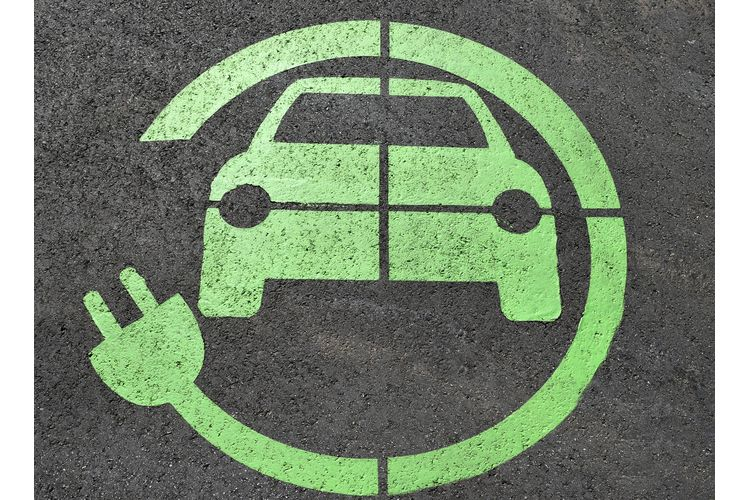
Road signs indicating a petrol station with an electric vehicle charging point or an electric vehicle charging point, proposed by the Polish Alternative Fuels Association (PSPA), will soon appear on Polish roads. They have been provided for in new government draft regulations.
New versions of draft regulations amending the regulations on road signs and signals and on detailed technical conditions for road signs and signals and road safety devices and the conditions for their placement on roads have been published on the Government Legislation Centre website. The draft regulations expand the catalogue of road signs and signals with new signs dedicated to electric vehicle users.
The government’s proposal includes, among other things, the introduction of a sign indicating an electric vehicle charging point (D-23c) and a petrol station with an electric vehicle charging point (D-23b). The drafted provisions also provide for the possibility of using information about a charging station or point on collective information boards regarding facilities located by the road (D-34b). The information will indicate the direction and distance to a charger located on a given road or another road in a nearby location. It will be possible to signpost access to stations located near motorway or expressway exits.
Legislative process
The proposal for new road signs for electromobility, including horizontal and vertical signs, was first presented by PSPA in the report “Electromobility Identification System”, which premiered in September 2019 during the New Mobility Congress. The catalogue included proposals for many signs and symbols, along with design specifications. So far, several dozen private entities have used them to mark their charging stations.
– We developed the electromobility identification system in Poland due to the lack of comprehensive legal solutions in this area. When the drafted provisions enter into force, drivers travelling around Poland will see information about the nearest charging station not only on their navigation screen or in a mobile application, but also on a vertical sign by the road, on collective information boards, on parking signs or at Travel Service Areas. This is an important step towards popularising electromobility in Poland – says Maciej Mazur, Managing Director of PSPA.
In 2020, the process of amending the regulation of the Ministers of Infrastructure and Internal Affairs and Administration of 31 July 2002 on road signs and signals and the regulation of the Minister of Infrastructure of 3 July 2003 on detailed technical conditions for road signs and signals and road safety devices and the conditions for their placement on roads began. These legal acts constitute the structure of the road signage system, and the introduction of a new category of signs dedicated to electromobility requires the amendment of both of them.
The drafted regulations, in addition to the D-23c, D-23b and D-34b signs, also provide for a number of other solutions for electromobility. The inscription on the plate designating an electric vehicle is to be changed. The current “EE” letter designation will be replaced by the “EV” designation. Under the D-18 “parking”, D-18a “parking – reserved space” or D-18b “covered parking” signs, a plate with the inscription “EV” may be placed, specifying a space intended for parking electric vehicles, and a plate with the inscription “EV charging”, specifying a space intended for parking electric vehicles exclusively for the time of charging. The inscription “EV” instead of “EE” will also be placed inside the P-18 “parking space” or P-20 “reserved parking space – envelope” sign. Importantly, both categories of parking spaces for electric vehicles may have a green surface.
– During the public consultations on the drafted regulations, we argued for the validity of adopting the “EV” inscription for the purposes of the newly introduced signs, bearing in mind its recognisability among drivers around the world and the need to standardise the markings used with those used in other European Union countries and globally. We are pleased that the Legislator shared this argument and also adjusted the existing regulations in this respect – said Joanna Makola, Head of the PSPA Legislative Centre.
The market needs it
As the results of the “New Mobility Barometer” developed by PSPA show, as many as 87% of Poles rate their knowledge about the location of charging points poorly. In addition to their informative function, the newly introduced signs will also play an extremely important role in terms of social education. They will make many Poles realise that charging infrastructure is not only already available, but also that the charging network is being systematically expanded, and that chargers can be used both in the city and on longer routes. The new regulations will thus contribute to debunking basic myths about electromobility.
Based on the PSPA and PZPM Electromobility Counter, at the end of April 2021, a total of 23,834 electric passenger cars were registered in Poland. Fully electric vehicles (BEVs) accounted for 49.68% (11,841 units) of this part of the vehicle fleet, and the remainder (50.32% share) consisted of plug-in hybrids (PHEVs) – 11,993 units. In the first four months of this year, their number increased by 5,098 units, i.e. 137% more than in the same period of 2020. Along with the increase in the number of electric vehicles, charging infrastructure is also developing. According to PSPA data, at the end of April, there were 1,456 publicly accessible electric vehicle charging stations (2,838 points) in Poland.
Source: PSPA