








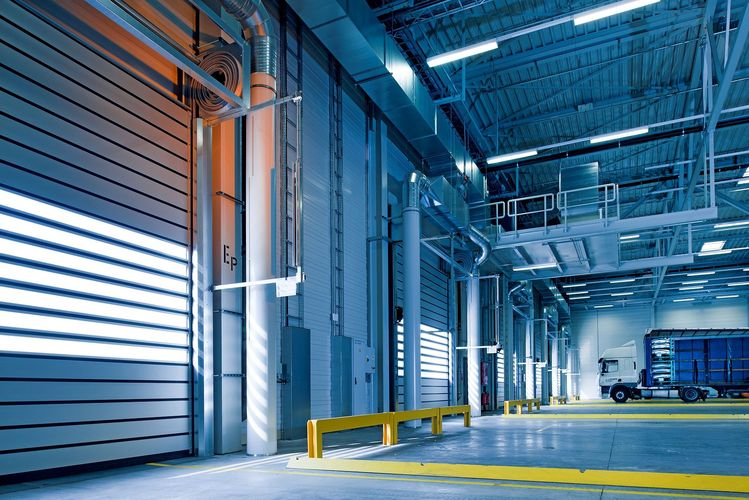
Diversification of warehouse products in Poland is multifaceted and has gained momentum in recent years. Newly emerging investments can differ significantly in many respects – they can be larger or smaller, located in different parts of the country, and serve diverse functions.
The first and quite obvious form is the division of warehouses based on their floor area, as well as the introduction of new products to the market that deviate from original assumptions. We are talking here about multi-tenant buildings, i.e., those intended for several different tenants and offering modules of no less than 2,500 – 3,000 sq m (or their multiples), with a total area greater than or equal to 10,000 sq m (so-called big-box).
Small Business Units warehouses near cities
However, many tenants – especially those who prefer locations near the centers of large cities – are looking for smaller warehouse spaces. Often, these are tenants who treat their warehouse as a business center, combining warehouse and office functions in one location. This group and its needs initiated the creation of the SBU (small business units) concept on the Polish market. The first model modern facilities of this type were built at the turn of 2008 and 2009 in Warsaw and assumed the division of the building into smaller modules, i.e., from 600 to 1,000 sq m, with a minimum office part of about 100-130 sq m (or a multiple thereof). Although this concept is not new, there is still a shortage of such space on the market, especially in regional cities, where tenants’ needs are often met within older-type facilities that clearly differ in technical terms from today’s standard.
According to a survey conducted by Cushman & Wakefield among warehouse developers actively operating in Poland, one of the most important trends for 2021 will remain the further development of SBU-type projects.
Warehouse locations in Poland
Another departure from the main market trend took place in the context of location – the warehouse market in Poland today is basically any location chosen by the tenant. In previous years, there were 5 main markets in Poland – i.e., Warsaw and its surroundings, Central Poland, Upper Silesia, Poznań, and Wrocław – which still account for nearly 80% of demand, but the concept of modern warehouse space has gradually entered large (Tri-City, Kraków, Szczecin) and smaller regional markets (areas of Bydgoszcz and Toruń, Lublin, Rzeszów, etc.). Modern warehouse parks are located today in almost every provincial city and can be built in almost any location chosen by the tenant.
What functions do warehouses fulfill?
From the perspective of the market and the tenants themselves, the most interesting seems to be the diversification of the warehouse product in terms of the function performed by a given space. And here the diversity is already huge today, and it will deepen over time. The market started with large spaces of a distribution nature. The first differentiation was forced on the market by manufacturing companies looking for space solutions adapted to their individual technical specifications. Next were the already mentioned concepts of urban warehouses (SBU), with a larger office part. And then came the era of e-commerce.
E-commerce changes the face of the warehouse market
The influence of tenants from this industry on the warehouse market in Poland is enormous. Already in 2019, a survey conducted for the Cushman & Wakefield report “How to tackle e-commerce in a warehouse” showed that nearly 25% of all available warehouse space was used for e-commerce needs. Today, after the changes forced by the COVID-19 pandemic and with a rapid transformation in the retail market area, the percentage share of e-commerce certainly exceeds 30% of total resources.
For the needs of e-shops, not only large distribution centers are being built (also highly diversified due to the type of products handled in them), but also transshipment facilities, courier investments, and small urban warehouses, i.e., last-mile facilities. Subsequent warehouse spaces may have a retail character and combine both retail and distribution functions. The main “culprit” will again be e-commerce and the development of the omnichannel concept. The variant of retail warehouses (retail warehousing) seems inevitable.
Ecology and technology in warehouses in Poland
The topic of warehouse product diversification is very extensive, and developers do not lack ideas to stand out from the competition. It is worth mentioning the increasingly strong trend of green facilities, usually certified by the BREEAM method. Their technical standard clearly differs from spaces realized even a few years earlier. Compared to 10-year-old and older facilities, this difference is even more pronounced and is associated with a significant difference in the costs of using the facility – which Cushman & Wakefield wrote about in detail in the “Industrial Goes Green” report.
It is worth mentioning the technical differentiation of warehouses. Automation is becoming increasingly popular (again: often forced by e-commerce), which causes warehouse facilities for different tenants to take on a very individual character. As an example, one can point to automatic high-bay warehouses.
What will the warehouses of the future look like?
Finally, it is worth remembering that the future is coming with further changes. Let autonomous cars be an example. If they are allowed for use in the European Union and Poland – and this is probably more a question of “when” rather than “if” – they will significantly change the warehouse specification. What will warehouses look like then? Here, too, the tenants will decide.
Source: Cushman & Wakefield