









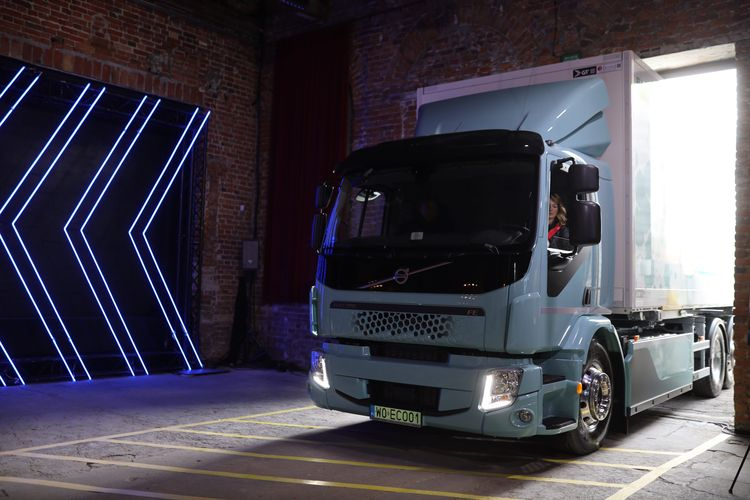
The EKO-LOG project has launched, marking the first study in Poland of a mass-produced, 100% electric truck, implemented by the Polish Alternative Fuels Association (PSPA). For 9 weeks, IKEA, H&M, and No Limit will test a zero-emission Volvo FE Electric truck in real-world conditions. Technological support for the pilot will be provided by Nexity.
Heavy-duty vehicles account for 19.2% of CO2 emissions from transport in the European Union. In large urban agglomerations, these vehicles generate even more than 60% of CO2 emissions and contribute significantly to smog formation. Consequently, the electrification of heavy road transport is of particular importance in Europe’s pursuit of climate neutrality.
– Electromobility is a direction discussed primarily in the context of passenger cars and delivery vans. Meanwhile, Poland has the largest fleet of heavy-duty vehicles in the European Union, accounting for almost one-fifth of the entire EU fleet. 98% of trucks in our country are equipped with diesel engines. Reducing emission levels from the heavy road transport sector in Poland is a major challenge, which is why PSPA, together with five industry partners, has initiated the EKO-LOG project, which will determine whether an electric truck in Poland can be an alternative to conventional vehicles – says Maciej Mazur, Managing Director of PSPA.
– As part of the EKO-LOG project, we will evaluate the mass-produced, zero-emission Volvo FE Electric truck in five different areas. We will examine performance, utility, socio-environmental, cost, and fleet aspects related to the electrification of heavy-duty vehicles. EKO-LOG is the first project of its kind in Poland, representing an important step towards popularizing zero-emission solutions in heavy transport – adds Albert Kania from PSPA, EKO-LOG Project Coordinator.
The project was inaugurated on May 27 in Warsaw during a Volvo Trucks conference. Vehicle tests will begin on June 1 and last until July 31. During this time, the electric Volvo truck will be implemented into the fleet of No Limit, which is responsible for managing logistics processes. As part of the pilot, deliveries will be provided for the other study partners – IKEA and H&M – on the route from warehouses located in Grodzisk Mazowiecki and Pruszków to collection points in Warsaw. Nexity will be responsible for processes related to monitoring and managing the vehicle’s charging processes.
As part of the EKO-LOG project, a Volvo FE Electric vehicle with a gross vehicle weight of up to 27 tons will be used for testing. The truck has a three-axle electric chassis with a GT Trailers body and a box with a lift with a load capacity of approx. 13,000 kg, capable of holding 18-19 Euro pallets. The range of the Volvo FE Electric is approx. 200 km, depending on the battery configuration and driving cycle. Fast charging (DC) of the 265 kWh battery takes approx. 2 hours, while replenishing energy with alternating current (AC) takes approx. 11 hours.
The study will analyze a number of important operational parameters of the Volvo FE Electric truck, including average energy consumption, range, charging time and power, weight of the transported load, energy flows, average speed, and distance covered. The collected data will be used to develop a model that allows for estimating the actual range of the vehicle. The EKO-LOG project will also include a comparative study of noise emissions between the electric truck and a combustion-engine truck, which will allow for the assessment of additional environmental benefits resulting from the electrification of heavy transport.
– Volvo Trucks’ approach goes far beyond technological aspects. In the context of electromobility in Poland, we are aware that a lot must happen for Volvo Trucks’ electric vehicles to become an everyday reality. We focus on the benefits that electric trucks bring to people’s daily lives, helping to create cleaner, quieter, and less congested city life, as well as a productive and healthy work environment for the user and drivers. Electrified trucks are very much in line with Volvo Trucks’ vision to drive progress towards a more sustainable society. The EKO-LOG project will give us an answer as to how our FE and FL models perform in Polish realities – says Paweł Kupczyk, Product and Business Development Director at Volvo Trucks Poland.
During the tests, three surveys will be conducted, aimed at different target groups. The first study, addressed to the residents of Warsaw, will allow for the assessment of public awareness regarding zero-emission heavy transport. The second survey will be directed to fleet managers to determine the potential of the electric truck market in Poland. The results of the third study will allow for determining the opinions of drivers regarding the utility aspects of the zero-emission truck.
Based on data provided by Volvo Trucks and collected as a result of the EKO-LOG project, a comparative analysis of the operating costs of the electric truck will be developed, allowing for the identification of savings generated during the vehicle’s use.
– The EKO-LOG project is the first venture of this kind for IKEA, in which we will test a zero-emission truck in real-world conditions. This is an important step for us on the path to finding zero-emission solutions in transport and developing electromobility. In accordance with our People and Planet Positive strategy, we want 100% of transport related to deliveries and services for customers to be based on electric vehicles or other zero-emission solutions by 2025. IKEA’s ambition is to be a climate-positive business. To this end, by 2030, we want to reduce our greenhouse gas emissions by an amount greater than what the entire IKEA value chain emits, while simultaneously growing our business – says Anita Ryng, Country Communication Manager at IKEA.
The final test for the electric Volvo FE Electric in the EKO-LOG project will be the completion of a trip on an intercity route (Warsaw – Łódź – Warsaw). The test will provide an answer to the question of whether heavy-duty electromobility also works for deliveries outside of urban agglomerations.
– Comprehensive, two-month tests of an electric truck with a GVW of up to 27 tons and a capacity of 18 pallet spaces is an important project in the development and promotion of electromobility in the logistics industry in Poland. No Limit’s task is to verify the efficiency of the charging process and goods delivery in various operational variants for our clients. Participation in the EKO-LOG project is another step forward for us in implementing the pro-ecological Environmentally Friendly Logistics program, which we have been running since 2015 – says Maciej Rybak, Service Line Director Home Delivery & POSM at No Limit.
The results of the EKO-LOG project will be officially presented on September 9, 2021, at the Jastrząb track near Radom, during the 4POLAND trade fair organized by Volvo Trucks.
Source: PSPA