Experts from Orange Polska – Agnieszka Zawistowska, Director of Development and Sales responsible for the Transport and Logistics industry in the B2B division, and Artur Piecha, Marketing Director for Key Accounts and Corporate Clients – discuss the opportunities and threats posed by 5G, the potential for economic and labor market development, and which Polish cities can already be considered smart cities.
Urszula Dziewit-Gontowska: What is 5G essentially: a revolution or just an evolution in technology? Artur Piecha: 5G is definitely a revolution, but we will have to wait a little longer for its effects. We will fully appreciate them only after 5G is launched on the target 3.6 GHz frequency and solutions utilizing this technology are implemented. At the moment, we are waiting for the President of the Office of Electronic Communications (UKE) to announce the auction that will allow the spectrum to be distributed among operators. We hope, and these are the regulator’s declarations, that the auction will be resolved this year.
U.DG.: 5G stirs up many emotions. Protests are being organized, appeals are being signed to refrain from its implementation, and videos about its harmfulness are appearing online. Are these concerns justified?
A.P.: The vast majority of these concerns are unjustified and largely stem from ignorance. This shows how important education is when implementing new technologies. And this education is available. At Orange, we organized workshops for representatives of non-governmental organizations at the end of 2019 and in 2020, dedicated to building awareness and disseminating knowledge about 5G technology. The first was led by experts from Orange Polska. For the second, we invited guests from outside our organization to lead as well – people with extensive experience in digitalization gained from working in government institutions and the European Commission. We are, of course, not the only organization involved in education. Operators, state institutions, industry chambers, individual companies, scientific institutions, and non-governmental organizations have been conducting it for a long time. The activity of so many diverse institutions is very gratifying, but there are many challenges, and we still have a lot to do.
U.DG.: If we consider 5G as a better version of 4G, although this is a very simplified view, what problems of its predecessor does it eliminate?
A.P.: 5G is not just an “improved 4G.” It is a new technology that actually allows for the elimination of the limitations of the previous generation network and provides new opportunities, especially for Industry 4.0. Gigabit throughput, the elimination of latency, and the ability to handle millions of devices connected to the Internet of Things (IoT) are just some of its advantages. According to a McKinsey Global report published in 2020, about 127 new devices connect to the Internet every second worldwide1. According to the same report, 30 to 50 billion devices were expected to be connected to the network by the end of 2020. Forecasts indicate that by 2025, there will be over 75 billion devices connected to the Internet of Things in use. We use them every day, even if we don’t always know it. It is thanks to them, for example, that we make contactless payments, can rent city bikes, use automatic traffic lights, or parking lots that inform about space occupancy. In the future, thanks to 5G, it will be possible to create new services that no one thought existed until recently, and which will revolutionize our lives. In addition to higher throughput compared to previous generations of mobile networks, 5G also offers smarter, stronger, and more energy-efficient connectivity. For the general public, this will mean, for example, smoother access to services while traveling or richer experiences based on augmented and virtual reality, which we will use in education, employee training, and sales presentations, among other things. This will allow for a precise understanding of the technical details of a given project, e.g., a building visualized in 360 degrees, making the reception of the presented content more complete. And all this will happen without having to leave the office or home. In the long term, 5G will offer speeds up to 10 times higher than 4G and access to a network that will operate continuously at a constant, high level in city centers, even during peak hours.
 Agnieszka Zawistowska: For companies, 5G will significantly streamline transport, logistics, and industrial processes and improve their way of working. This will translate into increased productivity and efficiency, as well as lower costs. Their competitiveness in the market will also increase. A world of new opportunities will open up for many sectors of the economy, such as transport and logistics, industry, health, media, and smart cities. Examples are numerous. In the field of mobility, primarily the fluidity and autonomy of transport will grow, thanks to the ability to handle many interconnected vehicles (passenger cars, trucks, buses, or trains) through dynamic adaptation to various road safety requirements, software downloads, information transmission, or vehicle-to-vehicle communication. Another example of using the capabilities of this new technology could be the operation of industrial robots and the possibility of their cooperation to improve the efficiency of production plants or the automation of building monitoring. In factories, it will be possible to connect many objects, collect data, and analyze them increasingly accurately using artificial intelligence. In industry, data from remote valve controls or probe readings will be able to be used in real-time.
U.DG.: Does the (unaware?) consumer associate 5G with a mobile network? How far outside the box of such thinking do you need to go to understand it well?
A.Z.: 5G is, of course, a technology used in a mobile network, but it is crucial to understand how it works and what opportunities it provides. It must be clearly emphasized that 5G is not just faster mobile Internet, but above all new opportunities for, among others, Industry 4.0, and thus the digitalization and development of the entire economy. In EU countries, the Orange Group can boast of projects that put the capabilities of 5G into practice, and we are also implementing the first so-called 5G campus networks in Poland. One of the largest French ports in the city of Le Havre uses a 5G network on the 3.5 GHz frequency thanks to Orange. The network improves the attractiveness and competitiveness of the port because it gives companies operating in its area access to data in real-time and enables them to use tools such as connected robotics or augmented reality for maintenance or remote interventions. As Stéphane Richard, Chairman and CEO of Orange, said, “5G is a great technological revolution and a unique opportunity for all companies in the industrial port area and the urban community of Havre Seine Métropole. It will help improve their competitiveness, efficiency, and flexibility. It will also be a powerful lever for economic recovery and energy transition – two major challenges for French society.” Another example of the practical use of 5G is the company Schneider Electric. Its factory is the first plant in France where a private 5G network has been launched. It is available on an area of 2,000 sq. m. and allows for the transmission of huge amounts of data at speeds above 1 Gb/s, thus ensuring reliable connectivity for, among other things, industrial applications using augmented reality. Factory employees have tablets with an AR (Augmented Reality) application connected to the 5G network, thanks to which, after filming an object, they get data about its status, future maintenance, or parts requiring replacement. As a result, efficiency has improved, downtime has been reduced, maintenance activities have been streamlined, and the number of human errors is lower.
U.DG.: Can 5G be considered in terms of competition to fiber optics?
A.P.: Fiber optics is not competition for 5G. On the contrary. A fiber optic network is necessary as one of the elements for the successful implementation of 5G, because, for example, base stations are connected to the network via fiber optic links. That is why, among other things, we consistently invest in fiber optics. Since 2015, Orange Polska has spent approximately PLN 3.6 billion on the fiber optic construction program (in 2019 alone, we spent PLN 721 million on fiber optics, which is every third zloty allocated for investments). Comparing the scale of Orange’s own investments: in 2020, we covered 4 times more buildings than in 2017 – over 191 thousand versus 52 thousand. Assuming work in a system of 52 weeks a year x 5 working days x 8 hours, in 2020, Orange teams were connecting fiber optics at a rate of 735 buildings per day, which is one building every 40 seconds. The second key issue for the implementation of 5G is, of course, the availability of frequencies necessary to fully utilize the capabilities of the next-generation network.
U.DG.: In the context of 5G, there is also talk of a smart city. What does this concept mean from the point of view of a company – a telecommunications expert? Do we already have such cities in Poland, and which solutions applied in them are worth paying attention to?
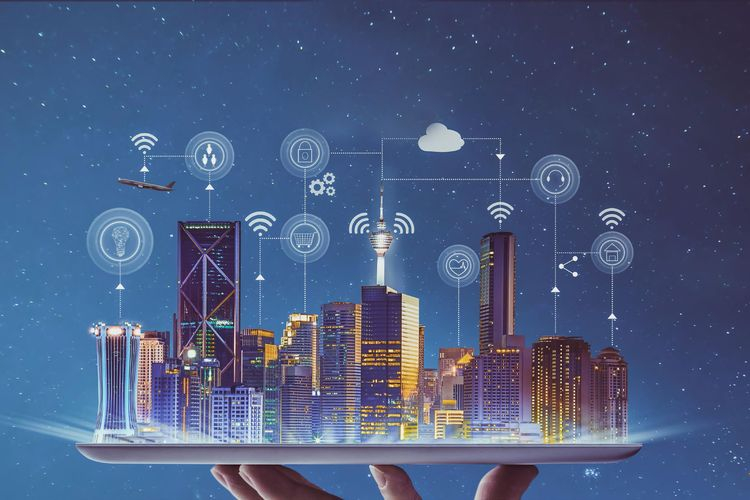
A.Z.: Rapid urbanization causes cities to struggle with many problems related to, for example, transport organization, pollution, noise, traffic jams, crowded parking lots, or waste collection. To meet them, they must function more efficiently and in a more sustainable way. IoT solutions that make up the concept of Smart City, which in the simplest terms boils down to connecting many devices to one network so that information flowing from them can be managed and decisions resulting from them can be made practically in real-time, help local governments with this. With Smart City understood in this way, 5G is needed to fully implement solutions such as autonomous public transport, traffic management, lighting, or municipal management and to use all their capabilities. The three most important attributes of the 5G network – fast data transfer, minimal latency, and support for a huge number of connected devices – will allow for the emergence of breakthrough solutions that affect our daily lives. As a model example of a smart city, the World Economic Forum points to Vienna. In Poland, there is no city that could be considered a full-fledged Smart City with a clear conscience yet, especially among large agglomerations, but we undoubtedly have gems among smaller cities. Here, the best example is Bolesławiec, where Orange has implemented an entire IoT ecosystem, which consists of, among others, Smart Lights (urban lighting management system), Smart Bikes (city bike system), and Smart Sensors (air quality sensor system). In total, over 80 Polish cities and smaller towns are already using Smart City solutions from Orange.
U.DG.: Let’s return to the issue of security at the end. Looking from this perspective, is 5G more of a safeguard for our future in the digital world, or does it carry threats, as skeptics predict?
A.P.: Let’s emphasize once again that 5G is safe, and the concerns associated with it mainly stem from ignorance. This does not mean, of course, that there are no threats in the network. We must be aware that if we move most of our activities to the Internet, cybercriminals also become active. How much this activity is increasing is shown by data from CERT Orange Polska and CyberTarcza, which recorded almost four times more data phishing incidents in 2020 than in 2019. There were 40 million blocked attempts to access phishing sites. Here, however, specific cybersecurity solutions come to the rescue. The number of companies using the 24/7 Orange Security Operations Center (SOC) doubled last year (to over 1,000). As examples of solutions from the Orange Polska service portfolio, it is worth mentioning Mobile Device Management (MDM) – secure and fully remote device management in the company, as well as Cyberwatch – protection of client devices and informing about detected communication attempts with sites that pose a threat to their corporate network, Orange Network Security (ONS) increasing the security of Internet use, Managed UTM providing employees with secure access to websites, or Next Generation SOC – technology for monitoring incidents and responding to them in combination with the experience of the Orange Polska SOC and CERT.
U.DG.: How is the implementation of 5G progressing (the 5G architecture probably allows for two different models of its implementation)?
A.P.: Orange Polska consistently maintains that only the rapid allocation of frequencies in the 3.6 GHz range will enable the implementation of full-fledged 5G network services in Poland from the point of view of parameters important to customers. Due to the situation related to the cancellation of the auction, we decided to implement a solution in the 2100 MHz band based on the Dynamic Spectrum Sharing mechanism, which allows for the allocation of resources to 4G or 5G services depending on demand. On July 1, 2020, we started offering commercial 5G services based on a network of 1,600 base stations located in 370 towns in Poland, primarily in Warsaw, Łódź, Kraków, and the Silesian agglomeration. In January 2021, stations in the Tri-City were added to this. This service is available to about 90 thousand residents of the Tri-City. The coverage of this network includes the main communication route of the agglomeration and popular points, including the Gdańsk Old Town. Our ambition, as a leader in services, is to actively participate in the implementation of the 5G network in Poland and to provide customers with access to modern services operating based on this network. We are constantly working to prepare for the full implementation of the 5G network. We are also continuing to expand the fiber optic network, which will condition the effective operation of the 5G mobile network.
A.Z.: In December 2020, we signed an agreement with the Łódź Special Economic Zone (ŁSSE) for the implementation of an internal 5G network in the 3.6 GHz band. This network is already operational and provides coverage in two ŁSSE buildings, among other things for the needs of the ŁSSE 5G Lab, which is a space equipped with appropriate tools, equipment, and infrastructure for testing 5G innovations. It is intended for startups creating solutions based on 5G technology in the areas of IoT, virtual reality (VR), augmented reality (AR), but also artificial intelligence and the communication of autonomous vehicles with the environment. Orange provides expert support related to the application of 5G technology in industry and is involved in the development of startups. Selected companies operating in the zone will also receive support as part of the Orange Fab program, which deals with testing and developing innovative solutions. Orange Polska will build the second campus network in Poland operating in the target 5G band of 3.6 GHz in Ksawerów near Łódź on 6,000 sq. m. in the Miele household appliance factory. We will provide 5G coverage there, but also LTE. Transmission in the network will be able to take place at a speed of over 750 Mb/s. The network, which is already being built, will allow for the digitalization and automation of the quality control process for created products, as well as the launch of employee training on a large scale using virtual reality (VR). In the future, thanks to the 5G network, it will also be possible for the lifts used in the factory for transporting parts and components necessary in production to function as fully autonomous vehicles.
U.DG.: How will the pandemic affect the implementation of 5G. Will it delay it, or will it accelerate it in the end?
A.P.: The lockdown and the rapid increase in network load caused by, among other things, the increased shift to remote work by business customers and widespread remote learning meant that traffic in the Orange fixed network increased by more than half at its peak, and by a quarter in the mobile network. The situation was similar for other operators. It is almost certain that this trend will not stop. In this situation, further expansion of the fiber optic network and the fastest possible implementation of 5G – a technology that provides much higher reliability and network throughput – are becoming a necessity. On the other hand, changing the date of the auction means, in consequence, postponing the launch of 5G on target frequencies across the country. This does not mean, however, that the implementation of 5G has come to a standstill. As I mentioned, at Orange Polska, we faced this challenge and already last year we launched 5G on frequencies shared with 4G. Similar actions were taken by other operators operating in our market. The most prosaic result of the pandemic is the slowing down of the work of many offices and institutions, which results in, among other things, delays in issuing decisions regarding permits for entering road lanes, necessary for building the network. This, in turn, means logistical difficulties in implementing projects in the field, including the construction of the fiber optic network.
U.DG.: How much will 5G affect our lives after implementation?
A.P.: It will certainly make them easier and will also prevent threats related to the inevitable overload and inefficiency of older generation networks in the face of growing data transmission and the requirements of innovative solutions. Informatization and digitalization have a positive impact on the development of economic and social prosperity. For every 10% increase in Internet penetration in a given country, there is a 2.8% increase in GDP per capita. Investments in building a 5G network are therefore necessary both from the point of view of the competitiveness of the Polish economy and the access of Polish citizens, both in large urban centers and in rural areas, to next-generation digital services. They will also directly translate into attracting technologically advanced investments and an increase in the number of jobs. Accenture research shows that by 2028, the implementation of a 5G network in Poland could generate GDP growth of PLN 63.2 billion and contribute to the creation of about 98 thousand new jobs. This is to be possible thanks to investments in the 5G network, the sale of 5G access services, as well as potential profits related to the possibilities of improving operational efficiency.
1 McKinsey Global Institute: The-Internet-of-things-Mapping-the-value-beyond-the-hype.pdf
The article comes from the magazine LOGISTYKA 2/2021.
The e-edition of the magazine is available in our offer!
Stay up to date, subscribe to the LOGISTYKA magazine!