Urban freight transport accounts for 25% of CO2 emissions related to all urban transport. Kalisz is no exception to this statistic. The distribution of goods in urbanized areas is being developed very intensively, which contributes to increased traffic, mainly in metropolitan centers.
In September 2019, a European research project with the acronym SPROUT (Sustainable Policy RespOnse to Urban Mobility Transition) was launched to address the topic of urban mobility transformation. The project is funded by the European Union under the Horizon 2020 program and is implemented by a consortium consisting of 29 partners from Europe, the United States, China, and Israel.
As part of the project, 6 pilots are being conducted, focusing on new solutions in the area of urban mobility (freight and passenger), including operational and business models for public and private transport. Among the pilot cities are Valencia, Padua, Budapest, Tel Aviv, Ningbo from China, and Kalisz, located in the Greater Poland region. The pilots cover a wide spectrum of issues, including: intermodal consolidation hubs in cities, shared mobility based on bicycle and car rentals, or non-motorized traffic planning using large amounts of data.
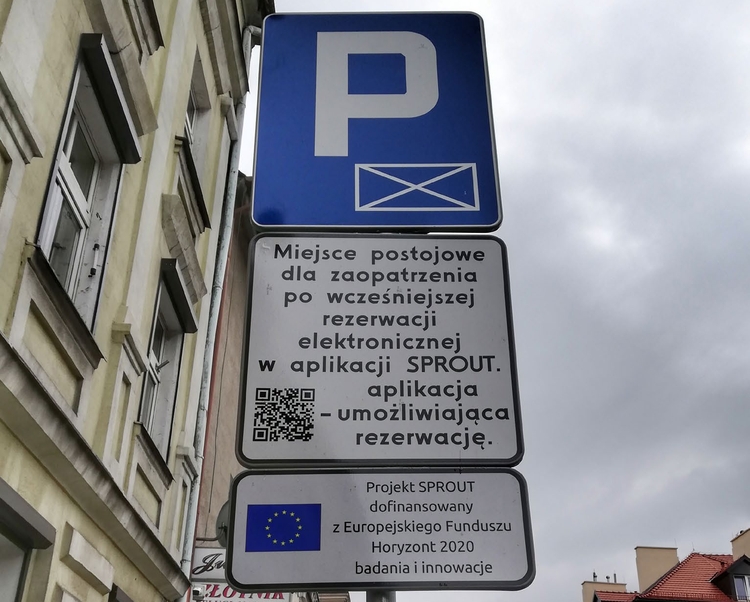
Photo: Wiktor Żuchowski
Łukasiewicz – Institute of Logistics and Warehousing, together with the City of Kalisz and the Kalisz Business Incubator, is implementing a project aimed at improving the organization and management of loading/unloading operations in the city center through the implementation of an intelligent unloading bay. The pilot allows not only for the study of flows and the number of transport operations but also practically verifies knowledge about mobility in the city and will enable the development of recommendations for policies developed in this area.
As part of the Kalisz pilot, a concept for introducing a digital solution was developed and tested in practice. The concept is based on the implementation of a sensor network using Internet of Things (IoT) technology, which enables access to transport data in real-time and dynamic management of unloading operations in the city. The target users are urban freight transport drivers who can reserve a parking space using mobile phone applications – an interface between users and the IoT management system.
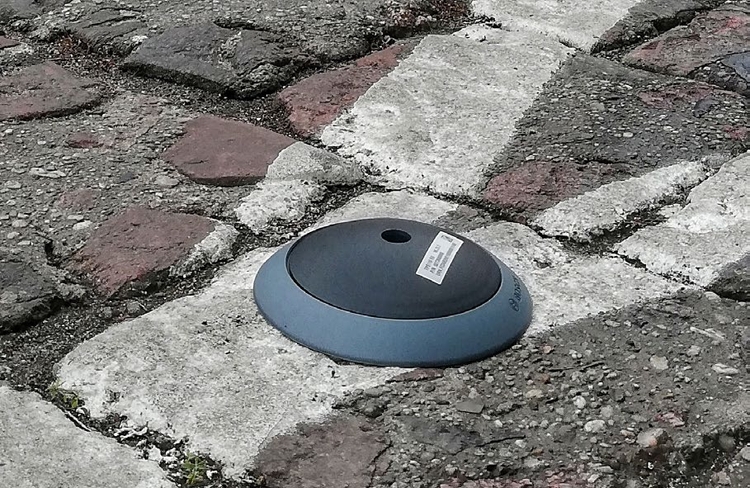
Photo: Wiktor Żuchowski
The developed pilot solution allows drivers to book a parking space in advance, ensuring the possibility of driving directly to the transshipment point and parking in a pre-selected spot near the destination. The goal of the solution is to reduce unnecessary truck traffic and maneuvering, as well as to increase the safety of pedestrians and drivers during the entire transport operation.
As a result of the project, it was determined that the bays are used on average 9 times a day. This is a relatively small number, however, when analyzing this result, two significant phenomena that influence the final popularity of the solution should be kept in mind. The first is the pandemic, with its unknown impact on urban deliveries. The second is the very short average time of transshipment operations (nearly 40% last less than 5 minutes), allowing drivers to park in non-designated places and thus avoid fees. This also has a logical explanation – parking in a prohibited place (as close as possible to the destination) usually shortens the manual transport route, and thus additionally reduces the duration of the entire operation.
Most transshipment activities take place between 6:00 AM and 6:00 PM. At other times, the transshipment bays could be used for parking private cars, especially in densely populated areas. Introducing such rules would require changes in local policy and disciplining drivers to vacate parking spaces in the early morning hours. However, this would allow for more efficient use of available parking spaces in the crowded city center.
Another conclusion from the project is the need to verify the demand for bay reservations each time before starting any potential implementation. It is difficult to indicate what level of bay utilization justifies the introduction of reservations – at what level of availability will drivers decide to use the reservation option.
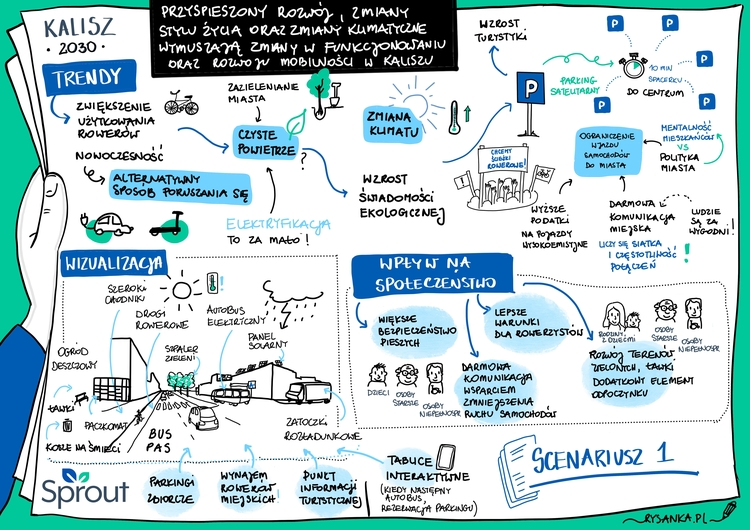
Author: RysAnka
Another pillar of the project, allowing for the achievement of the assumed goals, was a series of creative workshops, activating stakeholders from Kalisz to talk about trends influencing the city’s development in the future and predicted directions of change over the next ten years. A key aspect of the activities was the selection of the most cross-sectional group of stakeholders – that is, on one hand, organizations, companies, associations, and individuals who have an influence on shaping urban mobility in Kalisz, and on the other – groups of users who actively use and will use the current and future logistics infrastructure of the city, as well as the introduced solutions and services. The meetings provided an excellent platform for exchanging views and listening to the expectations of various stakeholder groups – representatives of administration, business, and society. As a result of the joint work, three alternative development scenarios for “Kalisz 2030” were created.
The first workshop focused on analyzing how various types of global trends can change the functioning of the city, depending on what the direction of change will be in the future. The most important question that the workshop participants had to answer was: what will the future of urban mobility look like in 10 years and what impact will global trends and different directions of their development have on its transformation? Aspects of tax policy, economy, demography, tourism, digitalization, and social changes in the area of ecological awareness and the broadly understood lifestyle of residents were analyzed, among others. At this stage, the probability of individual factors occurring (e.g., crisis or economic growth) was not assessed; the goal was to predict hypothetical consequences for mobility in Kalisz.
The next meeting aimed to develop alternative scenarios for the development of the situation in terms of mobility in the city until 2030. They took the form of coherent stories describing the potential evolution of mobility. Users received the first draft, obtained thanks to software that consistently and logically combined previously defined factors and trends, thus creating three different visions of the future. The main task of the stakeholders was to refine the scenarios and enrich their content. During the workshops, various creative techniques were used. For each of the alternative scenarios, among other things, headlines of articles that could appear in newspapers in 2030 were developed. It was also discussed what elements of infrastructure, devices, vehicles, and services should be placed on the visualization of a “typical city street” of Kalisz in 2030 and how a series of changes will affect different social groups. Ideas, insights, and comments were recorded live in the form of graphic notes, so that immediately after the workshops, participants could see the result of their work. By talking about potential trends and trying to predict the effects of various phenomena, the stakeholders of Kalisz have the opportunity to prepare for upcoming changes.
The effects of the SPROUT project are ready to be used by city authorities, and the scale of their potential implementation remains at their discretion. The project contractors are ready to implement similar activities in other innovation-friendly metropolitan areas.
The article comes from the magazine LOGISTYKA 2/2021.
This issue of the magazine is available for sale!