Currently functioning supply chains are being improved at all stages of their operations, starting from the supply of materials, through planning and production of finished goods, to the distribution of goods. Enterprises strive to eliminate all imperfections encountered in the flow of goods to customers. The focus on the delivery of products to the customer is so great that other elements in the area of logistics that affect company costs are often forgotten. These include, among others, pallet management.
Currently, increasing attention is being paid to the flows of materials, waste, and packaging coming from customers and returning to enterprises. While the flow of complaint returns is constantly monitored (to build the best possible customer relationships), the flow of returnable packaging returning from the customer is often overlooked. In this context, an auxiliary device such as a flat pallet can be identified as returnable packaging.
Many transport companies use a so-called pooling system for pallet turnover. Pooling systems are divided into open systems – a collection of exchangeable pallets that can be used by all participants in a given trade flow, and closed systems – a collection of pallets used only by entities served by the operator, which are its property. In such a case, the owner of the pallets is the operator of a specific pallet pool, who rents the carriers to their customers. They are delivered to customers where palletized load units are formed, and subsequently, they are sent through the operator’s transport network to final customers.
The existing state of the enterprise in terms of pallet management
The flow of pallets through the transport network of the studied enterprise takes place according to the open pallet pool illustrated in Figure 1. First, new pallets are ordered directly from the manufacturer. At the time of delivery to the customer, they are checked for quantity and quality. This allows for filing complaints and potentially returning individual pallets or the entire delivery. Upon acceptance, the pallets are appropriately divided according to customer balances; then they are secured and returned to customers – distribution companies. At their location, palletized load units are formed, which are then delivered by the transport company to the final customers – the recipients of the goods. At this point, there are 2 possibilities for the further fate of the pallets. They can either remain with the customer on the pallet balance and be collected in the future, or the customer must issue a pallet in return. Since it is very rare for a customer to be able to unload a delivery immediately and return to the driver the same carrier on which the goods were delivered, another pallet is often issued, which must also meet EUR/EPAL standards. Subsequently, the pallets return to the transport company, where they undergo quantitative and qualitative inspection, and decisions are made about their further fate – whether they will be reintroduced into circulation, whether they require repair, or whether they need to be scrapped.
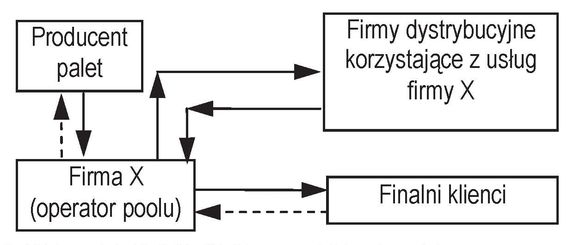
Fig. 1. Relationships within an open pallet pool (dashed arrows symbolize return flows).
Source: own elaboration based on: Jacyna M., Lewczuk K., Designing Logistics Systems, PWN Scientific Publishing House, Warsaw 2016.
The pallet system managed in this way generates a very high workload associated with the constant need for quantitative and qualitative control of pallets. Every time the carriers reach the transport company, they are subjected to an inspection process to eliminate the introduction of low-quality carriers into circulation. In order to size them in terms of costs, the methodology contained in the book: Jacyna M., Lewczuk K., Designing Logistics Systems, PWN Scientific Publishing House, Warsaw 2016 was used. Tables 1-7 contain an annual summary of the values of auxiliary parameters necessary to determine the costs generated by the currently used pallet management system. It was additionally assumed that the constant monthly number of new pallets purchased by the company is 325. This generates annual costs of: 325 [pallets/month] x 12 [months/year] x 25 [PLN/pallet] = 103,500 [PLN/year].
The total pallet costs are then: 12,600 [PLN/year] + 103,500 [PLN/year] = 116,100 [PLN/year]. It was assumed that one pallet space (ps) consists of 15 pallets.
Transport companies purchasing new pallets from manufacturers often return carriers that do not meet Euro standards when buying new ones. Thanks to this action, they get rid of the problem of carrier disposal, while manufacturers often use wood from such pallets in the production of blocks.
The entire article is available below in PDF format.
The article comes from the magazine LOGISTYKA 6/2018.
The e-edition of the magazine is available in our offer!