









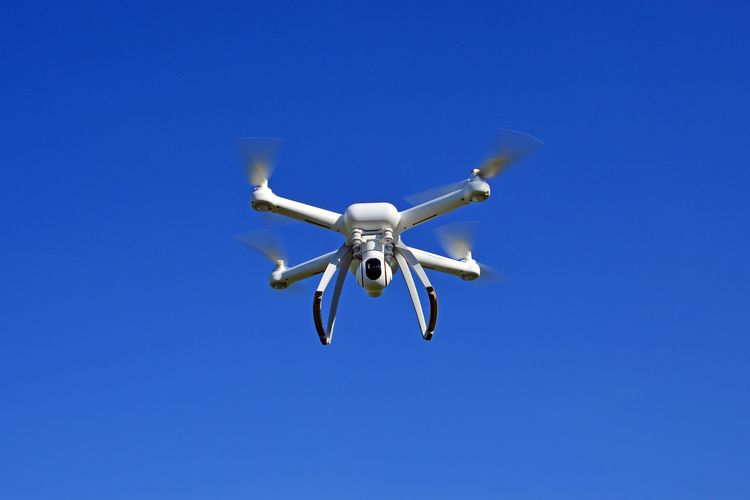
Simulating the addition of multiple distributed drones to live air traffic – this is, in short, what the NaviLab project is about, which will be launched as part of the cooperation between the Polish Air Navigation Services Agency (PANSA) and the Poznań Supercomputing and Networking Center (PSNC). This simulation laboratory will allow for the creation of an air traffic management system that will be even more fluid and safe. And it will be assisted by the immense computing power of the Poznań supercomputer.
NaviLab is another element of the cooperation between PANSA and PSNC under the NaviHub initiative. It is a software laboratory that will enable the use of air traffic management systems currently used by controllers for simulation and testing purposes. This will allow for the safety analysis of introducing a large number of distributed Unmanned Aerial Vehicles (UAVs) into Polish airspace, which will share this space with manned aircraft.
NaviLab allows for simulating the addition of virtual drones to real traffic in the Polish sky. Thanks to this, it will be possible to study the impact of UAVs on air traffic safety, airspace capacity, as well as the external environment. Based on NaviLab simulations, various solutions regarding flight coordination methods will be tested, as well as airspace configuration to meet the needs of not only manned but also unmanned flights. In all classes of airspace and at all altitudes, including very low ones. The launch of NaviLab will take place in April of this year. Thanks to the cooperation between PANSA and PSNC, the computing power of the Poznań supercomputer and the infrastructure of the broadband national research network PIONIER (Polish Optical Internet) will be used to conduct these complex simulations.
A key advantage of NaviLab will be the ability to conduct comprehensive research and tests in an environment as close to reality as possible. Simulations conducted in this way will help in developing new solutions that will ensure the highest air traffic safety in an increasingly complex space. Among other things, a system for dynamic airspace configuration will be developed for the needs of managing distributed traffic of autonomous unmanned aerial vehicles and air taxis, which will be used in the construction and organization of the U-Space for the Solidarity Transport Hub (CPK) and urban areas.
Modern and fully digital technologies will make the air traffic management system even more fluid and resistant to various types of external factors, such as a sudden increase or decrease in air traffic.
NaviLab is part of a joint initiative by PANSA and PSNC called NaviHub. It is a platform connecting the knowledge, competencies, and experience of institutes, universities, enterprises, and aviation facilities. The goal of NaviHub is to create and test modern solutions for navigation and air traffic, which will be used at both existing and new airports in Poland.
Source: PANSA