









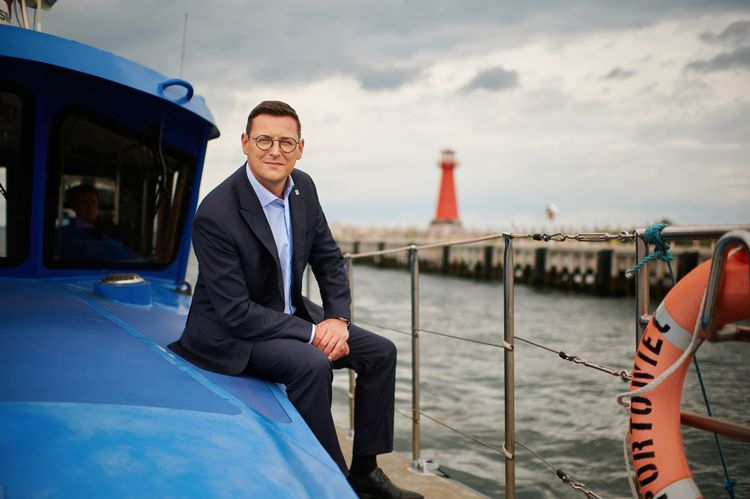
Janusz Mincewicz talks to Łukasz Greinke, President of the Port of Gdańsk.
Janusz Mincewicz: Shouldn’t Poland place greater emphasis on the development of intermodal transport within the Baltic – Adriatic Corridor, expanding the reach of Polish ports to include the Czech Republic, Slovakia, Austria, Hungary, Ukraine, and Belarus?
Łukasz Greinke: Our goal is to attract cargo from the Czech Republic, Slovakia, and Hungary. We are an alternative gateway to the world for these countries. Together with the National Chamber of Maritime Economy, we organize, for example, meetings for the logistics industry of the Czech Republic, Slovakia, and Hungary. We showcase the potential of our terminals. Currently, DCT Gdańsk, the largest container terminal on the Baltic Sea, has also started activities in this direction. It has opened a representative office in the Czech Republic to familiarize entities responsible for supply chains with the nature of our port’s operations. We have very good relations with Slovakia, where cars are manufactured, and the company responsible for their distribution, Hyundai Glovis, uses the Port of Gdańsk in its logistics chain. The same applies to the Citronex group and the distribution of bananas, which travel from the port to the headquarters in Zgorzelec and then to recipients in the Czech Republic, Slovakia, and Hungary. We are aware that there are still many challenges ahead. Together with DCT Gdańsk, we have prepared a study that analyzes the so-called “white spots” on the railway, which is the main means of transport regarding relations with our neighbors, causing limitations in transport. We are also waiting for the construction of the final sections of the A1 motorway, which will significantly speed up travel from the Czech Republic to Gdańsk. The economic calculation will work in our favor, and I am convinced that it is only a matter of time before these markets are convinced by us. I think it is good news that Hungary has opened its consulate in Gdańsk, which shows that it is not only us who are looking for common business relations.
J.M.: For several years, transshipments have been growing at the Port of Gdańsk and other Polish ports. Do they have a chance to compete with the largest German and Dutch ports?
Ł.G.: Let us remember that just a dozen or so years ago, the largest “Polish” container port was the German port of Hamburg. Currently, freight rates are the same from/to Asia (China, Korea, Malaysia, Japan) to the Northern Europe region, specifically from the port of Le Havre through Antwerp, Rotterdam, Bremerhaven, and Hamburg to Gdańsk. The cost of transport from the transshipment port to the final recipient must be as short as possible, because land transport: rail, and even more so road, is several or a dozen times more expensive per unit cost of cargo than sea transport. The economies of Central and Eastern European countries are no longer emerging markets, but increasingly mature market economies that need more and more goods based on cheap transport. Recipients located in the Czech Republic, Slovakia, Belarus, Ukraine, and above all in Poland use the Port of Gdańsk, from which it is 530 km to Silesia, while from Hamburg it is over 800 km, and from Rotterdam 1200 km; it is similar with other cities in our region; we are already handling 4-5% of the Czech and Slovak market, among other things, thanks to the launch of a regular train from Ostrava to the Port of Gdańsk three years ago. Geography, and above all economics, naturally chooses transport routes and corridors, and these will clearly rely more and more on handling cargo passing through the quays of the Port of Gdańsk in the case of serving countries in our region. Our goal is to continuously strengthen our position. Thanks to investments and clearly defined directions, our contractors are increasing their transshipment capabilities, and the Port of Gdańsk is growing in strength. We are already a port without limitations. This is influenced by: the deep-water fairway, thanks to which we can receive the largest vessels with a draft of up to 15 meters in the Outer Port; the lack of tides, i.e., constant water depth, as well as the lack of icing, allowing for year-round operation. In the first half of 2020, we advanced to the group of the 20 largest ports in Europe in terms of transshipment volume. And not so long ago, this was unattainable for us. Of course, we are still a bit behind the European leaders, but as you can see, we are gradually climbing up.
J.M.: Is the port’s infrastructure already at a world-class level?
Ł.G.: Currently, nearly 40 investments at various stages of advancement are being implemented and planned at the Port of Gdańsk. Their total value today reaches PLN 6 billion. These are investments carried out by the Port of Gdańsk, the Maritime Office, PKP PLK, as well as contractors operating in the port area. The Port of Gdańsk has not experienced such a scale of investment since the 1970s. We are carrying out multi-million investments, modernizing and deepening the fairway in the Inner Port, and expanding the quays, thanks to which not only is the accessibility to the inner part of the Port of Gdańsk for larger ships improving, but above all, this means increased transshipment capabilities for our operators. After the completion of the investments, the port channel will gain in width and depth. The total length of the modernized quays is almost 5 km, plus a 7-kilometer fairway. A significant part of these tasks has already been completed or is in the final phase of implementation. The completion and acceptance of all works are planned for the second half of this year.
J.M.: Thank you for the conversation.