









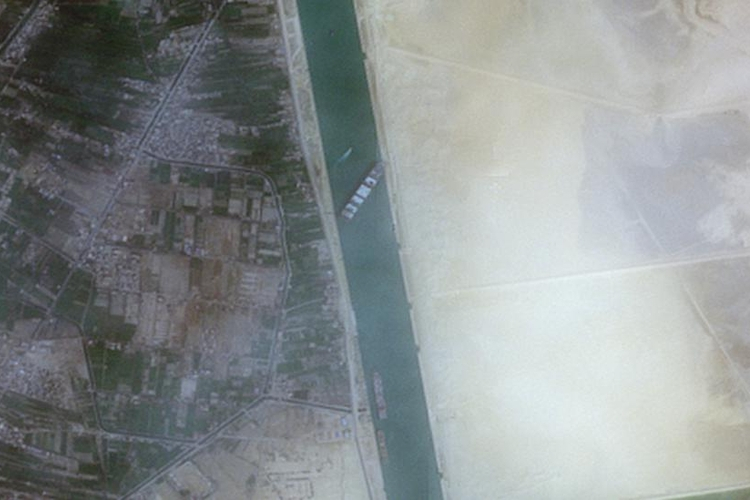
This is the third day of the struggle to clear traffic in one of the most frequented “bottlenecks” of global maritime trade routes. The 220,000-ton container ship Ever Given hit the eastern bank of the Suez Canal, eventually running aground with its bow and stern in the coastal shallows and completely blocking the waterway. Refloating the ship could take even several weeks.
We can learn about the current situation in the Suez Canal thanks to images taken by the European Copernicus satellite.
– Satellite imagery provides a broader perspective on the unfolding situation in the Egyptian Suez Canal, where a massive container ship has become stuck sideways, blocking the busy canal. In images from the European Copernicus Sentinel-2 satellites, we see not only the situation of the Ever Given container ship itself but also many other vessels waiting for the opportunity to enter the canal on both sides – comments Dr. Sylwia Nasiłowska, Product Manager at CloudFerro. – Data from satellites also gives us the ability to analyze the characteristics of the observed phenomena. The incident in the Suez Canal was recorded by both of the flagship European satellite systems of the Copernicus program: Sentinel-1 and Sentinel-2, the day after the event.
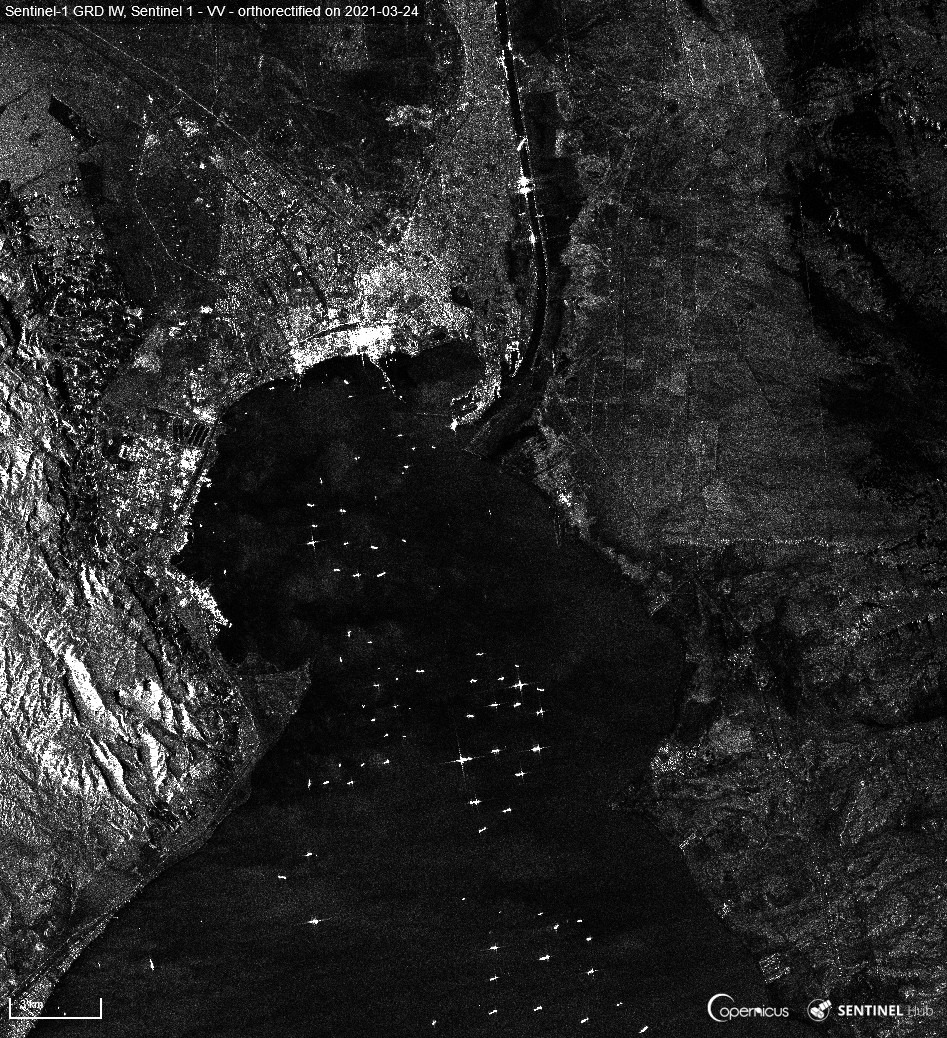
Photo: CREODIAS.eu
– The Suez Canal has been blocked by a mega-container ship 400 meters long with a tonnage of 224,000 tons. At the moment, it is loaded with about 10,000 40-foot containers (20,000 TEU) – says Marek Grzybowski, President of the Baltic Sea and Space Cluster.
According to experts, some of these types of units are too large to traverse the canal connecting the Mediterranean Sea with the Red Sea.
The ship’s operator, Taiwan’s Evergreen Marine Corporation, issued a statement admitting that the ship was overcome by strong winds as it entered the canal from the Red Sea. For several days, attempts have been made to pull the container ship off the shallows and clear the Suez Canal. Since then, long traffic jams have been forming on the waterway, preventing ships from passing through the sea route, causing delays and large financial losses. More than 160 ships have already been blocked in this way, and their number is still growing.
 – At the moment, about 160 ships are waiting on both sides of the canal. Among them are 41 bulk carriers and 24 tankers – lists M. Grzybowski. – And every day of the canal’s downtime means millions of tons of undelivered cargo. Goods worth about $40 billion are on ships waiting to pass through the Suez Canal. As a result of the blockage of the Suez Canal by the mega-container ship Ever Given, goods (general cargo, bulk, oil, and fuels) worth $9.6 billion are not moving daily on the detained ships. The blockade has meant that goods worth $400 million do not reach the markets of Asia, Europe, and the Middle East every hour.
Such large losses, caused by the delay in traversing the sea route and the uncertain date for clearing the canal, are causing some container ship operators to decide on an alternative route and sail around the entire African continent, which, however, will extend transport by another 10 days.
The Suez Canal lies on one of the world’s most important trade routes. It is through this “bottleneck” that 19,000 vessels pass annually, accounting for 10 percent of all international freight traffic. This is, among other things, the main route for tankers from the Middle East and container ships sailing from China to Europe. This is not the first such serious incident to have occurred in this place in recent years. Similar blockades took place in 2014, when two container ships collided, and in 2018, when one of the ships had an engine failure.
Photo: EPA/European Space Agency Copernicus Sentinel-2 Satellite Image and CREODIAS.eu.