








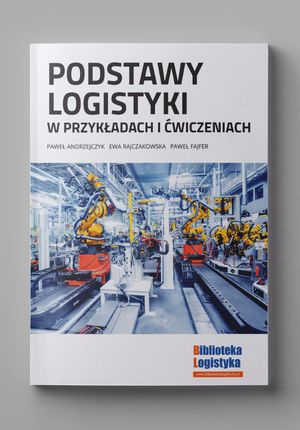
Authors: P. Andrzejczyk, E. Rajczakowska, P. Fajfer
Price: 39.00 PLN
Description:
The book contains over 80 inspiring exercises and examples encouraging interactive work. An additional supplement to the content is a presentation of the most important technical terms, including abbreviations, in English.
Students receive:
– Basic knowledge “in a nutshell” and an extensive set of tasks with varying levels of difficulty.
– Solutions to some tasks following a “step-by-step” scheme.
– A special package of exercises requiring mathematical calculations in a spreadsheet and filling in interactive fields.
– Useful comments and tips regarding the content of more difficult tasks.
Year of publication: 2020
ISBN: 978-83-63186-77-7
Volume: 152 pages
Table of Contents:
1. Introduction to logistics processes and systems
1.1. Processes and systems
1.2. Logistics systems and processes
1.3. Infrastructure of logistics processes
1.4. Planning logistics processes
1.5. Planning production processes – introduction
1.5.1. Master Production Schedule – MPS
1.5.2. Bill of Materials – BOM
1.5.3. Inventory file – INV
1.5.4. Material Requirements Planning – MRP
2. Information flow in logistics
2.1. Identification standards used in logistics
2.2. Principles of cargo labeling in logistics
2.3. Automatic identification systems used in logistics processes
2.4. IT systems used in logistics
2.5. Electronic Data Interchange
3. Functioning of the supply chain and logistics networks
3.1. Organizing flows in supply chains
3.2. Organizing flows in logistics networks
3.3. Logistics centers
3.4. Functioning of logistics centers
3.5. Evaluation of the functioning of a logistics center
3.6. Indicators in supply chains
3.7. Indicators in logistics networks
4. Statistical tools used in logistics
4.1. Introduction to statistics
4.2. Basic statistical tools
4.3. Forecasting – introduction
4.4. Simple statistical models
4.4.1. Naive model
4.4.2. Simple arithmetic mean
4.4.3. Moving arithmetic mean
4.5. Exponential smoothing – simple Brown’s model
4.6. Trend – simple linear regression model
4.7. Seasonal fluctuations
4.8. Econometric model
4.9. Testing the correctness of selected statistical methods
4.10. Cross-sectional task