








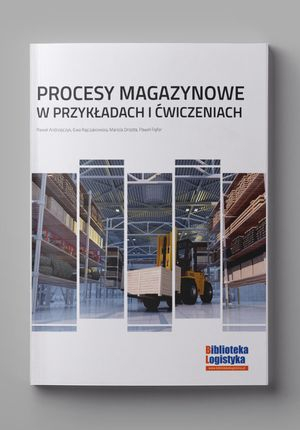
Authors: P. Andrzejczyk, E. Rajczakowska, M. Drozda, P. Fajfer
Price: 49.00 PLN
Description:
Warehouse Processes in Examples and Exercises is a collection of over 250 original exercises for self-study, illustrated with numerous practical examples and theoretical commentary. The book clearly guides the reader through basic warehouse processes. Anyone who diligently completes the presented tasks will gain new competencies and skills in the following areas:
– organizing warehouse processes based on algorithms,
– load unitization,
– planning warehouse layout based on storage systems,
– organizing picking processes using modern methods in this area,
– determining specific warehouse indicators,
– preparing and checking the accuracy of warehouse documentation.
The added value of this exercise book is its bilingual nature. Since some tasks are presented in English, the work aligns with current trends in vocational education.
The book is addressed to future specialists training in the professions of: logistics technician, freight forwarder technician, port and terminal operations technician. It will also be useful for students pursuing education in fields related to the broadly understood TSL (Transport-Shipping-Logistics) industry. The theoretical and practical material has been developed in such a way that it can also serve as a kind of industry guide for distribution center employees.
Year of publication: 2019
ISBN: 978-83-63186-69-2
Volume: 256 pages
Table of Contents:
Introduction
1. Warehouse processes – introduction to algorithms
1.1. Warehouse – basic concepts
1.2. Processes carried out in the receiving area (goods receiving scheme in the warehouse)
1.3. Inventory storage in the warehouse (goods storage scheme in the warehouse)
1.4. Order picking (goods picking scheme in the warehouse)
1.5. Shipping area (goods dispatch scheme from the warehouse)
1.6. Progress test
2. Warehouse processes carried out in the receiving area
2.1. Receiving area – introduction
2.2. Receiving area – typical operations
2.3. Receiving area – moving loads in the warehouse, determining the number of transshipment stations and their parameters
2.4. Receiving area – moving loads in the warehouse. Warehouse truck cycle time
2.5. Receiving area – moving loads in the warehouse. Unloading time of an external means of transport using a warehouse truck
2.6. Receiving area – moving loads in the warehouse. Determining the number of internal transport vehicles
2.7. Progress test
3. Storing goods in the warehouse
3.1. Load unit – introduction
3.2. Packaging in TSL systems – introduction
3.3. Packaging dimension system
3.4. Forming a load unit – introduction
3.5. Warehouse modules in rack storage
3.6. Warehouse modules in block storage
3.7. Warehouse module volume
3.8. Storage with stacking of load units
3.9. Progress test
4. Warehouse processes carried out in the picking and shipping area
4.1. Picking area – introduction
4.2. Picking area – order picking
4.3. Order picking vs. collective packaging configuration
4.4. Cardboard packaging – basic types of cardboard
4.5. Planning the picking route in relation to process execution time
4.5.1. Planning the picking route using the S-Shape method
4.5.2. Planning the picking route using the Midpoint method
4.5.3. Planning the picking route using the Return method
4.5.4. Planning the picking route using the Largest gap method
4.5.5. Planning the picking route using the Combined method
4.6. Analysis of the picking process
4.7. Picking vs. compliance of shipments and loading
4.8. Shipping area vs. compliance of order picking
4.9. Progress test
5. Warehouse documentation
5.1. Warehouse documentation – introduction
5.2. Warehouse manual
5.3. OHS instructions in warehouse processes
5.4. Scope of employee activities (duties)
5.5. Rules for filling out warehouse documentation
5.6. Order
5.7. Delivery note
5.8. Pz document (receipt from outside)
5.9. Mm document (inter-warehouse transfer)
5.10. Rw document (internal issue)
5.11. Pw document (internal receipt)
5.12. Wz document (external issue)
5.13. Zw document (internal return)
5.14. Invoice
5.15. Warehouse card
5.16. Examples of English-language warehouse documents
5.17. Examples of bad practices when filling out warehouse documentation
5.18. Progress test
6. Determining warehouse location and calculations related to its operation
6.1. Determining warehouse location using the center of gravity method – demand version
6.2. Determining warehouse location using the center of gravity method – supply-demand version
6.3. Metrics and indicators defining warehouse efficiency – introduction
6.4. Metrics and indicators defining the efficiency of warehouse area and space utilization – practical exercises
6.5. Metrics and indicators defining the efficiency of warehouse operations
6.6. Metrics and indicators defining the economic aspects of warehouse operations
6.7. Progress test
7. Cross-sectional tasks
7.1. Task 1. Circulation of warehouse documents
7.2. Task 2. Warehouse documentation related to the execution of a production order