








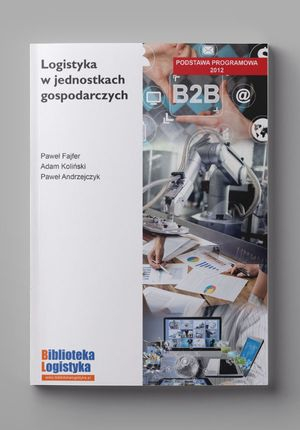
Authors: M. Stajniak, M. Hajdul, M. Foltyński, A. Koliński, P. Andrzejczyk
Price: 19.00 PLN
Description:
The textbook titled “Logistics in Business Entities” has been developed in accordance with the assumptions of the new core curriculum for the logistics technician profession and contains a systematic presentation of thematically related learning outcomes described in the first part of qualification A.32 “Organization and monitoring of the flow of resources and information in organizational units.” The book discusses the most important issues related to the flow of information in enterprises and the IT tools that improve it. The authors also draw attention to the importance of documents accompanying moving goods and information. An equally important issue presented in the textbook is waste management, which arises during processes carried out in supply chains. After mastering the material contained in the textbook, a future logistics technician will be able to, among other things: – use measures and indicators for assessing the efficiency of the flow of information and resources in business entities, – use various forms of communication and transmit information between cooperating organizational units, – prepare documentation regarding waste management.
Year of publication: 2015
ISBN: 978-83-63186-01-2
Volume: 238 pages
Textbook approved for school use
Table of Contents:
Table of Contents
Preface
1. Business entities
1.1. Introduction and basic definitions
1.2. Characteristics of civil and commercial law companies
1.2.1. Civil partnership
1.2.2. Registered partnership
1.2.3. Professional partnership
1.2.4. Limited partnership
1.2.5. Limited joint-stock partnership
1.2.6. Limited liability company
1.2.7. Joint-stock company
1.3. Cooperatives
1.4. State-owned enterprises, state and local government legal entities
1.4.1. State-owned enterprise
1.4.2. State legal entities
1.4.3. Local government legal entities
1.5. Foundations and associations
1.5.1. Foundation
1.5.2. Association
1.6. Types of enterprise activity
1.6.1. Trading enterprise
1.6.2. Manufacturing enterprise
1.6.3. Service enterprise
1.7. Skills and knowledge test
2. Flow of resources and information between organizational structure units
2.1. Organizational units in business entities
2.2. Flow of resources in business entities
2.3. Flow of information in business entities
2.4. Controlling and evaluating the efficiency of flows in a business entity
2.5. Efficiency of information flow in a business entity
2.6. Skills and knowledge test
3. Acquiring information for the needs of logistics activities in a business entity
3.1. Basic definitions
3.1.1. Data and information – definitions and classification
3.1.2. Information system and IT system
3.2. Information systems
3.2.1. Transaction systems
3.2.2. Management information systems
3.2.3. Decision support systems
3.2.4. Expert systems
3.2.5. Artificial intelligence systems
3.3. Information systems in logistics
3.4. IT systems in an enterprise
3.4.1. Enterprise Resource Planning (ERP) systems
3.4.2. Warehouse Management Systems (WMS)
3.4.3. Customer Relationship Management (CRM) systems
3.4.4. Supply Chain Management (SCM) systems
3.5. Skills and knowledge test
4. Organizing work in business entities according to logistics principles
4.1. Principles of work organization in business entities
4.1.1. Organization and its environment
4.1.2. Fundamentals of organization management
4.1.3. Principles of work organization
4.1.4. Information flow within the organization
4.1.5. Forms of communication in organizations
4.1.6. Storage and protection of information
4.2. Cooperation of organizational units in the scope of logistics flows
4.3. Flow of documents of cooperating organizations
4.4. Skills and knowledge test
5. Functioning of business entities and environmental protection
5.1. Fundamentals of ecologistics in logistics processes
5.2. Circulation of physical goods in the economy
5.3. Places of waste generation
5.4. Types of waste
5.5. What distinguishes waste from non-waste in logistics processes
5.6. Principles of waste management
5.7. Integrated waste management systems based on logistics principles
5.8. Environmental protection in logistics processes
5.9. Ecologistics as a tool for sustainable development
5.10. Ecologistic supply chain
5.11. National law in the field of waste management
5.12. Basic documents in waste trading
5.12.1. Waste transfer note
5.12.2. Waste record card
5.12.3. Hazardous waste transfer note
5.13. Examples of applying ecologistic solutions in logistics processes
5.14. Skills and knowledge test
Glossary of basic terms in Polish, English, and German
List of English abbreviations and acronyms
Bibliography