








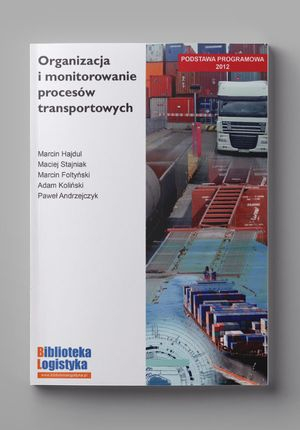
Authors: M. Stajniak, M. Hajdul, M. Foltyński, A. Koliński, P. Andrzejczyk
Price: 43.00 PLN
Description:
The textbook titled “Organization and monitoring of transport processes” has been developed in accordance with the assumptions of the new core curriculum for the logistics technician profession and contains a systematic presentation of thematically related teaching content described in the first part of qualification A.31 “Management of technical resources during the implementation of transport processes”.
After mastering the material contained in the textbook, a future logistics technician will be able to, among other things:
– organize transport tasks,
– correctly plan shipments and create their schedules,
– prepare transport documentation, – evaluate the quality of transport processes,
– apply international standards for cargo identification and data exchange.
The textbook contains many examples from the practice of transport companies, thanks to which students will find answers to questions such as:
– what services can a freight forwarder provide,
– what regulations govern transport services,
– what IT systems support the management of transport processes,
– what is involved in pricing transport services,
– what is involved in analyzing the efficiency of transport companies,
– what are the measures and indicators for evaluating the efficiency of transport processes.
Year of publication: 2015
ISBN: 978-83-63186-01-2
Volume: 238 pages
Textbook approved for school use
Table of contents:
Preface
1. Transport processes in logistics activities
1.1. Transport – basic information
1.2. Branches of transport and its classification
1.3. Characteristics of transport activity
1.4. Structure of the transport process
1.5. Transport in supply chains
1.6. The importance of transport in logistics systems
1.7. Outsourcing of transport services
1.8. Ecological aspects in transport management
1.9. Skills and knowledge test
2. Transport infrastructure
2.1. Point infrastructure of road transport
2.2. Linear infrastructure of road transport
2.3. Point infrastructure of rail transport
2.4. Linear infrastructure of rail transport
2.5. Point infrastructure of air transport
2.6. Linear infrastructure of air transport
2.7. Point infrastructure of maritime transport
2.8. Linear infrastructure of maritime transport
2.9. Point infrastructure of inland waterway transport
2.10. Linear infrastructure of inland waterway transport
2.11. Point infrastructure of intermodal transport
2.12. Linear infrastructure of intermodal transport
2.13. Skills and knowledge test
3. Functioning of the transport and forwarding market
3.1. Forwarding – basic information
3.2. Classification of freight forwarders
3.3. Stages of forwarding
3.4. Functioning of a forwarding company in the transport services market
3.5. Demand in the transport services market
3.6. Supply in the transport services market
3.7. Factors influencing the supply of transport and forwarding services
3.8. The course of the forwarding process in international trade
3.9. Skills and knowledge test
4. Legal regulations used in transport and forwarding activities
4.1. Law in transport activity
4.2. Law in forwarding activity
4.3. Provision of transport services in the light of legal regulations
4.4. Provision of forwarding services in the light of the Civil Code
4.5. INCOTERMS®2010 trade terms
4.6. Skills and knowledge test
5. Basic conventions and acts concerning transport
5.1. Basic conventions and acts concerning road transport
5.2. Basic conventions and acts concerning rail transport
5.3. Basic conventions and acts concerning water transport
5.4. Basic conventions and acts concerning air transport
5.5. Skills and knowledge test
6. Transport and forwarding documents
6.1. Transport and forwarding documents – basic information
6.2. Basics of preparing transport and forwarding documents
6.3. Documents accompanying forwarding and their circulation
6.3.1. Request for quotation
6.3.2. Forwarding order
6.3.3. Shipping instructions
6.3.4. Forwarding contract
6.4. Transport documents
6.5. Transport documents – road transport
6.5.1. Domestic road consignment note
6.5.2. International road consignment note (CMR)
6.6. Transport documents – rail transport
6.6.1. Domestic rail consignment note
6.6.2. CIM consignment note
6.6.3. SMGS consignment note
6.7. Transport documents – water transport
6.7.1. Bill of Lading
6.8. Transport documents – air transport
6.8.1. Air Waybill (AWB)
6.9. Skills and knowledge test
7. Information flow in transport processes
7.1. Information flow in transport processes – basic information
7.2. IT systems supporting the management of transport processes
7.3. Transport exchanges and logistics platforms
7.4. Integration of information flow in transport processes
7.5. Skills and knowledge test
8. Organization of the transport process
8.1. Organizing transport tasks – basic information
8.2. Means of transport and their role in the organization of transport processes
8.3. Elements of the transport process affecting delivery time
8.4. Planning the course of the transport process
8.5. Planning transport tasks
8.6. Determining the capacity of the transport network
8.7. Criteria for selecting means of transport
8.8. Simple methods of planning transport processes
8.8.1. Northwest corner method
8.8.2. Least cost method
8.9. Transport models
8.9.1. Shuttle model
8.9.2. Continuous shuttle model
8.9.3. Radial model
8.9.4. Circuit model
8.9.5. Relay model
8.9.6. Transit shipments
8.10. Planning and scheduling shipments in practice
8.11. Skills and knowledge test
9. Prices and tariffs in transport
9.1. Prices of transport services – basic information
9.2. Tariff systems in transport
9.3. Prices and tariffs in road transport
9.4. Prices and tariffs in rail transport
9.5. Prices and tariffs in air transport
9.6. Prices and tariffs in maritime transport
9.7. Prices and tariffs in intermodal transport
9.8. Skills and knowledge test
10. Efficiency of transport processes
10.1. Efficiency of transport companies’ operations – basic information
10.2. Measures and indicators for evaluating the efficiency of transport processes
10.3. Analysis of transport process outsourcing
10.4. Analysis of transport process quality
10.5. Skills and knowledge test
Glossary of basic terms in Polish, English, and German
List of English abbreviations and acronyms
Bibliography