









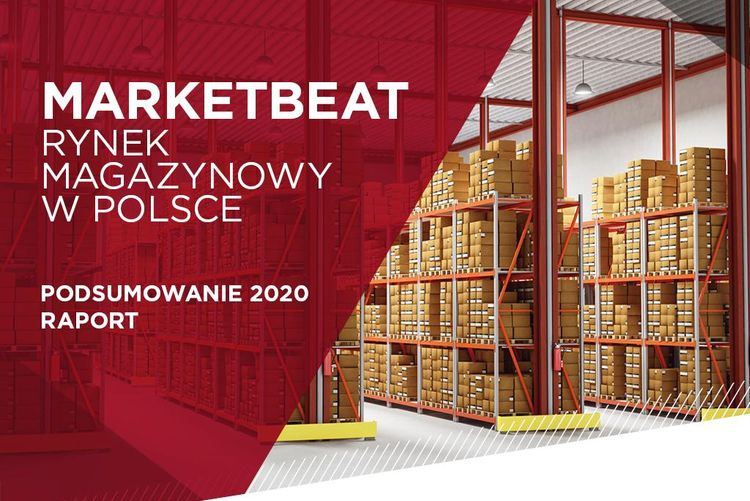
International advisory firm Cushman & Wakefield has summarized the year 2020 on the Polish warehouse real estate market. In 2020, total demand for modern warehouse space reached nearly 5 million sq m for the first time in history, growing significantly by 24% year-on-year. Approximately 3.45 million sq m, i.e., nearly 70% of the total transaction volume, consisted of new leases and expansions.
– Such a high result in tenant activity was influenced both by the implementation of investment decisions made back in 2019 and at the beginning of last year, i.e., in the period preceding the coronavirus pandemic, as well as the rapid growth in the dynamics of the e-commerce sector caused by restrictions on stationary retail in subsequent months of 2020. Lease renewals accounted for the remaining 1.54 million sq m, which also testifies to the specific, high resilience of companies in the warehouse sector under difficult market conditions – says Joanna Sinkiewicz, Head of Industrial & Logistics Agency at Cushman & Wakefield.
In the demand structure, similar to the previous year, the largest share was held by two sectors: logistics/CEP (34%) and retail (17%), driven by growing consumer demand for fast-moving consumer goods (FMCG), electronics/home appliances, and furniture/interior furnishings.
We did not observe significant changes in the level of warehouse rents, although a slight downward trend was visible in some markets due to high supply levels and an increase in vacancies. Base rents range from EUR 2.50-3.80/sq m/month for BIG-BOX facilities to EUR 4.00-5.25/sq m/month for SBU (Small Business Units) facilities in urban areas in key markets. Financial incentives offered by developers usually reach 10-30% of the base rent rate, depending on lease terms. These consist of rent-free periods ranging from one to two months for each year of the lease and financial contributions for selected finishing works or costs of potential tenant relocation.
In the fourth quarter, the amount of warehouse space available for lease decreased by nearly 300,000 sq m.
At the end of Q4 2020, approximately 1.42 million sq m was available for lease on the warehouse market, which accounted for 6.8% of the total supply in Poland. Strong demand growth in Q4 2020 and a relatively low level of new supply compared to previous quarters contributed to a significant drop in vacancy levels by over 300,000 sq m. Lower availability of warehouse space and a high level of pre-let agreements for projects under construction may indicate a likely, slight limitation in the scale of financial incentives offered to tenants in 2021 in some regional markets.
Supply: developer activity remains at a high level
In 2020, nearly 2 million sq m of warehouse space was completed on the warehouse market, and its total stock in Poland increased by 11% y/y. Compared to the record-breaking 2019, the volume of new supply fell by 27% (or 0.74 million sq m). Despite a similar number of completed investments, a significantly lower share of large projects exceeding 50,000 sq m was noticeable. In 2020, it amounted to 370,000 sq m compared to 1 million sq m in 2019, when subsequent large investments for companies such as Amazon, Zalando, Leroy Merlin, Castorama, and Carrefour were finalized. Meanwhile, at the end of last year, over 2 million sq m was under construction, about 100,000 sq m more than a year earlier. Approximately 73% of the volume of investments under construction has already been secured by pre-let agreements, which is a significant increase of 23 pp y/y resulting from both high demand and the tendency to limit speculative investments due to higher market risk during the COVID-19 pandemic.
In 2021, the start of many new development projects is planned, including large ones such as Wrocław CAMPUS 39 by Panattoni Europe (180,000 sq m, Wrocław), 7R Park Gdańsk-Port (123,000 sq m, Tri-City), Hillwood Rokitno (110,000 sq m, Western Poland), or DL Invest Park Teresin (100,000 sq m, near Warsaw).
– In addition to warehouse parks offering larger warehouse modules (BIG-BOX) and BTS (build-to-suit) investments, developers are actively developing investments as part of the gaining momentum trend of “last mile” logistics development. A good example is Warsaw, where developers are implementing subsequent projects of this type in Okęcie, in the Żerań, Targówek Przemysłowy, and Bielany areas. Developers are also targeting other cities in Poland, such as Poznań, Wrocław, Łódź, Kraków, Gdańsk, Gdynia, or Rzeszów. The standard of warehouse facilities is changing, offering convenient solutions for specific operations related to e-commerce logistics or light manufacturing. The ecological trend and automation also have a strong impact on the standard of new facilities. Developers and tenants are increasingly willing to invest in new IT technologies, industrial automation, renewable energy, and a friendly work environment – says Adrian Semaan, Senior Research Consultant, Cushman & Wakefield
Forecast
– While many industries are experiencing huge difficulties due to the pandemic, the warehouse market has recorded strong growth. This is mainly due to long-term development driven largely by the high dynamics of the e-commerce sector, which gained additional importance under the conditions of stationary retail restrictions. Poland’s strategic location at the intersection of major trade routes, as well as further investments in transport infrastructure in connection with the development of urban and cross-border logistics, allow us to look at the market condition in 2021 with optimism. Long-term growth is also predicted by investors, who spent a record EUR 2.6 billion on industrial projects in 2020 – adds Joanna Sinkiewicz.
The full report is available below in PDF format.
The report comes from the website: https://www.cushmanwakefield.com/pl-pl/poland