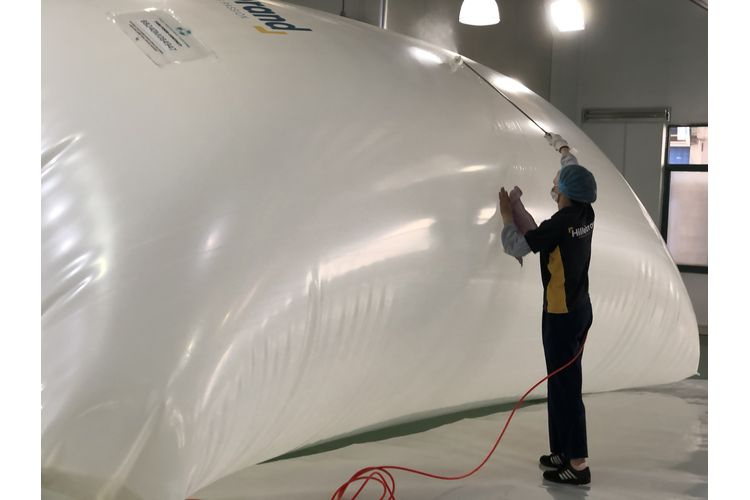
Hillebrand, a global logistics operator specializing in the beverage industry, is implementing recycling processes for its packaging and transport equipment. Flexitanks are safe, efficient, and eco-friendly containers for transporting bulk liquids. Hillebrand has implemented recovery and recycling programs in many of its branches around the world.
Already in the initial design phase of flexitanks, Hillebrand engineers, based on the concept of a circular economy, incorporated 100% recyclable compressed polyethylene (LLDPE) layers into their production. Hillebrand design teams are exploring the possibility of using polymers recycled from old flexitanks in the production of new ones. The Hillebrand engineering team is also conducting research on reducing the thickness of the film used to produce flexitanks without compromising their quality. For example, the newly developed ML flexitanks use 18.6% less plastic than traditional models, which translates into a 1.5% reduction in CO2 emissions.
Three methods of recycling or recovering flexitanks
After unloading at the customer’s site, emptied flexitanks are transported to Hillebrand warehouses. Here, reusable metal parts are removed, and the tank itself is designated for recycling.
Hillebrand uses 3 methods for recycling and recovering flexitanks – mechanical, chemical, and thermal (energy recovery). In the case of tanks that previously carried products such as wine, mechanical recycling is the best solution. Here, the plastic from which the flexitank is made is sorted, cleaned, ground, regranulated, and mixed, and the resin resulting from these processes can be used as a secondary raw material for the production of, for example, construction film, garbage bags, or plastic pipes. This method allows for the preservation of 70% of the energy used, compared to one-time thermal recovery.
The second method is chemical recycling (Advanced recycling), considered a complement to mechanical recycling and dedicated to customers who want to obtain higher quality waste from flexitank disposal for reuse. Here, depolymerization is used in recovery, i.e., the decomposition of polymers into monomers in order to use them as raw material for the production of new polymers with original quality. Another possibility is pyrolysis – converting mixed plastic waste into gasoline for fuel production or new polymers. The waste is processed into raw materials used to produce various types of chemicals and plastics. It is worth emphasizing that 1 ton of plastic waste processed through energy recovery generates 1.8 tons of CO2 compared to chemical recycling, which generates 0.4 tons of CO2. The third solution used by Hillebrand is thermal recycling or energy recovery, which consists of converting waste materials into heat, electricity, or fuel using various methods, including combustion or gasification. It is most often used when removing liquid residues is not economically viable due to their properties.
Choosing the right recycling method
When choosing the appropriate flexitank recycling method, Hillebrand experts must consider several factors. These include legal regulations governing plastic recycling in a given country, which determine the best recovery method and indicate the available infrastructure. An important element of the choice is the scale effect; the more empty flexitanks that need to be disposed of in a given location, the more economically viable it will be to build the appropriate infrastructure. The properties of the transported liquid and how easy it is to remove residues and clean the tank surface are also taken into account.
– In terms of flexitank recycling, we cooperate with an authorized and certified waste management company. We can ensure the delivery of empty flexitanks to the warehouse, where they are emptied and prepared for further recycling and recovery – says Bartosz Mierzejewski, sales manager, Hillebrand Poland.
Hillebrand focuses on sustainable supply chains
Environmental protection and sustainable supply chain activities play a key role in Hillebrand’s corporate social responsibility strategy. The company has set several specific goals in this area, i.e., a 45% reduction in CO2 emissions per container by 2025 (compared to 2008 and by 76% by 2050), and by 2022, 75% of its own flexitanks are to be subjected to recycling or sustainable recovery processes. Among the goals set for this year is, among others, guaranteeing the possibility of recovering and recycling flexitanks in every region of the world. Hillebrand also enables customers to measure greenhouse gas emissions generated during the transport of each shipment within the myHillebrand application. This not only allows for the calculation of the carbon footprint but also for taking actions to facilitate its reduction.
Source: Hillebrand