









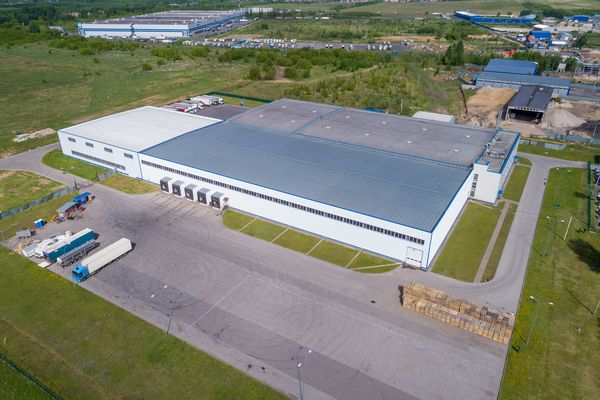
Despite the pandemic, the warehouse market in Poland remains in very good condition. In 2020, modern warehouse space resources increased by over 2 million sq m. Thus, the total supply in Poland reached 20.6 million sq m. Compared to 2019, this is an increase of over 10%. Colliers experts forecast that the high level of supply will also be maintained in 2021.
Warsaw with the largest supply growth
98% of the total supply of modern warehouse space in Poland is located in 11 major markets. Last year, the largest increase in new space compared to 2019 was recorded in Warsaw (566,000 sq m within three zones), Upper Silesia (438,000 sq m), and Wrocław (360,000 sq m).
– The intensive development of the warehouse market in the Warsaw agglomeration shows that the so-called last-mile logistics and small urban warehouses (SBU) serving e-commerce customers are currently gaining importance. In order to minimize the potential risk of losing liquidity in the flow of goods, companies see the need to reorganize and shorten the existing supply chain, hence their interest in warehouses located in cities. These are the products that developers operating on the market are focusing on today. We predict that the trend for renting smaller modules in urban areas will continue in 2021 – predicts Jan Barbasiewicz, Partner, Logistics and Industrial Department at Colliers.
Despite the unusual situation caused by the pandemic, most investments under construction were completed on schedule. The largest projects delivered in 2020 include: A2 Warsaw Park by Panattoni in Grodzisk (103,700 sq m), Hillwood Wrocław Wschód II (63,900 sq m), the next stage of Elite Mszczonów Logistic Park / formerly P3 Mszczonów (58,500 sq m), Panattoni Park Ruda Śląska II (56,000 sq m), Hillwood Oleśnica (53,000 sq m), and 7R Park Gdańsk II (51,800 sq m). Logistics centers of two e-commerce giants were also launched – Amazon opened its largest, eighth center in Poland in Gliwice, while Zalando opened its third location in the country (in Głuchów near Łódź).
– Since the beginning of 2020, we have observed an upward trend in the amount of new space delivered to the Polish warehouse market. While 455,000 sq m were delivered in Q1, it was already 622,000 sq m in Q2, and 671,000 sq m in Q3. In Q4, the pace slowed down and new supply reached 301,000 sq m. At the end of the year, another 2 million sq m were under construction. Developers from other sectors also notice the potential of the warehouse market, which, thanks to the intensive development of e-commerce and the courier industry, is becoming an attractive form of capital investment – says Maciej Chmielewski, Senior Partner, Director of the Logistics and Industrial Department at Colliers.
– Just as in the case of office real estate, developers in the warehouse market are also attaching increasing importance to the use of ecological solutions in line with the concept of sustainable development. The market is also moving towards warehouse automation and providing non-standard, flexible solutions in the offer, which make it possible to stand out and increase the attractiveness of the space. We expect that the warehouse space that will enter the market in the coming years will be of an increasingly higher standard – adds Jan Barbasiewicz.
Record demand
In 2020, tenants showed record activity – annual demand reached 5.4 million sq m. For comparison, in 2019 the total volume of leased space amounted to 4.3 million sq m, which is an increase of nearly 26% y/y.
The location most frequently chosen by tenants was Warsaw (1.2 million sq m leased within three warehouse zones) and Upper Silesia (1.07 million sq m), which recorded a 79% increase in demand compared to 2019. In these two markets alone, lease agreements covered nearly half (42%) of all warehouse space leased in Poland in 2020. Locations in Western Poland also gained popularity, where 265,000 sq m were leased (40,000 sq m in 2019), Bydgoszcz/Toruń (139,000 sq m vs. 55,000 sq m), and Kraków (150,000 sq m vs. 77,000 sq m).
– Such a high demand indicator for warehouses shows us the direction in which the market is heading – companies are developing online sales channels and are increasing their warehouse facilities for this purpose. This provides additional motivation for investors or investment funds to expand their investment portfolio with this type of space. With the exceptionally intensive development of the e-commerce sector, the challenge in the near future may be to ensure a sufficient number of facilities providing large areas of 20,000-40,000 sq m. As a result, tenants who will need to quickly rent additional space will have to wait for it. This situation will provide an advantage to companies that have managed to prepare for it – predicts Maciej Chmielewski.
2020 was full of significant transactions. The top five include, among others, two transactions by Amazon, which began construction of a logistics center in Świebodzin (200,400 sq m) as part of a BTS agreement, and in Hillwood Łódź Górna (67,500 sq m) as part of a new agreement. Also noteworthy is the lease by Euro-net of 73,400 sq m of space in Prologis Park Janki (new agreement), the lease by Żabka of the BTS Radzymin facility (67,500 sq m), and a BTS-type transaction concluded by 4F for a warehouse in Czeladź (67,000 sq m). Among the tenants, representatives of the 3PL sector (32% of the transaction volume) and the retail industry (24%) dominated.
Many new contracts, rents unchanged
The highest base rent rates were recorded in the Warsaw zone I – on average they ranged between 4 and 5 euros per sq m per month. In other zones and other regional markets, base rates fluctuated between 2.7-3.8 euros per sq m per month.
– Despite the high demand indicator, rent rates in the main warehouse markets in Poland remained at a stable level. We recorded a large share of new contracts in the lease structure – they accounted for more than half of the total volume (54%). Especially in the first months after the pandemic was announced, tenants showed a significant increase in interest in concluding short-term lease agreements – the share of space covered by this type of transaction increased by nearly 85% compared to 2019 – says Agnieszka Bogucka, Analyst in the Research and Consultancy Department at Colliers.
The number of vacancies has decreased
– Although high supply of new space often goes hand in hand with an increase in the vacancy rate, this year in the warehouse market we are not dealing with this type of dependency. On the contrary – great interest from tenants translated into a decrease in the vacancy rate, which at the end of the year amounted to 6.6%, i.e., 0.4% less than in the corresponding period of 2019 – reports Agnieszka Bogucka.
The lowest vacancy rate, again as in 2019, can be boasted by Szczecin (0.2%) and the eastern regions of Poland (0.3%). However, the most available space was located in Silesia (8.9%) and Central Poland (8.3%), which could have been influenced by the delivery of a large number of new warehouses in these areas.
– 2020 was a very good year for warehouses. Taking into account the amount of space currently under construction and the demand for it among tenants, we can predict that 2021 will not lag behind. Both in terms of supply, demand, and the vacancy rate, another promising year awaits us – concludes Jan Barbasiewicz.
Source: Colliers International