









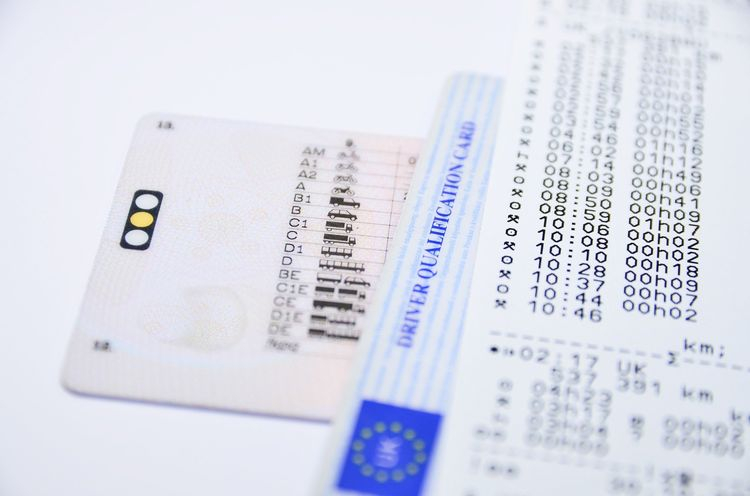
A small device, yet so many problems associated with it. We are talking about tachographs. The Mobility Package will lead to the gradual replacement of these devices, and after reading it, it is hard to shake the impression that it is not just about better supervision of driver and vehicle work and expanding control capabilities.
Tachographs have evolved. Initially, they were analog devices based on electromechanical systems. They recorded various information on paper media, colloquially called “discs” or “circles” by drivers. However, methods of interfering with their operation quickly became widespread, effectively making it impossible for authorities to perform checks. The simplest action was to get rid of the medium containing the information – the chart. More “sophisticated” methods involved removing the fuse from the tachograph’s power circuit and manually drawing the “correct” activity on the chart. Time travel was also popular, i.e., skillfully resetting the tachograph clock to falsify the actual activity time of the driver and the vehicle.
Then came the soulless beasts known as digital tachographs, which were supposed to guarantee complete control over drivers’ actions and vehicle activity. Shortly after their introduction, however, new methods of interfering with these devices were developed. Various switches and electronic circuits were constructed – and even a simple magnet taken from a speaker proved invaluable. Despite the threat of penalties, the practice of interfering with the recording of true driver and vehicle activity flourished and remains widespread, as can be seen on the websites of control authorities where cases of such manipulations are described.
The transition from analog to digital devices, however, took place smoothly and without costs for transport companies. From May 2006, every newly registered vehicle had to be equipped with a digital tachograph, but units with old devices recording activity on charts remained in use. Such vehicles can still be used for both domestic and international transport today.
The reaction to the interference with recordings was further modifications to tachographs and the way information recorded by these devices is provided. Two independent signal sources and differently constructed pulsers appeared, and finally, in mid-2019, “smart” tachographs saw the light of day. However, only in new vehicles. Installing them in transport units leaving the factory did not once again entail the need to replace old devices. Thus, a vehicle equipped with an analog tachograph, or even a previous-generation digital one, can still legally travel on European routes. The difference between the so-called smart tachograph and previous versions of digital devices is that the previous ones recorded the activity of the driver and the vehicle, while the newest ones also record the location of the transport unit. They do this at the start and end of work and every three hours of accumulated driving time. They also record attempts at manipulation and enable remote communication between control authorities and the device. All this is intended to serve more effective control, eliminate the possibility of interfering with records, and increase the chances of control officers detecting potential manipulations.
The start of using these devices, however, still did not eliminate the possibility of operating previous generations – both in domestic and international traffic. Therefore, no additional costs were incurred by carriers. It is obvious that international transport is unlikely to use vehicles equipped with analog tachographs anymore. These vehicles are over a dozen years old and do not meet stringent environmental standards, which entails the need to pay high tolls and closes the possibility of entering certain zones or regions. International carriers therefore take care of fleet replacement themselves, as it is in the interest of transport companies. The money spent on purchasing a new vehicle pays off during its operation.
The Mobility Package has been adopted. For some, a time of expenses – for others, a time of great business.
It includes regulations concerning tachographs. The package contains provisions amending Regulation (EU) No 165/2014 of the European Parliament and of the Council. It outlines requirements for the next generation of tachographs. They are to record the activity of drivers and vehicles, but also the vehicle’s location not only at the start and end of work and every three hours of accumulated driving time. Location recording is also to be performed:
– every time a European Union member state border is crossed,
– always when loading or unloading is performed.
The problem, however, is that the current devices in vehicles used for international transport will have to be gradually replaced. This will entail high costs for transport companies. However, where some lose, others usually gain. This will also be the case here. An additional market for manufacturers of recording devices has seemingly been created. For several years, new tachographs will be supplied to vehicles assembled in factories, but also to those already on the road that companies use for cross-border transport. It should therefore be expected that the demand for new devices will increase, and in this situation, their prices will likely also rise significantly. Of course, it must be assumed that only new tachographs, which are not yet being produced, will meet the requirements of the Mobility Package.
Analyzing the provisions of the Mobility Package, the future course of events can be determined. The relevant EU authorities are first to standardize the requirements for devices that will ensure the implementation of the functions imposed on them. This process is to be completed by February 21, 2022, at the latest, by issuing appropriate implementing acts. Within three years of their entry into force – i.e., probably at the beginning of 2025, vehicles participating in international traffic and equipped with analog and digital tachographs that are not “smart” will have to be equipped with new devices that are to ensure the recording of data and vehicle location in cases specified in the Mobility Package. More interestingly, however, even smart tachographs will be subject to replacement – but within 4 years of the adoption of the regulations that EU institutions are likely working hard on. Thus, this period will probably end in the first months of 2026. Consequently, this replacement will even apply to cars that were first registered no earlier than mid-June 2019. At the beginning of 2026, these will be six-year-old units – or even younger. It is hard to expect a mass sale of such vehicles, as they will still have high utility value. Therefore, a widespread replacement of the tachographs currently installed in them should be expected.
It remains to be hoped that in the case of smart tachographs, the process of adapting them to new requirements will end with a software and some component change – and not the entire device. Everything depends on the shape of the implementing regulations not yet issued. However, this is unlikely, perhaps even impossible from a technical point of view.
Adding to this the requirement to equip vehicles participating in international traffic with a total weight exceeding 2.5 tons with recording devices, which will enter into force on July 1, 2026, a high demand for next-generation recording devices can be expected. For some, expenses are looming. Companies performing international transport will face the necessity of incurring them. For others, however, golden years are coming. The demand for new tachographs was stimulated by the community’s authorities by adopting the Mobility Package.