A bad online purchase has happened to most of us. However, product returns are not rampant. As many as 57% of e-consumers rarely return goods, and 39% do not do it at all.
Online store customers return only 1 in 10 purchased products, most often sending them back via parcel lockers or courier, according to a study commissioned by CBRE. The reasons for dissatisfaction with online shopping are mainly unmet expectations, product damage, and non-compliance with the order. CBRE experts point out that the number of returns will grow in proportion to the increase in traffic in online stores, which are currently experiencing a boom. Customer expectations for efficient returns are another impulse for the development of the logistics sector.
– Giving up the ability to physically see a product requires providing customers with other benefits. Not having to leave home, fast and professional delivery, and easy returns are key among them. It is clear that if we order clothes that do not fit us or equipment that does not meet our expectations, we want to return it easily. Moreover, it is best if the return takes only a moment and the money returns to our account within a few days. Handling returns is a logistical challenge, and the competitive advantage of an online store depends on their efficiency. Automation and WMS systems may prove crucial, and large stores often decide to entrust processes to more experienced operators and outsource these services to a competent logistics provider – said Beata Hryniewska, Head of Warehouse and Logistics Department at CBRE.
We return rarely, but conveniently
A study commissioned by CBRE shows that 57% of online store customers rarely return products, and 39% do not do it at all. Only 5% of people decide to send goods back often or very often. 74% of e-consumers declare that they return 1 out of 10 ordered products. This is not much, but it can be expected that this frequency will grow in proportion to the growth recorded in online stores.
Looking at the way internet users choose to send back products ordered online, it can be seen that we liked parcel lockers (42%) and couriers who pick up products directly from our home (26%) the most. Slightly fewer people decide to walk to a post office (19%), and even fewer return goods purchased online in a brick-and-mortar store (7%) or drop-off points, such as a newsstand (6%).
– Many online stores build their advantage precisely by extending the possibility of returning products to, for example, 100 days, thus offering free ready-made return labels. This shows how important this element of the logistics puzzle is in operating an online store – added Beata Hryniewska.
We make thoughtful purchases in online stores
One of the problems with online shopping, most often indicated by consumers, is the inability to see the physical product. Therefore, the number one reason for a return is that the goods do not meet expectations (39%). The next two reasons indicate that e-store customers make rather thoughtful purchases. In second place among the reasons for returns is product damage (38%), and in third place is non-compliance with the order (37%). This shows that if the customer received a functional product that was as expected, they would most likely keep it.
The study was conducted on the Ariadna panel on a nationwide sample of N=1083 people. Quotas were selected according to the representation in the population of Poles aged 18 and over for gender, age, and size of the place of residence. Implementation date: October 9-12, 2020. Method: CAWI.
Source: CBRE
Read more about e-commerce:
– Bricomarche develops its services in the e-commerce segment
– e-Logistics in 2020 and 2021 – the growing importance of last-mile logistics
– The last mile requires investment
– Poczta Polska is expanding its network of own parcel lockers
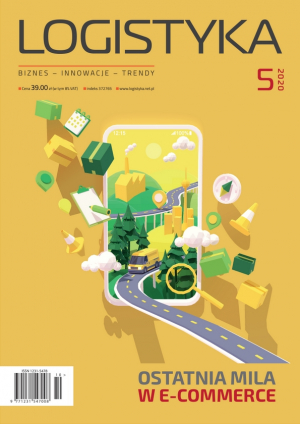
We write more about last-mile logistics in the magazine Logistyka 5/2020.
The e-edition of the magazine is available in our offer!