









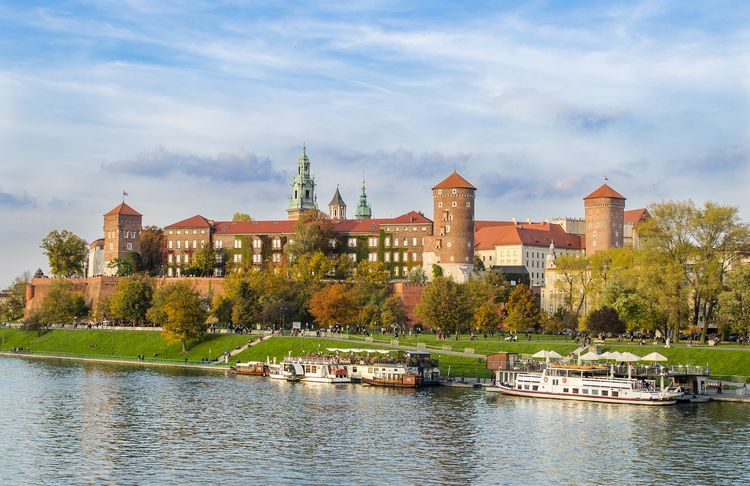
Kraków aims to become a zero-emission city by 2030, and to this end, it is building a completely new transformation strategy as part of the Deep Demonstrations process proposed by the EIT Climate-KIC organization.
– We want active forms of travel combined with public transport to account for 75% of the transport share. Large-scale thermal modernization is also needed, because reducing energy consumption is a prerequisite for introducing renewable energy as a heat source – announces Andrzej Łazęcki, Deputy Director of the Municipal Services Department of the Kraków City Hall. – Climate transformation is a very complex, long-term process. Previous experience shows that point-based interventions of a scattered nature are ineffective and, from the point of view of the goal of climate neutrality, far from sufficient. A new approach is needed. Such a methodology was proposed to us by the Deep Demonstration program – adds Andrzej Łazęcki.
Until now, Kraków has been one of the most polluted cities in Poland. According to the IQ Air 2019 World Air Quality Report, it ranked seventh in the country and 29th in Europe. However, this is gradually set to change. By 2030, the city – according to the assumptions of the new climate strategy – will become completely zero-emission. This is due, among other things, to the need to adapt to European climate policy. As part of the European Green Deal, in December, EU heads of government adopted a new CO2 emission reduction target – it is to be at least 55% compared to 1990. Therefore, Kraków is building a completely new climate transformation strategy as part of the Deep Demonstrations Healthy & Clean Cities process.
– This is a systemic change through innovation, based on four pillars. The first and most important is focusing on the goal, meaning we don’t wonder about what we cannot achieve today, but we set an ambitious goal. The second is using innovation as a lever for change. The third is orchestrating projects in a portfolio so that they complement and strengthen each other. The fourth pillar is learning by doing – lists the Deputy Director of the Municipal Services Department of the Kraków City Hall. – We dedicated the year 2020 to building solid foundations. The actions taken so far may not be as spectacular on the outside, but they have brought significant changes inside the office. I am primarily referring to an increase in awareness, meaning we know what we want, where we are, and how to achieve it.
The city has mapped all climate-related projects conducted so far, of which there were almost 120. A path of action was developed, and the biggest challenges were identified. The office also prepared two pilot projects concerning the areas that emit the most greenhouse gases, i.e., transport and building heating. The programs are to be completed within three years and then replicated on a city-wide scale.
– We started from the assumption that since the city is investing in street reconstruction, building a railway station, and bicycle paths, it is worth gathering these actions focused on a small area into a certain package. Additionally, we want to surround them with social and participatory activities that allow residents to make decisions, and combine them with climate change adaptation issues, i.e., introduce more greenery, street shading, or rainwater management – explains the representative of the Kraków City Hall.
As Andrzej Łazęcki announces, ultimately, the share of bicycle traffic in Kraków is to increase by several percent. Currently, the bicycle infrastructure, which consists of bicycle paths, pedestrian-bicycle paths, or contraflow lanes, counts approx. 235 km. New investments, including the construction of new bicycle paths, including the longest pedestrian-bicycle footbridge in Poland, meant that in the first weeks of September 2020 alone, the share of bicycle traffic increased by 26% y/y.
– In total, we want these active forms of travel combined with public transport to account for 75% of the travel share – declares Andrzej Łazęcki.
Kraków is also planning large-scale thermal modernization of buildings. The Municipal District Heating Company (MPEC), in its developed heat map, calculated that out of approx. 770,000 residents of Kraków, 68% use district heating supplied by MPEC. The city plans to centralize all activities, which will enable efficient management and the transfer of risks from building owners to an institution controlled by the city. At the same time, a large project has better opportunities to obtain long-term financing. The energy transformation project uses social innovation. It is the residents, non-governmental organizations, and entrepreneurs who jointly define the directions of change.
– At the beginning of December, we launched a citizens’ panel dedicated to the climate. Its overarching thought is climate neutrality, while the main theme is how the city and residents can improve energy efficiency and increase the use of renewable energy. We want to present our intentions, obtain broad social support for them, but also tips on what can possibly be improved – explains the representative of the Kraków City Hall.
In the process of climate transformation, the city also wants to draw on the experiences of other European cities that are also participating in the Deep Demonstrations program created by EIT Climate-KIC.
Source: Newseria